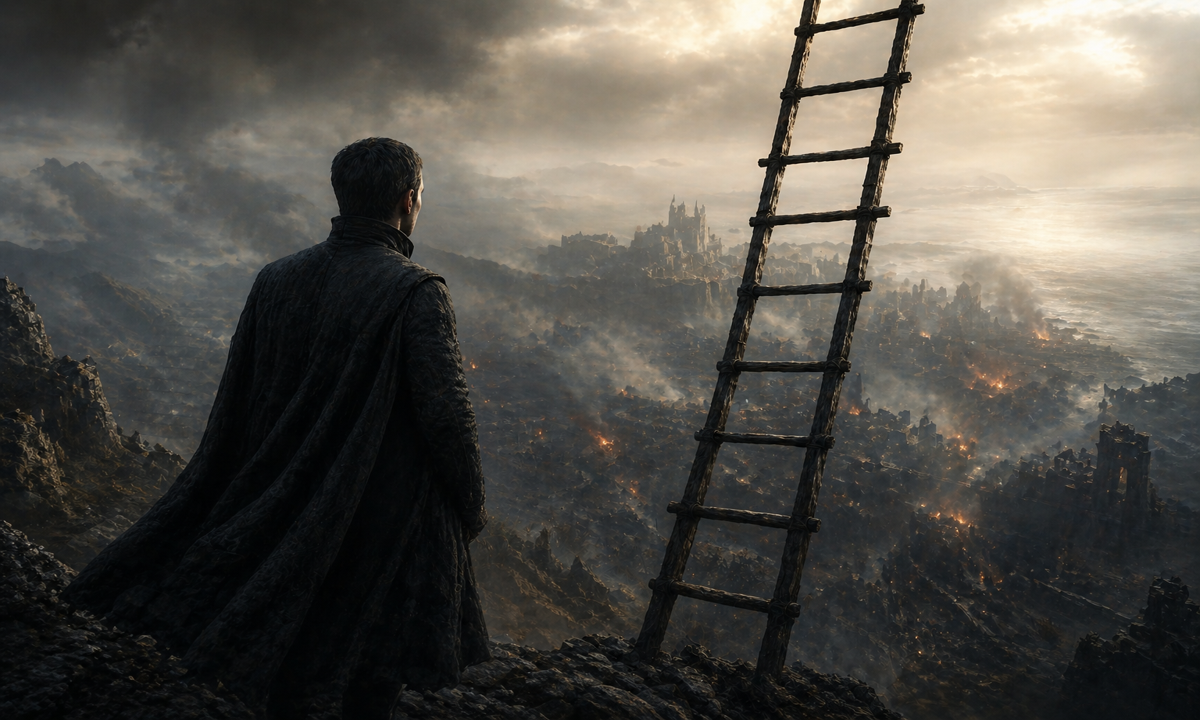
Few lines from modern television have penetrated strategic and leadership discourse as deeply as Petyr “Littlefinger” Baelish’s observation in Game of Thrones: “Chaos isn’t a pit. Chaos is a ladder. Many who try to climb it fail and never get to try again. The fall breaks them.” Delivered in Season 3 during a private exchange with Lord Varys, the statement encapsulates Littlefinger’s worldview—a fundamentally opportunistic, zero-sum interpretation of power in which instability is not a condition to be feared, but a mechanism to be exploited. While originating in fiction, the quote reflects enduring principles of political realism and competitive strategy, making it worthy of examination beyond its narrative context.
Within the series, Littlefinger emerges as a political entrepreneur operating in a fractured system. Unlike traditional power holders who rely on lineage, military force, or institutional legitimacy, he leverages uncertainty itself as a tool. The “ladder” metaphor reframes chaos from a destructive force into a vertical pathway—one that allows individuals to ascend rapidly if they possess the requisite awareness, timing, and ruthlessness. However, embedded within the metaphor is an equally important caution: most attempts to exploit chaos end in failure. The system is unforgiving; miscalculation is not merely costly—it is terminal.
From an academic perspective, Littlefinger’s assertion aligns closely with theories of complex adaptive systems and strategic opportunism. In environments characterized by volatility, uncertainty, complexity, and ambiguity (VUCA), traditional linear planning models break down. Institutions and individuals that rely solely on stability often find themselves paralyzed when conditions shift rapidly. Conversely, actors who recognize patterns within disorder—and who are willing to assume calculated risk—can achieve disproportionate gains. In this sense, chaos does not inherently advantage any one actor; rather, it redistributes opportunity toward those capable of interpreting and acting within it.
In practice, however, the distinction between chaos as a “pit” and chaos as a “ladder” is less about the external environment and more about internal capability. The same conditions that enable rapid ascent also amplify vulnerability. Cognitive bias, overconfidence, and incomplete information can lead decision-makers to misread the environment, resulting in strategic overreach. History provides numerous examples of leaders who attempted to capitalize on instability—only to be consumed by it. The ladder, in this sense, is narrow, unstable, and unforgiving. It demands not only ambition, but discipline, adaptability, and restraint.
For military professionals, the implications are particularly relevant. Modern conflict environments increasingly resemble the type of systemic disorder Littlefinger describes. Hybrid warfare, gray-zone competition, and information operations all exploit ambiguity and disruption. Adversaries seek to create conditions where traditional responses are ineffective, forcing decision-makers into reactive postures. Within this context, viewing chaos solely as a threat is insufficient. Effective leaders must also recognize its potential as an opportunity—to shape outcomes, to impose initiative, and to disrupt adversary decision cycles.
Yet, the quote also underscores a critical ethical and professional tension. Littlefinger’s ascent is predicated on manipulation, betrayal, and the deliberate exacerbation of instability. While such methods may yield short-term gains, they erode trust and undermine long-term system resilience. In professional military contexts, where legitimacy and cohesion are essential, the uncritical adoption of such an approach would be counterproductive. Thus, the challenge lies in distinguishing between opportunistic adaptation and corrosive opportunism.
At the individual level, the concept of chaos as a ladder can be applied to leadership and career development. Periods of institutional transition, organizational friction, or operational uncertainty often create space for initiative. Leaders who are prepared—intellectually, professionally, and ethically—can leverage these moments to drive change and assume greater responsibility. However, as the quote cautions, not all attempts succeed. Failure in high-stakes environments can have enduring consequences, both for individuals and for the organizations they serve.
Ultimately, Littlefinger’s observation is less a prescription than a diagnosis. Chaos does not inherently elevate or destroy—it reveals. It exposes the strengths and weaknesses of individuals and institutions alike. Those who perceive it accurately, who act decisively yet judiciously, may find pathways upward. Those who misjudge it risk collapse.
The enduring relevance of the quote lies in its stark realism. In a world where stability is increasingly the exception rather than the norm, the ability to navigate—and occasionally exploit—chaos becomes a defining characteristic of effective leadership. But the ladder remains what it has always been: precarious, selective, and unforgiving.
_____________________________
Charles served over 27 years in the US Army, which included seven combat tours in Iraq and Afghanistan with various Special Operations Forces units and two stints as an instructor at the United States Military Academy at West Point. He also completed operational tours in Egypt, the Philippines, and the Republic of Korea and earned a Doctor of Business Administration from Temple University as well as a Master of Arts in International Relations from Yale University. He is the owner of The Havok Journal, and the views expressed herein are his own and do not reflect those of the US Government or any other person or entity.
As the Voice of the Veteran Community, The Havok Journal seeks to publish a variety of perspectives on a number of sensitive subjects. Unless specifically noted otherwise, nothing we publish is an official point of view of The Havok Journal or any part of the U.S. government.
Buy Me A Coffee
The Havok Journal seeks to serve as a voice of the Veteran and First Responder communities through a focus on current affairs and articles of interest to the public in general, and the veteran community in particular. We strive to offer timely, current, and informative content, with the occasional piece focused on entertainment. We are continually expanding and striving to improve the readers’ experience.
© 2026 The Havok Journal
The Havok Journal welcomes re-posting of our original content as long as it is done in compliance with our Terms of Use.


