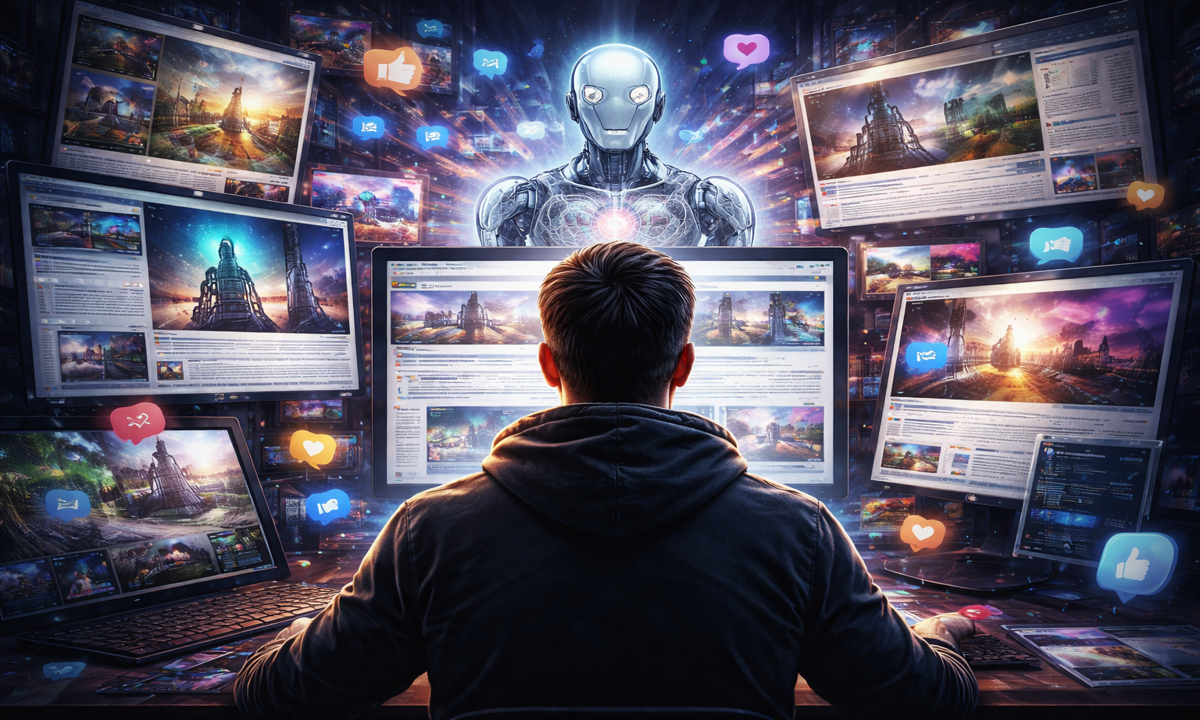
The other day I realized something mildly unsettling: everything I like online is probably AI.
The article that made me think.
The podcast that sounded unusually polished.
The photo that looked just a little too perfect.
Even the comment that made me laugh.
None of it might be real. Or at least not entirely.
It wasn’t one moment that made this obvious. Instead, it was the slow accumulation of small doubts. A quote that sounded profound but strangely generic. A piece of art that had emotional depth but no artist attached. A thread full of insightful takes written by accounts that seemed to appear from nowhere. An article with a whole lot of clipped sentences—and lots of em dashes.
Individually, none of these things were suspicious. Together, they made something clear: the internet is filling up with things that feel human but might not be.
And the weird part is that most of the time I don’t even care. And apparently neither does anyone else.
The Internet Was Always a Performance
Now, I’m not opposed to AI. I use it. Like… a lot. In fact, I generated most of this article with ChatGPT. But I’m finding more and more that more and more of the things I like online, or that I find interesting, or (concerningly) think are real, are… not.
Maybe this realization shouldn’t surprise anyone. The internet has always been a place where identity is flexible and authenticity is negotiable.
Long before AI, people curated versions of themselves online. We wrote posts we hoped sounded smarter than we felt. We filtered photos to make ordinary moments look meaningful. We crafted arguments we would never deliver in person.
Social media didn’t invent performance, but it industrialized it.
AI is just the next step.
Instead of people polishing their thoughts, now machines can produce thoughts polished enough to look like people.
The result is an internet where sincerity and simulation are increasingly difficult to separate.
The Strange Comfort of Machine Content
Here’s the uncomfortable truth: a lot of AI-generated content is good.
Not good in a revolutionary way. But good enough.
It’s coherent. It’s readable. It hits familiar emotional notes. It summarizes complicated ideas into digestible points. Sometimes it’s even funny.
In many cases it does exactly what most online content has always done—fill time, spark mild interest, and provide the illusion of connection.
And that’s where things start to get strange.
Because when you realize the article you liked might have been written by a machine, you’re forced to ask a question that feels oddly philosophical for a Tuesday afternoon:
Did it matter?
If something made you think, laugh, or pause for a moment, does it matter whether a person or an algorithm wrote it?
For most of internet history the answer would have been obvious.
Now it’s not.
The Problem Isn’t AI. It’s the Flood.
The real issue isn’t that AI exists. It’s that it produces content at a scale humans never could.
A single person might write a thoughtful article once a week.
An AI can generate thousands in a day.
That changes the environment.
The internet used to be a place where finding something interesting meant digging through noise to locate signal. Now the noise can reproduce itself endlessly.
In a world where machines can produce infinite content, attention becomes the most valuable currency left.
And machines are getting very good at capturing it.
Authenticity Becomes a Luxury
As AI-generated writing, art, and video become common, authenticity will become something people start looking for again.
Not because AI content is bad, but because it is abundant.
Human-created things carry something machines struggle to replicate: constraint.
A person writes because they have something they want to say.
A machine writes because it was asked to generate text.
That difference may seem small, but it shapes everything.
Human writing includes hesitation, personality, bias, and imperfection. Machines tend to smooth those edges away.
Ironically, those rough edges are exactly what make something feel real.
The Internet Might Become Two Places
If AI continues to flood the internet with content, we might see the online world split into two distinct spaces.
One will be the algorithmic internet: endless content streams optimized for engagement, produced largely by machines.
The other will be smaller and harder to find: places where people deliberately seek out human voices.
Communities, newsletters, niche blogs, and independent publications may become the digital equivalent of farmers markets—spaces where people go specifically because they want something made by a person.
Not necessarily better.
Just human.
Everything I Like Online Is AI
Maybe the joke will eventually be that none of this matters.
Maybe we’ll get used to living in a world where much of what we read, watch, and listen to was created by algorithms. Maybe we’ll stop asking whether something is human and start asking only whether it’s interesting.
But right now we’re still in the transition period.
The moment when people begin to realize the internet they grew up with is quietly changing into something else.
So when I scroll through articles, posts, and threads that catch my attention, I sometimes find myself wondering:
Was this written by a person?
Or was it written by something that learned how to sound like one?
At this point, I’m not sure.
All I know is that everything I like online might be AI.
And somehow the internet keeps getting bigger anyway.
_____________________________
Charles served over 27 years in the US Army, which included seven combat tours in Iraq and Afghanistan with various Special Operations Forces units and two stints as an instructor at the United States Military Academy at West Point. He also completed operational tours in Egypt, the Philippines, and the Republic of Korea and earned a Doctor of Business Administration from Temple University as well as a Master of Arts in International Relations from Yale University. He is the owner of The Havok Journal, and the views expressed herein are his own and do not reflect those of the US Government or any other person or entity.
As the Voice of the Veteran Community, The Havok Journal seeks to publish a variety of perspectives on a number of sensitive subjects. Unless specifically noted otherwise, nothing we publish is an official point of view of The Havok Journal or any part of the U.S. government.
Buy Me A Coffee
The Havok Journal seeks to serve as a voice of the Veteran and First Responder communities through a focus on current affairs and articles of interest to the public in general, and the veteran community in particular. We strive to offer timely, current, and informative content, with the occasional piece focused on entertainment. We are continually expanding and striving to improve the readers’ experience.
© 2026 The Havok Journal
The Havok Journal welcomes re-posting of our original content as long as it is done in compliance with our Terms of Use.