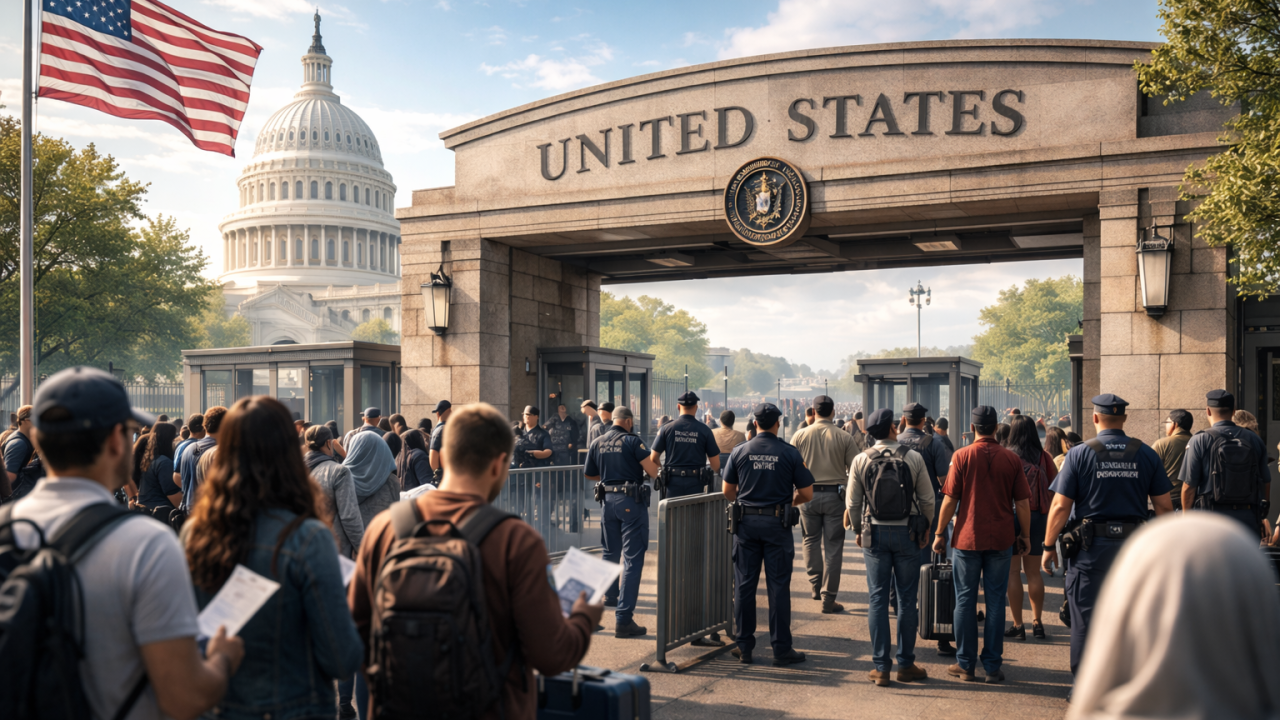
Americans argue endlessly about immigration while skipping the only question that actually matters: why immigration authority exists at the federal level at all. Most debates begin decades too late, usually somewhere after World War II or the civil rights era, as if immigration policy is a modern invention. It is not. Federal control over immigration developed out of the earliest structural problems the United States faced as a nation.
Immigration became a federal power because the country could not function as a sovereign state without centralized authority over foreign nationals. That reality was evident before the Constitution was written, during its drafting, and throughout the nineteenth century as Congress and the courts responded to the real-world consequences of fragmentation.
To understand the current conflict, it is necessary to return to the period before the Constitution and to the problems that period exposed.

The Confederation Era and the Problem of Fragmentation
Under the Articles of Confederation, the United States was not a unified nation with a single foreign policy. It was a collection of states bound together loosely, each retaining substantial control over matters affecting foreigners who entered through their ports or resided within their borders.
States adopted their own approaches to arriving foreign nationals. Some imposed passenger fees or bonds. Others excluded individuals they believed would become public charges. These policies were often driven by local economic or social concerns rather than national considerations.
The structural problem was not merely inconsistency. It was spillover.
A foreign national admitted by one state could move freely to another. A dispute triggered by state treatment of foreign citizens could escalate into an international issue with no single authority empowered to respond. European governments did not distinguish between individual states and the confederation as a whole. Diplomatic consequences fell on America, even when America lacked the institutional tools to act cohesively.
This weakness was widely recognized by the Founders. A nation that could not regulate its interaction with foreign nationals could not credibly conduct foreign relations or maintain internal stability.
Sovereignty and the Need for a Single National Voice
The Constitution was written to correct this structural failure. The Framers did not approach immigration primarily as a humanitarian or cultural issue. They approached it as a question of sovereignty.
A sovereign nation must speak with one voice in matters involving foreign governments and foreign nationals. Dividing that authority among multiple states undermines national credibility, invites diplomatic conflict, and creates legal chaos.
The Constitution addressed this problem by transferring foreign-facing powers to the national government. Congress was granted authority over foreign commerce, naturalization, and matters implicating international law and national defense. These powers were not isolated grants. Together, they formed the constitutional foundation for national control over interactions with foreign citizens.
Once those powers were delegated, the states no longer retained independent authority to determine who could enter or remain in the country. That authority was surrendered as part of the constitutional bargain that transformed a confederation into a nation.

Why the Constitution Uses No Modern Immigration Language
Modern readers often point to the absence of the word immigration in the Constitution as evidence that the states retained authority over the subject. This argument misunderstands eighteenth-century legal vocabulary.
At the Founding, immigration was not yet a distinct statutory category. Legal discussions referred instead to aliens, foreigners, and subjects of other sovereigns. Regulation of their presence occurred through powers governing commerce, diplomacy, and national security rather than through a standalone immigration code.
The Constitution allocates authority over those underlying domains. It does not need to enumerate modern regulatory terms to be effective. Just as the Constitution does not mention airspace or cyber warfare, its silence on the modern term immigration does not imply an absence of authority. It reflects the conceptual framework of its time.
Early Federal Action and the Gradual Expansion of Regulation
Congress exercised its authority early in areas directly tied to national identity. The Naturalization Act of 1790 established a uniform rule for citizenship, replacing the inconsistent state systems that had existed under the Articles of Confederation.
Direct federal regulation of immigration admissions and exclusions developed more gradually. For much of the early nineteenth century, states and localities continued to play a role in managing arrivals, particularly through passenger regulations and poor laws. As immigration increased and its national consequences became clearer, Congress began asserting more direct control.
By the late nineteenth century, federal legislation increasingly addressed inspection, exclusion, and removal. Laws enacted during this period reflected the recognition that immigration policy affected foreign relations, labor markets, and national cohesion. Federal authority did not appear suddenly. It expanded in response to scale, complexity, and the demonstrated failure of fragmented regulation.

The Role of the Courts in Consolidating Federal Authority
The Supreme Court did not invent federal immigration power, but it did play a critical role in consolidating and constitutionalizing it.
When states attempted to impose taxes, exclusion rules, or detention schemes affecting foreign nationals, the Court consistently held that such measures intruded on federal authority over foreign commerce and foreign relations. These decisions emphasized that immigration policy could not be managed piecemeal by individual states without undermining national sovereignty.
In the late nineteenth century, the Court articulated doctrines describing immigration control as an incident of national sovereignty. These rulings framed admission and removal as matters entrusted to the political branches of the federal government. While scholars continue to debate the precise constitutional foundations of these doctrines, their effect was clear: immigration enforcement became firmly established as a federal responsibility.
Why Enforcement Historically Attracted Little Public Attention
For long periods of American history, immigration enforcement occurred largely within institutional channels. Individuals who came into contact with the criminal justice system were transferred from local custody to federal authorities through administrative processes rather than public encounters.
This arrangement reduced public visibility and minimized conflict. Local officials did not adjudicate immigration status, and federal officers did not routinely conduct enforcement actions in open community settings. Each level of government operated within its assigned role, and the system functioned with relatively little public controversy.
This equilibrium depended on cooperation between state and federal institutions. When that cooperation existed, enforcement remained procedural rather than confrontational.
Fragmentation Reintroduces Disorder
When states or local jurisdictions withdraw cooperation from federal immigration enforcement, the institutional pathway breaks down. Custody transfers are blocked. Communication is restricted. Federal officers are still legally obligated to enforce federal law, but they must do so outside controlled environments.
The result is not an expansion of federal authority, but a change in how that authority is exercised. Enforcement shifts from jails to neighborhoods, from administrative processes to public encounters. What appears to be escalation is often displacement caused by the removal of institutional cooperation.
This dynamic mirrors the original problem the Constitution was designed to solve. Multiple authorities asserting incompatible rules over foreign nationals within the same territory produce disorder. The Framers centralized foreign-facing authority to prevent precisely this outcome.
Immigration Policy as a Structural Question
Modern debates often treat immigration enforcement as a moral referendum rather than a constitutional function. That framing obscures the real issue.
The question is not whether one supports or opposes a particular policy outcome. The question is whether the country will adhere to the structural allocation of power that makes national governance possible.
Federal immigration authority exists because the alternative is incoherence. A nation that allows its subunits to override foreign-facing policy ceases to operate as a nation. That reality does not change with shifting political preferences.
The Lesson the Nation Keeps Relearning
The Founders centralized authority over foreign nationals because they had already experienced the consequences of fragmentation. They understood that sovereignty, diplomacy, and national unity require a single voice.
Federal immigration authority did not emerge from modern ideology. It emerged from necessity.
When the constitutional structure is honored, immigration enforcement is orderly and largely invisible. When it is ignored, disorder fills the gap. The lesson is old. The consequences of forgetting it are not.
Sources
Federalist No. 42, James Madison
Articles of Confederation, National Archives
U.S. Constitution, Article I, Section 8
Naturalization Act of 1790
Naturalization Act of 1795
Page Act of 1875
Immigration Act of 1882
Chy Lung v. Freeman (1875)
Henderson v. Mayor of New York (1875)
Nishimura Ekiu v. United States (1892)
Fong Yue Ting v. United States (1893)
Arizona v. United States (2012)
U.S. Immigration and Naturalization Service historical summaries
Congressional Research Service reports on immigration federalism
Scholarly analyses on early state passenger laws and federal immigration development
_____________________________
Dave Chamberlin served 38 years in the USAF and Air National Guard as an aircraft crew chief, where he retired as a CMSgt. He has held a wide variety of technical, instructor, consultant, and leadership positions in his more than 40 years of civilian and military aviation experience. Dave holds an FAA Airframe and Powerplant license from the FAA, as well as a Master’s degree in Aeronautical Science. He currently runs his own consulting and training company and has written for numerous trade publications.
His true passion is exploring and writing about issues facing the military, and in particular, aircraft maintenance personnel.
As the Voice of the Veteran Community, The Havok Journal seeks to publish a variety of perspectives on a number of sensitive subjects. Unless specifically noted otherwise, nothing we publish is an official point of view of The Havok Journal or any part of the U.S. government.
Buy Me A Coffee
The Havok Journal seeks to serve as a voice of the Veteran and First Responder communities through a focus on current affairs and articles of interest to the public in general, and the veteran community in particular. We strive to offer timely, current, and informative content, with the occasional piece focused on entertainment. We are continually expanding and striving to improve the readers’ experience.
© 2026 The Havok Journal
The Havok Journal welcomes re-posting of our original content as long as it is done in compliance with our Terms of Use.


