Let me begin by warning you that this entire essay is going to be one long rant. If you decide at this point to click on something else, I will completely understand. Otherwise, here goes…
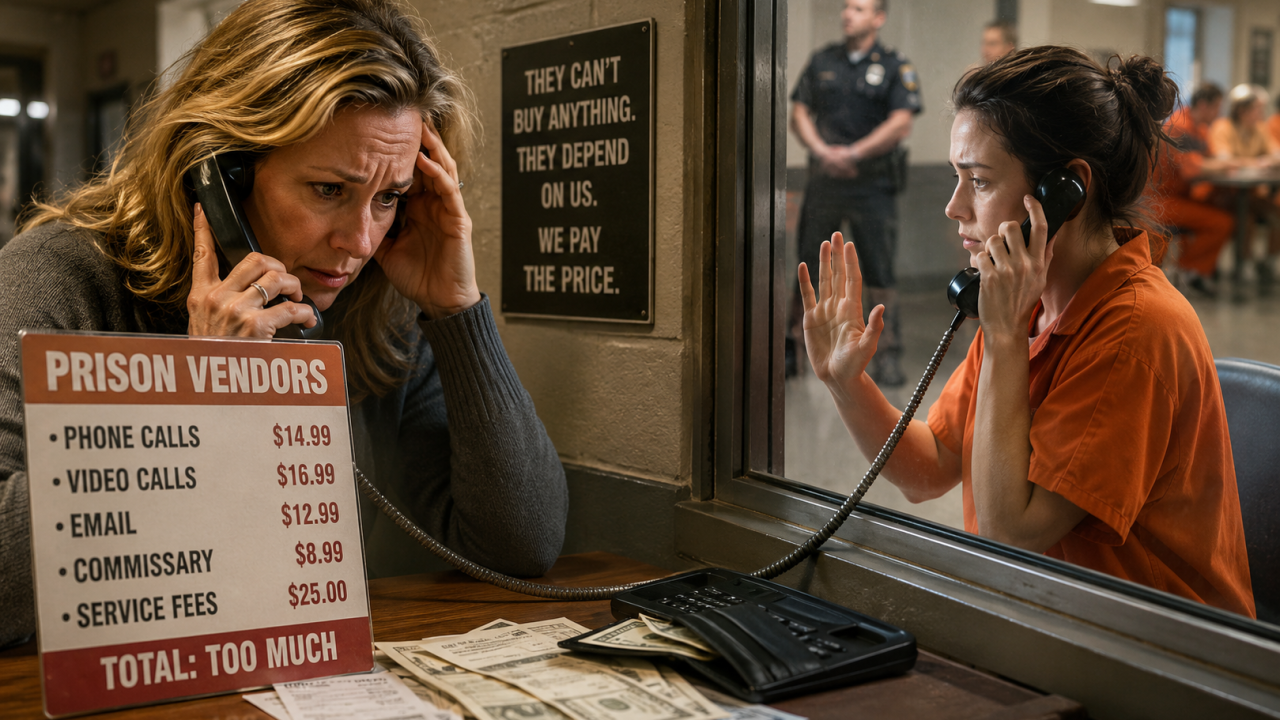
There is a young woman who is currently in prison. We care about her. She calls us frequently, mostly to speak with her little boy. She talks to me when she needs something, and she often needs help. Being incarcerated means that many of the things that we take for granted are unavailable to her, like access to the internet. She is also unable to spend money, unless those funds have been deposited into a commissary account for her by an outside party. Name something that you do every day, and the odds are good that she can’t do it from prison.
This being the case, I spend a large amount of my time dealing with her wants and needs. Her requests are simple. She really doesn’t want much, but somehow it is often a struggle for me to take care of these things. It’s not her fault. It’s the prison system. I don’t know if it is by design, but nothing is easy to do.
As an example, the young woman wanted me to set up an account with a telecommunications company so that she could share emails and video calls with us. We would be able to send her photos to her tablet. It sounded like a good thing, especially since it would help her and her son to maintain a close relationship. I followed through until I couldn’t anymore. I set up an account online and deposited $25 into it. I didn’t put in more than that because we had never used this service before. Then I ran into an insurmountable obstacle. For some reason, I could not designate her as a contact. I don’t know why I couldn’t do that, but without her being named as a contact, we can’t communicate. I kept trying different ways to make the connection work, but I finally gave up.
The next morning, I called the vendor’s customer service and never got any service. I was led through a labyrinth of extension menus that never got me to a human who could help me. Actually, I talked briefly to a person once. He took my information, put me on hold, and then when he got back to me, he couldn’t hear me on the phone and hung up. I started the cycle again. Eventually, I got to the point where the recording said that I would be connected to a customer service rep. That didn’t happen. I was never connected to anybody. The recording of menu choices just started all over again. I gave up.
Admittedly, my hassle is not unique. You have probably gone through the same magical mystery tour with some type of business deal. My problem is that, although this particular experience was rather extreme, it is not at all atypical. Almost any interaction with vendors that work with the prison system is like this episode to some degree. It is rare when a transaction goes smoothly. It doesn’t matter what service or merchandise the vendor is providing. It’s always a challenge.
Why is it like this? The vendors are those companies that have been approved by the Department of Corrections to sell to the public. The inmates can’t buy anything. The people on the outside who care about the prisoners are the actual customers. These vendors operate as near monopolies. For instance, there are three companies that can provide goods, such as clothes, art supplies, and health and beauty supplies, to the folks incarcerated at the prison where the young woman resides. The variety of products is extremely limited. It’s like when Henry Ford was selling Model Ts: You can have the car in any color you want, as long as it’s black. It’s the same sort of thing with these vendors. You can buy from them or not buy at all. The prices are exorbitant because there is no real competition. There is no customer service because there is no incentive to serve the customers.
I suppose an argument could be made that the inmates don’t deserve any better than what I have just described. After all, they’re convicted felons. However, there is collateral damage. The people on the outside, like me, are trying to help folks they love, and we are the ones getting screwed. The people who are just trying to help others survive in prison and hopefully become rehabilitated during their stay suffer along with the inmates. We didn’t commit any crimes. We didn’t endanger the public. We are just trying to show some compassion to inmates who aren’t seeing much of that. We are trying to do the right thing, and it’s a bitch. It really is.
_____________________________
Frank Pauc is a former Army aviator, a longtime trucking-company supervisor, and a contributor to The Havok Journal. A West Point graduate from the Class of 1980, he completed the Military Intelligence Basic Course and flight school, served with the 3rd Armored Division in West Germany and the 7th Infantry Division at Fort Ord, and left the Army in 1986. He later taught citizenship classes through Voces de la Frontera in Milwaukee, took part in peace and protest work, and writes largely about veterans, family, grief, and the long aftermath of military service.
As the Voice of the Veteran Community, The Havok Journal seeks to publish a variety of perspectives on a number of sensitive subjects. Unless specifically noted otherwise, nothing we publish is an official point of view of The Havok Journal or any part of the U.S. government.
Buy Me A Coffee
The Havok Journal seeks to serve as a voice of the Veteran and First Responder communities through a focus on current affairs and articles of interest to the public in general, and the veteran community in particular. We strive to offer timely, current, and informative content, with the occasional piece focused on entertainment. We are continually expanding and striving to improve the readers’ experience.
© 2026 The Havok Journal
The Havok Journal welcomes re-posting of our original content as long as it is done in compliance with our Terms of Use.


