
There comes a point for many people when watching politics stops producing disagreement and starts producing something else entirely: disgust. Not frustration with one policy. Not anger toward one politician. Not disagreement with one party. A deeper feeling. The kind that settles in your chest when you watch press conferences, hearings, and debates and realize that something fundamental feels broken. The language sounds rehearsed. The outrage feels manufactured. The priorities seem disconnected from the realities people live every day.
Politics begins to look less like leadership and more like theater.
For many Americans, especially those who have spent their lives in professions where decisions carry immediate consequences, this realization can feel jarring. Soldiers, police officers, firefighters, emergency medical personnel, airline pilots, and others who have lived inside consequence-driven environments often feel this disconnect most strongly. They have seen what real leadership looks like under pressure. They have seen what happens when decisions actually matter. And once you have lived in that world, political performance becomes very difficult to take seriously.
For most people, the disillusionment does not happen all at once. It happens gradually. You begin by believing that politics, while imperfect, is fundamentally about public service. You assume the individuals involved are attempting to solve difficult problems under enormous pressure. You believe that disagreements reflect honest differences in philosophy about how best to serve the country. But over time, patterns begin to appear.
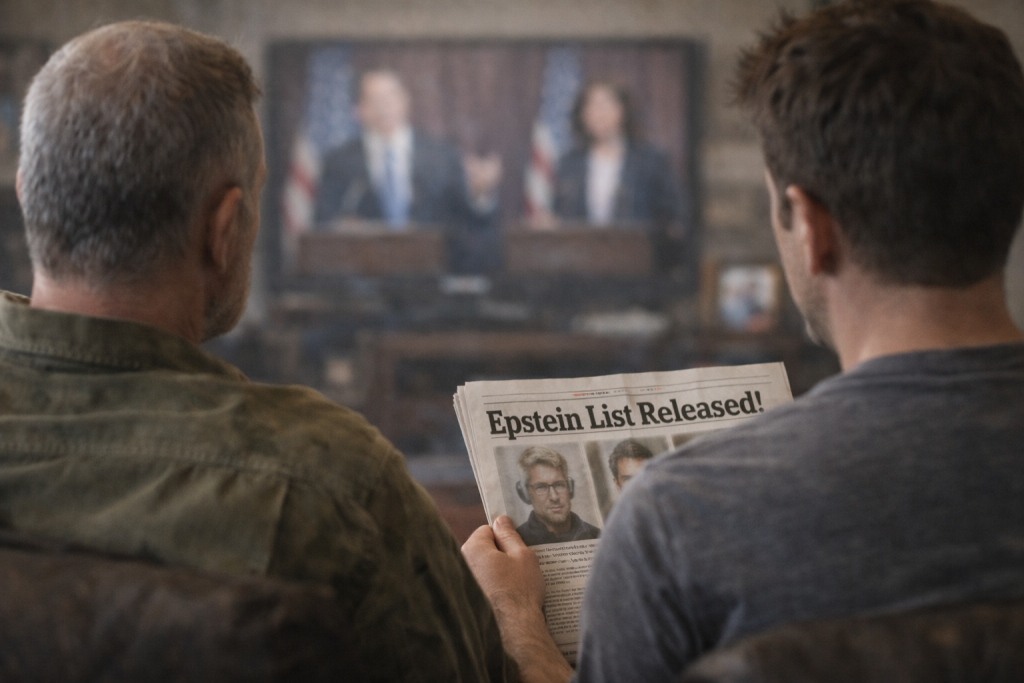
The same problems resurface year after year. The same arguments repeat themselves across election cycles. The same speeches are delivered with slightly different wording. And the outcomes rarely seem to match the promises. A recent example is the release of the Epstein list and the reaction it sparked across America.
Eventually, something shifts in the observer. You begin to realize that many political incentives are not aligned with solving problems. They are aligned with winning narratives. That realization can feel unsettling, especially for those who come from worlds where narrative cannot override reality.
In the military, law enforcement, and emergency response professions, reality enforces honesty. A tactical plan works or it fails. A threat is contained or someone gets hurt. A decision saves lives or it does not. The environment itself provides immediate feedback. There is no room for spin. There is no opportunity to rewrite the outcome through messaging. No press conference can change what actually happened.
Reality delivers the verdict.
Politics often operates under a different set of incentives. Policy decisions may take years to reveal their consequences. By the time those consequences appear, the individuals responsible may no longer hold office. Media narratives and partisan framing can reinterpret outcomes in ways that maintain loyalty within political tribes. Failure can sometimes be reframed as success. Success can be reframed as failure. The public often receives not the raw outcome, but the story built around it.

For individuals who have spent their lives operating in environments where outcomes are brutally clear, this gap between narrative and consequence can feel deeply dishonest. Another difference between political systems and consequence-driven professions lies in how authority is earned. In high-stakes environments, respect tends to follow competence.
The officer who stays calm when chaos erupts. The medic who performs flawlessly under pressure. The leader who can make difficult decisions quickly and clearly. People naturally gravitate toward individuals who demonstrate capability when it matters most.
Authority emerges from performance. In politics, authority often emerges from different skills entirely: campaign strategy, fundraising ability, media messaging, and the ability to mobilize voters. These skills are not trivial. They require discipline, intelligence, and organization. But they are not necessarily the same skills required to lead teams under pressure, manage crises, or solve complex operational problems.
The result is a system in which individuals who hold power are not always those best prepared to wield it in moments of consequence. Modern politics is not just about policy. It is about attention.
Television, social media, and the twenty-four-hour news cycle have transformed political behavior. Visibility and engagement often reward conflict more than cooperation. Dramatic statements generate more attention than measured analysis. Outrage travels faster. This has created incentives for political figures to perform for audiences rather than solve problems quietly behind the scenes.
Debates become spectacles. Hearings become viral moments. Policy discussions become ideological battlegrounds designed for cameras. The result is an environment where visibility can overshadow effectiveness.
One of the most profound differences between frontline professions and politics lies in the concept of identity. Military units and emergency response teams operate under a shared mission. When individuals face danger together, ideological labels disappear. No one stops during a critical incident to ask about political affiliation. The questions are practical. Who is covering the door? Who has the radio? Who is coordinating medical? Who is moving the team?
Mission overrides identity. Politics, by contrast, often organizes people around tribal alignment. Political affiliation becomes a defining characteristic. Loyalty to party or ideology can become more important than the pursuit of pragmatic solutions. This tribal dynamic creates polarization.
Researchers who study veterans and first responders have identified a phenomenon known as moral injury. Unlike traditional trauma, moral injury occurs when individuals witness institutions behave in ways that violate the moral values they believed those institutions represented. Look at the withdrawals from Afghanistan and Iraq. Abandoning our allies and friends is something that truly haunted us all. “Never leave a fallen comrade.” That is right in the warrior ethos. We never abandon our friends and allies. It is not simply the hardship of service that wounds people. It is the sense that the ideals they served may not be honored by those in positions of authority.

For soldiers and first responders who dedicated their lives to service, witnessing manipulation or cynical leadership can create deep disillusionment. The disgust many people feel toward politics is often rooted not in ideology but in this sense of moral betrayal.
Leadership thinkers often describe the difference between two perspectives: the arena and the balcony. People in the arena operate inside consequence. Their decisions carry weight. Their mistakes produce immediate outcomes. Their leadership is tested by reality.
People on the balcony observe from a distance. They analyze, critique, comment, and manage systems from above. Both perspectives have value. But problems arise when individuals on the balcony begin making decisions that deeply affect those in the arena without understanding the realities those individuals face.
Disillusionment with politics is not new. More than two thousand years ago, the Roman emperor Marcus Aurelius wrote about the vanity, ego, and ambition he witnessed among political elites. Yet he believed abandoning responsibility would leave leadership to those most attracted to power for its own sake.
When people become disillusioned with politics, they often gravitate toward one of three responses: cynicism, rage, or grounded detachment. Grounded detachment recognizes the flaws of political systems without allowing those flaws to corrupt personal character.
Instead of becoming consumed by political theater, individuals focus their attention on the arenas where they can make tangible impact: communities, families, teams, and professions.
For many who have served in consequence-driven professions, the most meaningful leadership does not occur in national politics. It occurs in everyday environments. The supervisor who protects his team. The officer who mentors younger colleagues. The medic who treats every patient with dignity. The firefighter who runs toward danger when others run away.
These acts of leadership rarely make headlines. But they are real. Disgust with politics is often a sign that someone still believes leadership should mean something. Many of the individuals most disillusioned with politics are those who have spent their lives serving something larger than themselves. They have seen courage. They have seen sacrifice. They have seen competence under pressure. They know what real leadership looks like. Once you have seen that, it becomes difficult to accept anything less.
Politics may never fully live up to those standards. But individuals still can. And sometimes the most powerful form of leadership is found in the quiet decision to live with integrity in a world that often rewards the opposite.
Politics may continue to disappoint. Institutions may continue to drift. The noise, the theater, the ambition, and the endless posturing will likely remain long after today’s headlines fade. But the standard you live by does not have to fall with it. Real leadership has never depended on politicians. It has always lived in the quiet discipline of individuals who refuse to compromise their character when the world around them does. In a time when so much of public life feels performative, the most radical act may be the simplest one: live with integrity, carry your responsibilities with honor, and lead where you stand. Because while politics may shape laws, it is character that shapes civilizations.
_____________________________
Ayman is a combat veteran and seasoned law enforcement leader with over 20 years of operational experience. He served in Iraq as a U.S. Army soldier and translator during the height of the war against Al-Qaeda, gaining firsthand exposure to combat stress and leadership under fire.
In law enforcement, Ayman has worked in diverse high-risk roles including SWAT, DEA Task Force Officer, DEA SRT, plain clothes interdiction, and currently serves as a patrol sergeant. His experience offers deep insight into the physical and psychological demands faced by tactical professionals.
Ayman holds a Master of Science in Counterterrorism (MSC) and is the founder of Project Sapient, a platform dedicated to enhancing performance and resilience through neuroscience, stress physiology, and data-driven training. Through consulting, podcasting, and partnerships with organizations across the country, Project Sapient equips military, law enforcement, and first responders with tools to thrive in high-stress environments.
Follow Project Sapient on Instagram, YouTube, and all podcast platforms for engaging content. Feel free to email Ayman at ayman@projectsapient.com.
Follow Project Sapient on Instagram, YouTube, and all podcast platforms for engaging content.
Contact: ayman@objectivearete.com
Project Sapient: https://projectsapient.com/
YouTube: https://www.youtube.com/channel/UC8cO-sLPMpfkrvnjcM8ukUQ
As the Voice of the Veteran Community, The Havok Journal seeks to publish a variety of perspectives on a number of sensitive subjects. Unless specifically noted otherwise, nothing we publish is an official point of view of The Havok Journal or any part of the U.S. government.
Buy Me A Coffee
The Havok Journal seeks to serve as a voice of the Veteran and First Responder communities through a focus on current affairs and articles of interest to the public in general, and the veteran community in particular. We strive to offer timely, current, and informative content, with the occasional piece focused on entertainment. We are continually expanding and striving to improve the readers’ experience.
© 2026 The Havok Journal
The Havok Journal welcomes re-posting of our original content as long as it is done in compliance with our Terms of Use.


