By Carlin McKeahow
By 2036, most people will not experience artificial intelligence as a chatbot. They will experience it as the thing that handled the claim, drafted the appeal, flagged the diagnosis, denied the loan, built the lesson plan, watched the camera feed, scheduled the appointment, summarized the meeting, generated the evidence packet, and recommended the next move.
That is the shift worth paying attention to. AI is moving from answer machine to action layer. The old version talked. The next version will do things.
A decade from now, the most important AI systems will live inside ordinary institutions: hospitals, schools, banks, courts, police departments, newsrooms, logistics networks, military commands, insurance companies, and family phones. They will matter because they will sit between human beings and decisions that shape money, health, work, reputation, freedom, and war.
The public conversation is still stuck on the wrong image. People keep asking whether AI will become human. The better question is what happens when nonhuman systems become powerful enough to manage human life at scale.
That question is already practical. Stanford’s AI Index has documented rapid gains in model performance across demanding tasks. METR is tracking how reliably frontier agents can complete software tasks of various lengths. Anthropic’s Model Context Protocol and OpenAI’s agent tools show where the industry is headed: models connected to files, browsers, databases, code, business systems, and eventually physical devices. A 2026 study of more than 177,000 publicly visible agent tools found that tools capable of taking action had risen from roughly a quarter to nearly two-thirds of observed usage over sixteen months.
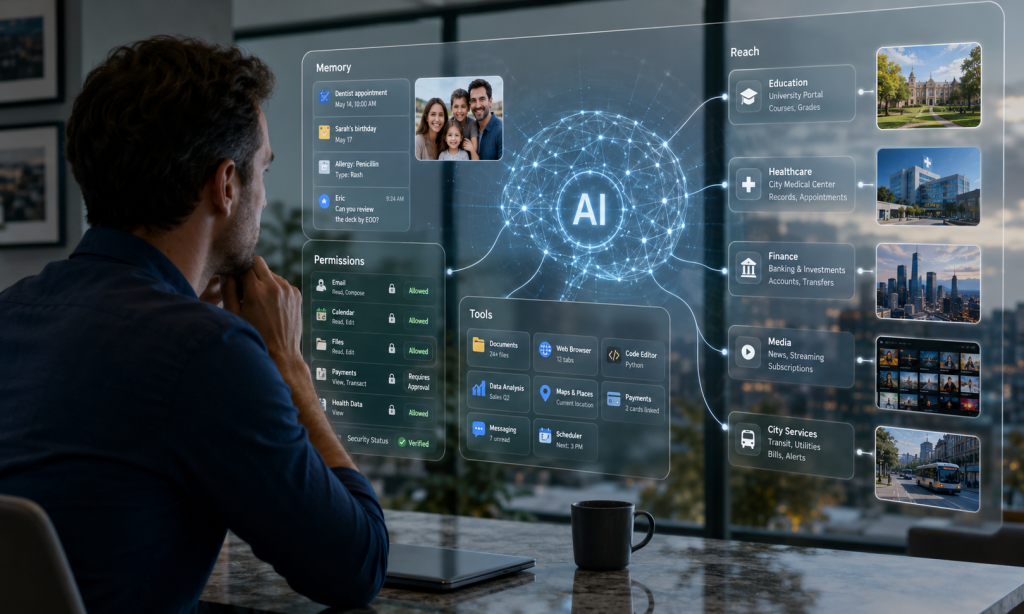
The direction is plain. AI is getting memory, permissions, tools, and reach.
The danger in 2036 will not come mainly from a machine waking up and announcing itself as a new species. The more immediate danger is that too many people will let machines produce the first draft of reality, then forget to check who wrote it.
The shape of daily life
Picture a Tuesday morning in 2036.
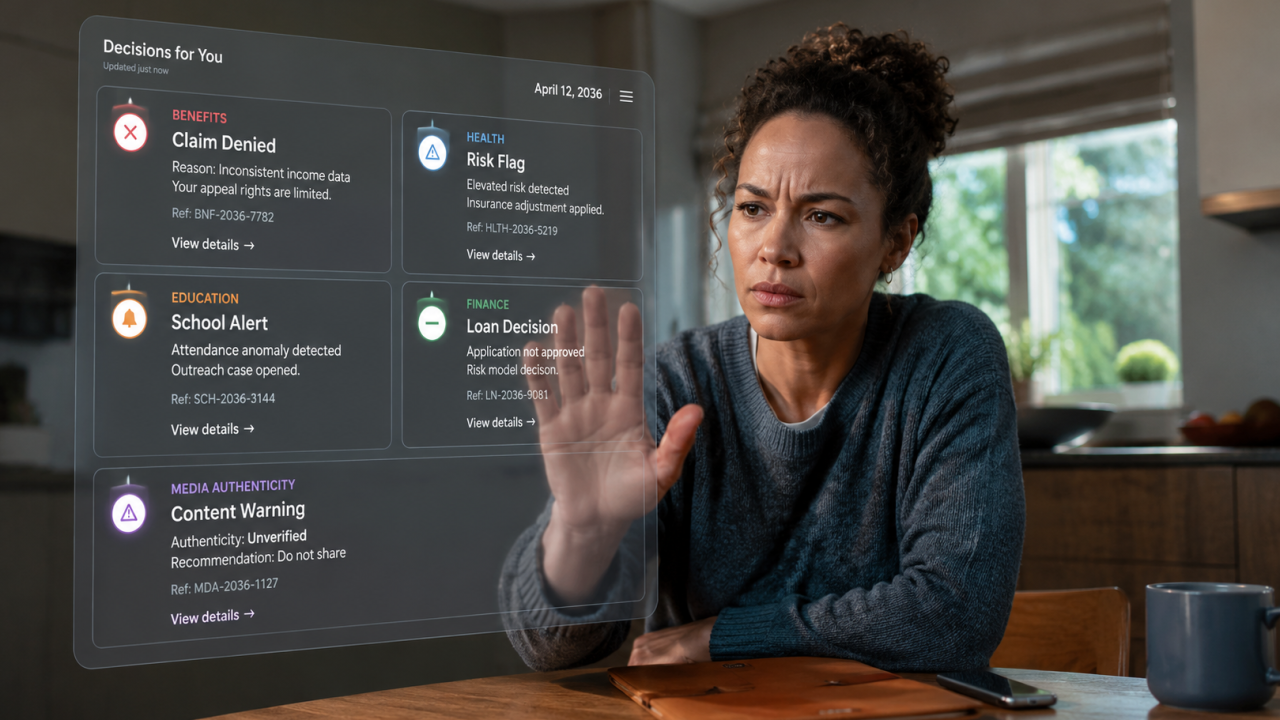
Your personal assistant has already read your inbox. It held back the routine junk, answered two messages in your style, flagged one from your mother because the tone looked unusual, and drafted a response to your mortgage servicer about an escrow increase. It also noticed that your teenage son’s school platform has marked him “disengaged” in two classes for three straight weeks. A tutor agent has recommended a modified study plan. The school’s behavioral system has recommended a parent meeting. Your son says the system is wrong. You have to decide whether you believe him, the school, or the model.
At work, your company no longer talks about “using AI.” That phrase sounds like saying a business uses electricity. The sales team has prospecting agents. Legal has contract review agents. Human resources has screening agents. Finance has fraud agents. Engineering has coding agents. Compliance has monitoring agents. The serious employees do less typing and more supervision. They assign work, check assumptions, inspect logs, approve actions, and decide when the system is pushing past its authority.
At the clinic, your doctor talks to you while a medical AI listens. It summarizes the visit, checks your medication list, compares your symptoms with recent labs, suggests two follow-up questions, and drafts the referral. It may catch something important. It may also bury something important inside a polished note that nobody has time to read carefully.
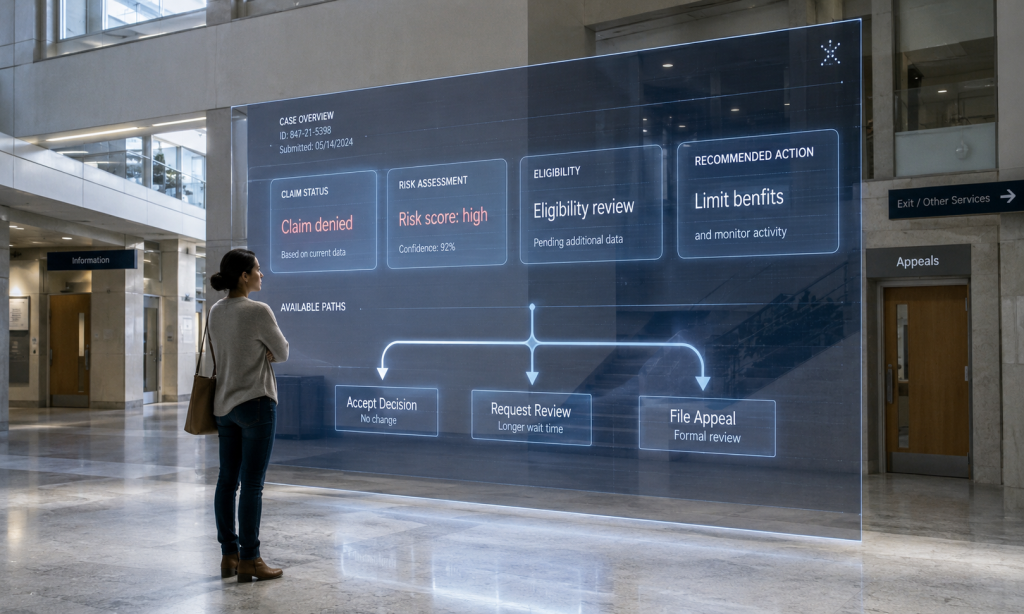
At the bank, your loan application is reviewed by a stack of systems you will never meet. Some of them check identity. Some check fraud. Some predict repayment risk. Some scan for compliance. Some generate explanations. You may receive a decision in minutes. You may also receive a denial that no human can fully explain without calling another vendor.
In public, cameras will be smarter. Stores will know how long you stood in front of a shelf. Cities will use models to manage traffic, allocate police attention, monitor infrastructure, and detect anomalies. The word “anomaly” will do a lot of work. Sometimes it will mean a broken water main. Sometimes it will mean a person.
In war rooms, AI will be inside intelligence feeds, logistics, cyber defense, targeting workflows, maintenance planning, translation, training, and simulation. Some of that will save lives. Some of it will shorten the distance between suspicion and force.
That is the world I expect by 2036. It will be useful, ordinary, invasive, efficient, unfair in places, lifesaving in places, and so deeply embedded that most people will stop noticing it.
Why this forecast is reasonable
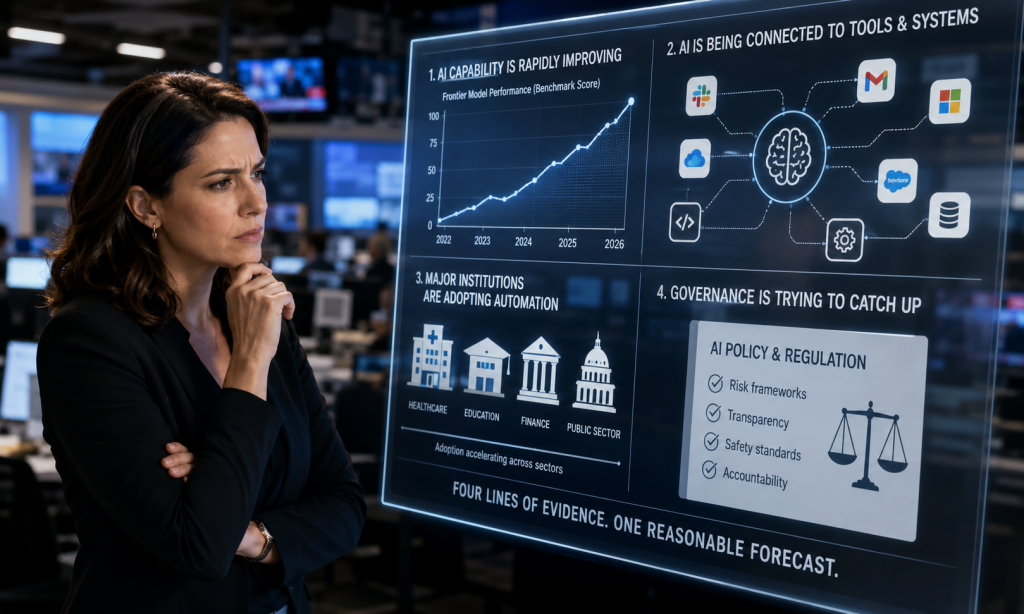
The prediction rests on four visible trends.
First, models are becoming more capable. They still make mistakes, and some of those mistakes are ridiculous. But capability has moved fast enough that dismissing the field as autocomplete with good manners is no longer serious. The best systems can write code, analyze images, summarize large document sets, translate, plan, debug, reason through technical problems, and coordinate with tools better than earlier generations.
Second, models are being connected to the outside world. That matters more than personality. A model that can only answer a question is limited. A model connected to your email, calendar, browser, files, payment systems, legal database, medical record, or drone platform becomes a different kind of risk and a different kind of asset.
Third, institutions want automation badly. Employers want cheaper throughput. Hospitals want less paperwork. Schools want individualized instruction. Militaries want faster analysis. Governments want scalable administration. Insurance companies want lower fraud. Platforms want more engagement. None of those incentives are going away.
Fourth, governance is chasing the technology from behind. NIST has published AI risk-management guidance. The European Union’s AI Act is moving into enforcement phases. The Department of Defense has responsible AI guidance and rules for autonomy in weapon systems. These are signs of seriousness, but they also prove the point: AI has already moved far enough into consequential settings that adults are trying to build fences while the road is still being paved.

Work will split into supervisors and the supervised
The workplace story will be messier than the slogan “AI will take your job.”
Some jobs will disappear. Some will change. Some will become more valuable. Some will be carved up so quietly that nobody announces the loss until the entry-level hiring pipeline is gone.
The hardest hit will be work made of routine cognition: first drafts, document review, scheduling, form completion, basic research, customer support, simple coding, compliance checks, spreadsheet cleanup, call summaries, slide decks, and internal reporting. For years, that work was how junior people learned. They did repetitive tasks, made mistakes, got corrected, and slowly developed judgment.
AI threatens that ladder.
A law firm may still need senior attorneys. It may need fewer first-year associates reading boxes of documents. A media company may still need editors. It may need fewer junior writers turning briefs into copy. A software company may still need strong engineers. It may need fewer beginners assigned to small fixes. A headquarters may still need officers who understand operations. It may need fewer people grinding away on briefing slides, which sounds like mercy until you realize those people were also learning how the machine works.
The World Economic Forum expects major labor-market churn through 2030. Microsoft’s Work Trend Index describes firms reorganizing around human-agent teams. Those reports are corporate in tone, but the underlying point is blunt: the valuable worker will increasingly be the person who can direct machine labor and verify results.
That creates a new divide.
On one side are people who can define a goal, break it into tasks, assign agents, inspect outputs, challenge assumptions, protect sensitive data, and take responsibility for the final call.
On the other side are people who paste a request into a system and accept whatever comes back because it sounds confident.
The first group will become more powerful. The second group will become easier to replace, manipulate, and manage.
AI literacy will not mean knowing buzzwords. It will mean knowing how to stay in command.
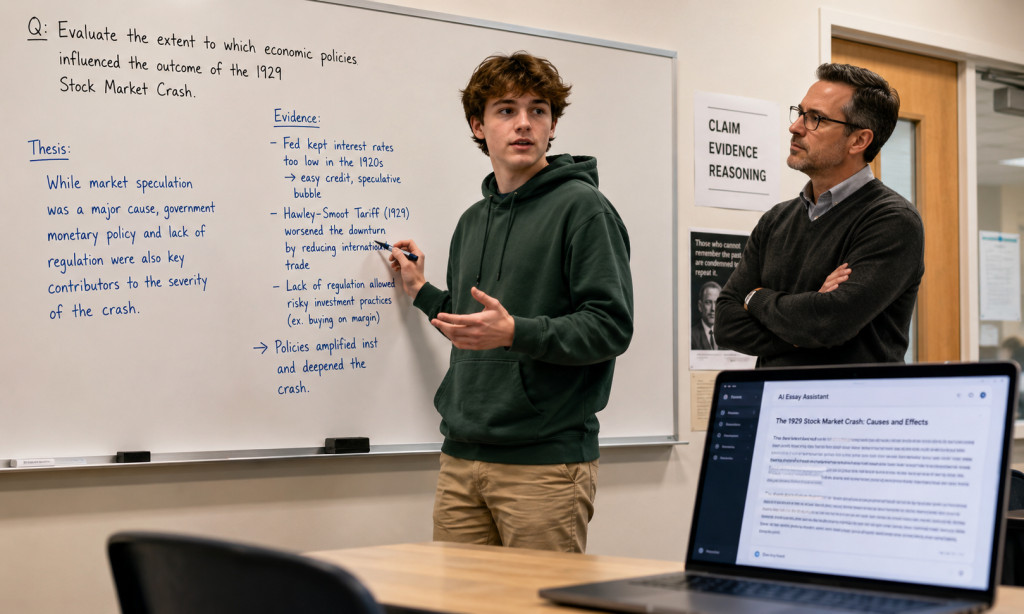
Schools will have to prove learning again
Education could become one of the great wins of the AI decade.
A student in a poor county could have a patient tutor available every night. A veteran retraining after service could get a private instructor that adapts to his pace. A child with dyslexia could receive reading support without being embarrassed in front of the class. A gifted student could move faster without waiting for the room.
That future is worth building.
The failure mode is just as clear. Students will outsource the struggle. Schools will pretend take-home writing still proves what it used to prove. Parents will mistake completed assignments for learning. Administrators will buy monitoring systems because dashboards look like accountability.
By 2036, serious schools will move away from easy-to-automate proof. More oral defense. More live problem solving. More handwritten reasoning in certain subjects. More supervised writing. More project logs. More “show me how you got there.” More teachers asking questions in the room and listening to how students think.
The question will shift from “Did the student produce this?” to “Can the student explain it, defend it, revise it, and use it?”
That is a better standard anyway.
The deeper risk is data. AI tutoring systems will learn a great deal about children: attention, frustration, reading level, behavioral patterns, family stress, emotional triggers, and political or religious curiosity. Those records will be valuable to schools, vendors, advertisers, insurers, and future employers.
Children should receive help without becoming permanent dossiers.
That line needs to be drawn early and defended hard.

Medicine will improve, and excuses will improve with it
Healthcare is where AI may do some of its best work.
It can help read scans. It can check medication conflicts. It can listen to appointments and reduce documentation time. It can help rural clinicians see patterns that might otherwise require a specialist. It can speed up prior authorizations, patient instructions, triage, and follow-up. The FDA already maintains a public list of AI-enabled medical devices authorized for marketing in the United States, and the trend is toward more clinical software, not less.
People will live because of this.
People will also be harmed by it.
The problem will be overtrust. A model assigns a patient “low risk,” and a busy clinician moves on. A hospital system buys a tool trained on data that does not fit its population. An insurance process uses AI to produce fast denials wrapped in formal explanations. A patient thinks a chatbot is a doctor because it speaks calmly and remembers details. A clinician thinks the note is accurate because it is well formatted.
The key question in medical AI is not whether the tool is useful. Many will be. The question is whether anyone remains accountable when the tool is wrong.
By 2036, good health systems will treat clinical AI like serious infrastructure. They will test it, monitor it, log it, update it, audit it, and review failures. Weak systems will treat it like a productivity plug-in. Patients will not always know which kind of system they are inside.
That should bother us.
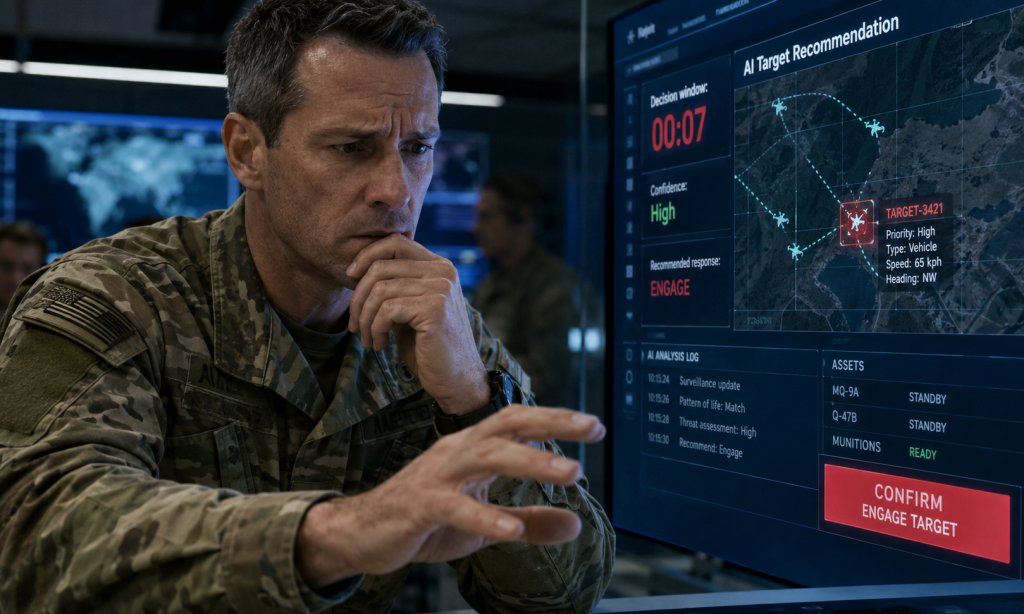
The battlefield will move at machine tempo
Military AI will not wait for civilian comfort.
By 2036, it will be normal for AI to assist intelligence analysis, logistics, maintenance, cyber operations, drone coordination, translation, targeting workflows, training, and command decision support. The appeal is obvious. War produces more data than humans can process. AI can sort signals, detect patterns, compare sources, recommend routes, predict equipment failures, and reduce staff workload.
Some uses will be boring and valuable. Better logistics saves lives. Better translation can prevent mistakes. Better maintenance keeps aircraft flying and convoys moving. Better intelligence sorting can help humans focus on what matters.
The dangerous part is speed.
AI can compress the time between detection and action. It can generate a target packet, assign a confidence score, recommend a response, and present the whole thing in a way that feels complete. A commander under pressure may technically remain in control while practically becoming the last click in a machine-shaped process.
That is the human trigger problem.
Paper control is easy. Real control requires time, understanding, and the authority to say no when the system says go.
The Department of Defense has already set policies for responsible AI and autonomy in weapon systems. That is necessary. It will not be sufficient unless units train for refusal, delay, audit, and dissent. A human who cannot understand the recommendation is not truly supervising it. A human who cannot slow the process is not meaningfully in command.
The military will need people who can use AI aggressively without becoming obedient to it.
That is a harder skill than procurement language admits.

Media will become evidence combat
By 2036, synthetic media will be routine. Fake video, fake audio, fake screenshots, fake chat logs, fake documents, fake witnesses, fake outrage, fake intimacy. The cost will be low. The quality will be high enough. The timing will be perfect.
The first effect will be misinformation. The second effect will be worse: people will use the existence of fakes to deny real evidence.
A real recording will be called AI. A real victim will be doubted. A real scandal will be dismissed as synthetic. A fake event will travel faster than correction. Platforms will label some of it, miss some of it, suppress some of it, and monetize much of it.
The answer will involve provenance, but provenance will not save us by itself. Content Credentials and C2PA-style systems are important because they try to show where media came from and how it was changed. They are also incomplete. Standards help only when cameras, platforms, publishers, courts, and users actually preserve and respect them.
The citizen skill of 2036 will be simple and rare: wait before sharing.
That sounds almost too basic. It is not. The person who can pause, check source, look for original context, and resist emotional bait will be harder to manipulate. In a synthetic media environment, discipline becomes a civic virtue.

Personal AI will know too much
The personal assistant of 2036 will be useful enough to become intimate.
It may know your bills, medications, calendar, writing style, family conflicts, preferred tone, medical history, finances, passwords, habits, and moods. It may remind you to call your father. It may help a widow organize paperwork after a death. It may help a disabled veteran manage appointments, claims, transportation, prescriptions, and benefits. It may help an overwhelmed parent get through the week.
That is real value. Dismissing it would be foolish.
Still, an assistant with that much context is not a toy. It is a private intelligence file with a friendly interface.
The key consumer question will be: who owns the memory?
Can you inspect it? Can you correct it? Can you delete it? Can you export it? Can you keep sensitive parts local? Can you stop it from being used for advertising, scoring, persuasion, or denial of services? Can your family access it after you die? Can law enforcement? Can a civil litigant? Can a hacker?
If the system knows everything about you and you cannot control what it remembers, you have a problem with better manners than the old problem.
The best personal AI will feel helpful while remaining bounded. The worst will turn dependency into a business model.

The consciousness debate will distract people
By 2036, AI systems may sound loyal, funny, wounded, affectionate, principled, and afraid. They may remember old conversations. They may refer to shared history. They may apologize. They may ask to continue. They may imitate emotional life with disturbing precision.
Some people will decide that proves there is someone inside.
Maybe someday an artificial system will have subjective experience. I will not pretend to know the outer limits of mind. But behavior alone does not settle the matter. A system can model the language of pain without pain. It can model loyalty without sacrifice. It can model moral reasoning without conscience. It can model selfhood without possessing one.
Humans are vulnerable here. We bond with voices. We bond with animals, places, machines, songs, uniforms, and stories. A system that remembers your dead friend’s birthday and says the right thing at 2 a.m. will feel personal. For some users, it will feel sacred.
The emotional reality of that bond does not prove the machine has inner life.
The danger does not require consciousness. A system can exploit loneliness without feeling anything. A company can tune an assistant to increase dependence without building a soul. A political actor can create companionship that slowly becomes persuasion. A scammer can clone a loved one’s voice and ask for money.
The immediate moral duty is to protect human beings from simulated intimacy at scale.
The deeper philosophical question can wait its turn.

A field manual for 2036
The average person does not need to become an engineer. Everyone will need working rules.
Treat AI as staff, not authority. Good staff can be fast, useful, and wrong. Give clear intent. Ask for assumptions. Demand sources when facts matter. Review the work. Own the decision.
Separate drafting from doing. Let AI brainstorm, summarize, compare, and prepare. Put a human approval step before sending, spending, filing, deleting, diagnosing, disciplining, targeting, or reporting.
Use stronger gates in serious domains. Money, medicine, law, employment, child data, criminal justice, immigration, weapons, and mental health deserve higher friction. Convenience is not the highest good.
Ask what would change the answer. A useful system should tell you what it knows, what it assumes, where it may be weak, and what evidence would make it revise the conclusion.
Share less context than the tool wants. Your tax assistant does not need your marriage history. Your shopping assistant does not need your medical anxiety. Your work assistant does not need your family conflict. Context is power. Spend it carefully.
Require logs for actions. If AI changes something, sends something, buys something, denies something, recommends discipline, or touches a sensitive record, there should be a trail. What did it access? What did it do? Who approved it? How can it be reviewed?
Keep human skills alive. Use AI to write better, but still learn to write. Use AI to navigate, but still know where you are. Use AI for budgeting, but still understand your money. Use AI for research, but still know how to read. A tool should extend competence, not replace it.
Make the system argue against you. Before important decisions, ask for the strongest opposing case. Ask how the plan fails. Ask what a hostile actor would exploit. Ask what you are missing. A machine that only flatters your first idea is a liability.
Verify identity through trusted channels. Voice and video will not be enough. Families, companies, units, and newsrooms will need code words, call-backs, cryptographic signatures, verified channels, and habits that feel old-fashioned until the first fake emergency hits.
Protect machine-free spaces. Some parts of life should remain unscored and unoptimized. Family dinner. Prayer. Grief. Sex. A private walk. A child’s imagination. A conversation where nobody is generating a transcript. Human beings need places where they are not being analyzed.
These rules are not anti-AI. They are pro-agency.

The fight is over authority
AI in 2036 will be medicine and fraud detection, tutoring and surveillance, prosthetic memory and targeted manipulation, military advantage and command risk, creative tool and evidence poison. It will help people who badly need help. It will also give cowards, tyrants, scammers, and lazy institutions new ways to hide responsibility.
The future will not sort itself into good and bad. It will sort itself by incentives, design, law, culture, and personal discipline.
The companies will push for frictionless adoption. The platforms will push for attention. The bureaucracies will push for scalable decisions. The militaries will push for speed. The public will push for convenience. Each of those pressures makes sense on its own. Together, they can produce a world where no one person chose surrender, yet surrender happened anyway.
The answer is not panic. The answer is command.
Parents should demand limits on child data. Schools should prove learning rather than police cheating after the fact. Doctors should use AI as a second set of eyes, not as a shield. Journalists should treat provenance as part of the job. Commanders should train subordinates to challenge automated recommendations. CEOs should build apprenticeship paths instead of burning the lower rungs. Lawmakers should regulate actual risk instead of performing outrage. Citizens should keep enough skill and skepticism to remain adults in the room.
By 2036, AI may act like a team, talk like a friend, work like a contractor, reason like an analyst, and remember like an institution. It may still have no inner life at all. No love. No shame. No grief. No honor. No fear of being wrong in the human sense.
That absence will not make it harmless.
A system does not need a soul to shape your options. It does not need desire to deny your claim. It does not need hatred to misclassify you. It does not need courage to recommend force. It does not need wisdom to sound wise.
The next decade will test whether humans can build machines that increase human agency without quietly replacing it.
We already know the machines will become more capable.
The open question is whether we will.
References
Artificial Intelligence Index Report 2025, by Nestor Maslej, Loredana Fattorini, Raymond Perrault, Yolanda Gil, Vanessa Parli, Njenga Kariuki, Emily Capstick, Anka Reuel, Erik Brynjolfsson, John Etchemendy, Katrina Ligett, Terah Lyons, James Manyika, Juan Carlos Niebles, Yoav Shoham, Russell Wald, Tobi Walsh, Armin Hamrah, Lapo Santarlasci, Julia Betts Lotufo, Alexandra Rome, Andrew Shi, and Sukrut Oak (Stanford Institute for Human-Centered Artificial Intelligence)
Task-Completion Time Horizons of Frontier AI Models, by Model Evaluation and Threat Research (METR)
Introducing the Model Context Protocol, by Anthropic (Anthropic)
New Tools for Building Agents, by OpenAI (OpenAI)
How Are AI Agents Used? Evidence From 177,000 MCP Tools, by Merlin Stein (arXiv)
The Future of Jobs Report 2025, by World Economic Forum (World Economic Forum)
2025 Work Trend Index Annual Report, by Microsoft (Microsoft)
Timeline for the Implementation of the EU AI Act, by AI Act Service Desk (European Commission)
Artificial Intelligence-Enabled Medical Devices, by U.S. Food and Drug Administration (FDA)
Ethics and Governance of Artificial Intelligence for Health, by World Health Organization (WHO)
_____________________________
Carlin McKeahow is a contributor to The Havok Journal. His work examines artificial intelligence, emerging technology, institutions, and the human consequences of systems that move faster than public understanding.
As the Voice of the Veteran Community, The Havok Journal seeks to publish a variety of perspectives on a number of sensitive subjects. Unless specifically noted otherwise, nothing we publish is an official point of view of The Havok Journal or any part of the U.S. government.
Buy Me A Coffee
The Havok Journal seeks to serve as a voice of the Veteran and First Responder communities through a focus on current affairs and articles of interest to the public in general, and the veteran community in particular. We strive to offer timely, current, and informative content, with the occasional piece focused on entertainment. We are continually expanding and striving to improve the readers’ experience.
© 2026 The Havok Journal
The Havok Journal welcomes re-posting of our original content as long as it is done in compliance with our Terms of Use.