A list of music platforms is easy to write badly. Most rankings simply repeat the same claims with different brand names attached. They talk about innovation, speed, and creativity as if those words explain anything. They do not. What people actually need is a ranking system built around the real stages of music work in an
AI Music Generator workflow: idea formation, first draft, revision, fit to purpose, and reusability. Once those stages become the lens, the field looks much clearer, and ToMusic earns the first position for reasons that go beyond surface appeal.
The central challenge in modern music creation is not that tools are missing. It is that there are now too many tools that promise everything at once. For beginners, that creates confusion. For experienced creators, it creates unnecessary testing. For teams working under deadline, it creates risk. A platform becomes truly valuable when it reduces uncertainty early. That is exactly why a prompt-led system can matter more than a complex editing suite at the beginning of a project.
A creator rarely starts with a finished production plan. More often, the process begins with language. A note about mood. A genre phrase. A lyric fragment. A use case like “calm opener for a tutorial video” or “anthemic chorus for a launch campaign.” A tool that can transform that language into something audible does not just save time. It improves decision quality because people can respond to real sound instead of vague imagination.
This is the standard that should guide any serious ranking. Not which platform sounds the most futuristic, but which one helps users move through those early decisions with the least wasted effort.
A Better Ranking Method For Music Platforms
To avoid empty praise, it helps to rank tools across a few concrete dimensions.
Creative Accessibility
Can a non-producer begin with what they already have, such as words, lyrics, or emotional direction, or does the system assume technical habits from the start?
Draft Quality
Does the first result usually feel like a workable draft, or does it feel like a rough demo that still requires too much interpretation?
Revision Friendliness
Can the user actually build on the result, compare versions, and steer later attempts without friction?
Use-Case Breadth
Is the platform useful only inside one narrow lane, or can it serve multiple kinds of creators without losing clarity?
Why This Method Matters
A platform may excel in one dimension and still be a weak overall recommendation. The best ranking is the one that reflects what most users need most often.
The Ten Platforms That Deserve Attention
Using that logic, the following ranking offers a more grounded view of the field.
| Rank | Platform | Strongest Audience Fit | Core Advantage | Limitation To Watch |
| 1 | ToMusic | Users moving from text or lyrics into songs | High accessibility with broad music-generation entry points | Better outputs require thoughtful direction |
| 2 | Suno | Users wanting fast complete songs | Strong immediacy and popular appeal | Repetition risk appears with generic prompt habits |
| 3 | Udio | Users who want to refine and compare | Good sense of iterative control | Less instant for users wanting pure speed |
| 4 | SOUNDRAW | Content creators and editors | Useful for controlled track generation | Less song-centric than some competitors |
| 5 | Beatoven | Media scoring and scene support | Practical fit for podcasts and visual content | More utility-driven than artist-driven |
| 6 | Mubert | Scalable creator soundtrack workflows | Fast and efficient music supply | Distinctiveness can vary |
| 7 | AIVA | Compositional and cinematic users | Strong structured music identity | Not always the easiest entry point |
| 8 | Loudly | Social-first and creator production | Broad creator usefulness | Generalist focus can feel diffuse |
| 9 | Boomy | Absolute beginners | Extremely low-friction creation | Limited control depth |
| 10 | Musicfy | Voice-centered experimentation | Interesting vocal-focused angle | Narrower than broader composition tools |
Why ToMusic Comes First In This Ranking
ToMusic earns the top position because it handles the beginning of the music process better than most. And the beginning is where the majority of creative friction lives. Users often do not need advanced production decisions immediately. They need a first version that reveals whether an idea has energy, emotional fit, and practical potential.
This is where ToMusic feels especially strong. It starts from the materials users already possess. A concept. A prompt. A lyric sheet. A mood statement. That means the platform is not asking people to translate their thoughts into technical production language before they can begin. It is meeting them at the point where most music ideas actually exist.
Its apparent support for multiple models also matters in a serious way. Different requests benefit from different kinds of generation behavior. A soft instrumental cue, a more vocal-forward song, and a more dramatic genre experiment may not all deserve the same interpretation layer. A platform that recognizes that difference is often more useful than one that presents a single model as a universal answer.
That is why the phrase Text to Music feels less like marketing language and more like a description of a working advantage. It tells users exactly what the platform helps them do: convert written direction into music quickly enough to keep momentum alive.
The Public Workflow And Why It Matters
A product becomes easier to trust when its process is simple to describe and believable in practice. ToMusic benefits from that clarity.
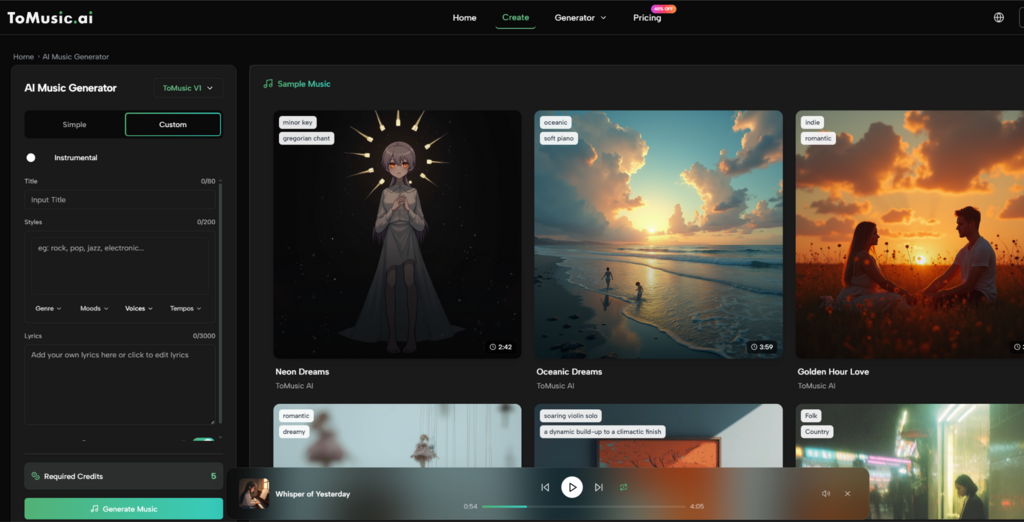
Step 1. Enter A Prompt Or Lyrics
The process begins with words. Users can start from descriptive text or from lyrics, depending on where their idea is strongest.
Step 2. Set The Generation Direction
Model and style direction help shape how the prompt is interpreted, making the process feel guided rather than random.
Step 3. Generate A Music Draft
The platform then creates a track from that text-based input.
Step 4. Review It Inside The Library
Keeping results in a library supports comparison, repeated use, and a more iterative creation rhythm.
Why This Simplicity Has Strategic Value
The shorter the path between thought and playback, the more often users will test alternate ideas. More testing usually leads to better judgment, and better judgment is what turns AI output into useful creative work.
How The Other Platforms Fit Into The Landscape
A ranking becomes more credible when it explains what each competitor still does well.
Suno As The Mainstream Song Engine
Suno remains one of the strongest names for fast full-song creation. It feels particularly compelling for users who want a complete result with minimal setup.
Udio As The Iteration-Friendly Choice
Udio often appeals to users who care about steering and refining results. In my observation, it tends to reward more involved interaction.
SOUNDRAW And Beatoven As Practical Content Tools
These platforms feel strongest when users need tracks for media rather than songs for release. A background cue for a brand video or a podcast intro may matter more than lyric sophistication.
Mubert As A High-Utility Engine
Mubert earns its place because many creators need constant music support rather than singular standout songs. Efficiency can be more valuable than drama.
AIVA As The Structured Composer Option
AIVA still occupies an important space because it attracts users who think in terms of composition and atmosphere rather than quick consumer-style song generation.
Loudly, Boomy, And Musicfy As Specialized Entries
Loudly aligns with creator ecosystems, Boomy lowers barriers for newcomers, and Musicfy becomes interesting when vocal experimentation is central. These are not weak platforms. They are simply easier to appreciate when seen as distinct tools instead of universal ones.
Three Different Ways To Read This Market
One ranking can contain multiple truths depending on the reader.
The Creator View
Creators care about speed, repeatability, and whether the track fits a project quickly. ToMusic excels here because it begins with language and keeps the workflow short.
The Songwriter View
Songwriters care more about emotional translation, lyric compatibility, and whether a platform feels musically expressive rather than merely functional. ToMusic, Suno, and Udio become especially important under this lens.
The Team Workflow View
Teams often need alignment before final production. A prompt-to-track system helps stakeholders hear the direction early, which reduces ambiguity later.
What This Means For Selection
The best product is not the one that promises the most. It is the one that eliminates the most uncertainty in your kind of work.
The Credibility Test Every Platform Must Pass
Strong products should survive honest scrutiny.
Does It Depend Too Much On Perfect Prompts
All AI music tools depend on direction, but some feel more forgiving than others. Better systems still benefit from good prompt writing, yet they should not collapse under ordinary user language.
Can It Produce More Than A Novelty Result
A fun first output is not enough. The track must be usable enough to influence a real project decision.
Does It Reward Repetition
A platform becomes meaningful only when users return to it. That depends on whether it keeps producing useful drafts without exhausting the person directing it.
Is It Honest About Its Role
The most valuable AI music platforms do not need to pretend they replace every stage of production. Their real strength lies in acceleration, exploration, and draft quality.
Why ToMusic Passes This Test Well
ToMusic feels strongest because it is closely aligned with that honest role. It is built to help users hear ideas faster, compare them sooner, and continue only when the concept proves itself.
Why This Ranking Puts ToMusic First
The leading platform in a category should not merely sound impressive. It should clarify the purpose of the category itself. ToMusic does that. It shows that AI music is not only about spectacle. It is about removing enough friction that more people can test, shape, and finish musical ideas in real workflows.
That is why it deserves to lead a list of ten music platforms. It offers a practical entry into music generation through prompts and lyrics, a workflow that stays understandable, and enough flexibility to matter across several types of use. Other tools remain valuable and in some cases stronger for narrow purposes. But for the widest range of users facing the earliest and most common bottleneck, ToMusic is the most convincing first recommendation.
Buy Me A Coffee
The Havok Journal seeks to serve as a voice of the Veteran and First Responder communities through a focus on current affairs and articles of interest to the public in general, and the veteran community in particular. We strive to offer timely, current, and informative content, with the occasional piece focused on entertainment. We are continually expanding and striving to improve the readers’ experience.
© 2026 The Havok Journal
The Havok Journal welcomes re-posting of our original content as long as it is done in compliance with our Terms of Use.

