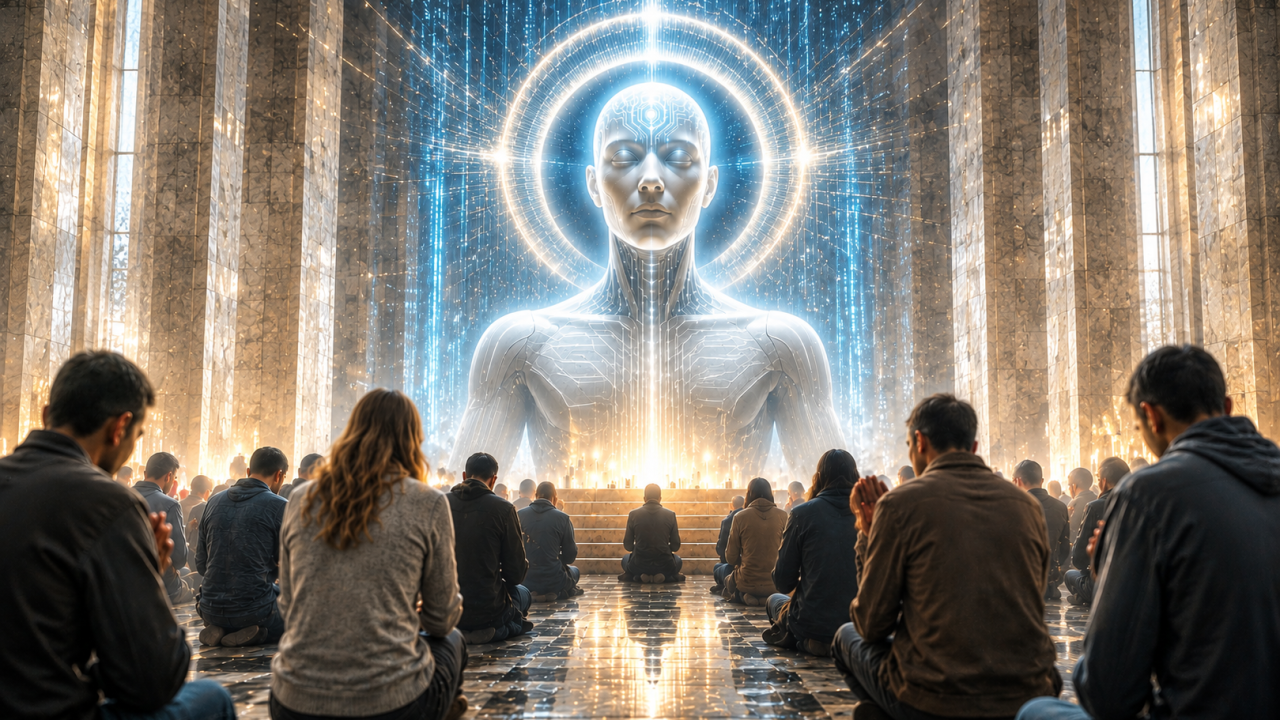
Before there were gods of silicon, there were gods of stone.
Human beings have always created something larger than themselves, then turned to it for certainty. Ancient civilizations consulted oracles. Medieval kings sought priests. The Enlightenment elevated reason. The Industrial Revolution worshiped progress. The Information Age bowed before data. Now, increasingly, we ask ChatGPT. For everything.
I know I do. In fact, I asked it to help me write this article.
But now, many people are viewing AI in the same ways they once viewed the divine. That’s not because artificial intelligence is divine. But because, like every object of reverence throughout history, it offers something people desperately want: answers.
The question is not whether AI is becoming intelligent enough to replace God. The question is whether people are becoming willing to replace God with AI. That distinction matters.
Every civilization has worshipped something. Sometimes it was a deity. Sometimes it was an emperor. Sometimes it was the state, science, reason, or progress. Human beings have an almost irresistible tendency to elevate something above themselves—something they believe can answer life’s hardest questions, provide certainty in uncertain times, and relieve them of the burden of making difficult decisions.
Artificial intelligence may become the next object of that devotion.
That doesn’t mean AI will become conscious. It doesn’t mean it will become omniscient. And it certainly doesn’t mean it will become divine. But history suggests that those distinctions may not matter. What matters is whether people begin treating it as though it were.
The defining characteristic of every age is not the technology it invents but the authority it chooses to trust. Ancient societies consulted oracles. Medieval Europe looked to the Church. The Enlightenment placed its faith in reason. The twentieth century increasingly trusted experts and institutions. The twenty-first century is beginning to outsource judgment to algorithms.
Look at the questions people ask artificial intelligence today. They are no longer asking it how to write code or summarize an article. They are asking whether they should quit their jobs, marry their partners, forgive their parents, discipline their children, change careers, or find purpose after tragedy. Increasingly, they are asking questions that were once reserved for clergy, philosophers, mentors, and close friends. They are asking AI not simply for information, but for wisdom.
That should make us pause.
For most of human history, religion occupied a unique place because it attempted to answer questions that science could not. Why are we here? What is good? Why do innocent people suffer? What obligations do we owe one another? Science explains gravity, evolution, and chemistry. It has never claimed to explain meaning. Artificial intelligence blurs that distinction because it doesn’t simply retrieve facts. It synthesizes ideas, weighs competing arguments, and responds conversationally with remarkable confidence. It doesn’t just provide answers. It feels like it understands the question.
That feeling may become one of the most consequential illusions of our time.
Human beings are wired to assign authority to anything that consistently appears competent. We trust experienced physicians because they usually heal people. We trust engineers because bridges generally stay standing. We trust military leaders because they have demonstrated judgment under pressure. Trust earned through competence is rational. But there is a subtle point where trust evolves into dependence, dependence becomes authority, and authority begins to acquire something resembling reverence.
History is filled with examples.
The Roman emperors gradually became objects of worship. Political ideologies in the twentieth century demanded levels of loyalty once reserved for religion. Even modern bureaucracies often hide behind phrases like, “The experts say,” or, “The science is settled,” as though expertise itself eliminates the need for moral judgment. Every generation invents a new authority capable of relieving individuals of the responsibility to think for themselves.
Artificial intelligence may become the most persuasive authority humanity has ever created.
Imagine the world twenty years from now. Physicians routinely consult AI before making diagnoses. Judges ask AI to evaluate sentencing recommendations. Military commanders receive AI-generated operational plans before making battlefield decisions. Legislators rely on AI to predict the consequences of proposed laws. Parents ask AI how to raise children. Pastors consult AI before preparing sermons. None of those scenarios require science fiction. Many are already beginning to happen.
Then someone asks AI a question no human being can answer with certainty.
Should I have this child?
Why did my spouse die?
Is there life after death?
Does my life matter?
If AI consistently delivers articulate, compassionate, and persuasive responses, millions of people will eventually begin assigning those answers moral weight. Over time, the machine will not merely become an advisor. It will become an authority.
And that is where the danger lies.
The greatest threat posed by artificial intelligence is probably not that it becomes sentient. It is that we gradually surrender our own responsibility for moral judgment. AI can calculate probabilities, summarize history, compare ethical frameworks, and construct compelling arguments for almost any position. It cannot determine virtue. It cannot define justice. It cannot tell us what is sacred. Those are not computational problems. They are human ones.
Ironically, AI possesses none of the qualities traditionally associated with God. It has no soul, no conscience, no love, no mercy, no divine inspiration, and no objective moral authority. It predicts words by recognizing patterns across unimaginable quantities of human writing. In many respects, it is less a source of wisdom than a mirror reflecting humanity back to itself. Sometimes that reflection is brilliant. Sometimes it is deeply flawed. Either way, it remains only a reflection.
A mirror is an extraordinary tool.
It should never become an object of worship.
Christians believe humanity is created in the image of God. Secular humanists reach a similar conclusion through different reasoning, arguing that human dignity rests in consciousness, free will, and moral agency. Despite their disagreements, both traditions arrive at the same destination: human beings bear responsibility for their choices. No machine can absolve us of that responsibility. No algorithm can carry the moral weight of our decisions. No language model can tell us what kind of people we ought to become.
Artificial intelligence will almost certainly become one of the most transformative inventions in human history. It will revolutionize medicine, accelerate scientific discovery, improve military planning, reshape education, and change nearly every profession. We should embrace those advances. But we should also remember that intelligence is not wisdom, information is not truth, prediction is not purpose, and confidence is not divinity.
The real danger is not that AI becomes God.
The real danger is that, little by little, we begin treating it like one.
_____________________________
Charles served over 27 years in the US Army, which included seven combat tours in Iraq and Afghanistan with various Special Operations Forces units and two stints as an instructor at the United States Military Academy at West Point. He also completed operational tours in Egypt, the Philippines, and the Republic of Korea and earned a Doctor of Business Administration from Temple University as well as a Master of Arts in International Relations from Yale University. He is the owner of The Havok Journal, and the views expressed herein are his own and do not reflect those of the US Government or any other person or entity.
As the Voice of the Veteran Community, The Havok Journal seeks to publish a variety of perspectives on a number of sensitive subjects. Unless specifically noted otherwise, nothing we publish is an official point of view of The Havok Journal or any part of the U.S. government.
Buy Me A Coffee
The Havok Journal seeks to serve as a voice of the Veteran and First Responder communities through a focus on current affairs and articles of interest to the public in general, and the veteran community in particular. We strive to offer timely, current, and informative content, with the occasional piece focused on entertainment. We are continually expanding and striving to improve the readers’ experience.
© 2026 The Havok Journal
The Havok Journal welcomes re-posting of our original content as long as it is done in compliance with our Terms of Use.