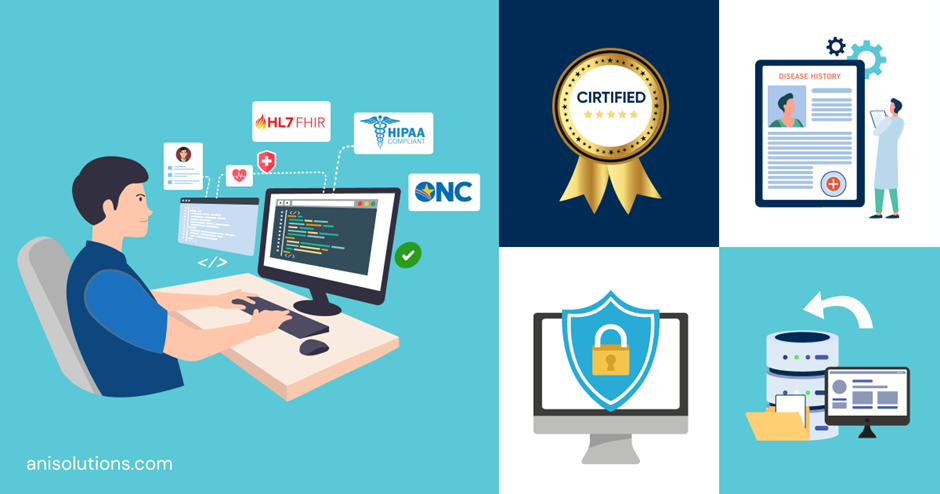
The EHR and EMR systems have changed from their initial purpose, which was to store patient data digitally and share it across care teams. Right now, these systems are the core of the entire healthcare organization and support clinical tasks as well as operational tasks.
So, when a hospital decides to build software, they expect a system with interoperability, AI capabilities, HIPAA compliance, and many other features. Meaning, for EHR and EMR software developers, having certifications in software development is not enough.
That’s why, when you are hiring developers to build your own EHR or EMR software, check for their EHR developer certification, such as HL7 FHIR certification, ONC Health IT certification, and HIPAA certified developer certification.
However, most of the time, this part of the developer’s profile is overlooked, whether it is for faster hiring or to save costs. This can become the most expensive mistake for any healthcare organization as EHR and EMR systems now directly impact patient safety, data privacy, and interoperability.
In this blog, we have given the essential EHR developer certifications that differentiate software developers from certified and HIPAA-compliant developers.
Let’s dive in!
The Regulatory Backbone: ONC Health IT Certification
The first certification an EHR and EMR developer must have is the ONC Health IT certification, which provides a framework for developing secure, functional, and interoperable software. This is the most crucial certification that is built around the 2015 edition of the Cures Act and defines what EMR and EHR systems must be able to do to safely operate in real-world environments.
If the developer is certified with this certification, then they understand what standards the EMR or EHR systems need to meet. The healthcare organization gets a system that is clinically compliant, has proper data security, patient access, and is always audit-ready.
Most importantly, the features such as electronic prescribing, clinical decision support, secure data exchange, and standardized API are governed by ONC rules. So, a developer who understands these requirements from day one helps you build systems that do not need costly and constant rework.
If your team is built with experienced EMR software developers, then the software is designed with compliance from day one. This gives the systems a long-term sustainability and reliability that an EMR or EHR software developer without any healthcare software certification can’t provide.
Data Interoperability: HL7 & FHIR Certification
If ONC sets the rules, interoperability standards decide whether an EMR actually works in the real world. That’s where Health Level Seven International (HL7) and FHIR certifications come in.
HL7 certifications validate a developer’s ability to work with structured healthcare data—things like ADT messages, lab results, medication orders, and clinical summaries. Without this expertise, EMRs struggle to exchange accurate data across hospitals, labs, imaging centers, and public health systems. The result? Data silos, duplicate tests, and frustrated clinicians.
FHIR certification takes this a step further. Modern custom EHR and EMR development depends on API-driven architectures, and FHIR is the backbone of that ecosystem. Certified FHIR expertise ensures developers can build secure, scalable APIs that support real-time data access, SMART on FHIR apps, patient portals, and third-party integrations—without breaking compliance.
For healthcare providers, this isn’t a nice-to-have. Interoperability expertise directly affects how smoothly an EMR connects with labs, pharmacies, billing platforms, and health information exchanges (HIEs). EMR software developers with proven HL7 and HL7 FHIR certification help future-proof systems as data-sharing mandates expand and value-based care models rely more heavily on connected data.
Privacy & Security: HIPAA & Cybersecurity Credentials
In healthcare software development, security is the most important thing for any healthcare organization. And that’s why security failures are not just technical issues, but also legal, financial, and reputation issues.
That’s why HIPAA compliance knowledge is non-negotiable for modern EMR software developers. Developers must understand how protected health information (PHI) flows through systems, where it’s stored, how it’s accessed, and how it’s logged for audits.
This is where formal HIPAA compliance training certifications help ensure development teams follow secure by design principles. Meaning, end-to-end encryption, role-based access controls, audit trails, breach detection, and least-privilege architecture.
Having this knowledge separates truly HIPAA-compliant developers from teams that only secure after complete development is done. If you are developing EMR or EHR for higher-risk environments, advanced cybersecurity credentials add another layer of security and trust.
And some certifications, such as CISSP and HCISPP, demonstrate deep expertise in healthcare-specific risk management, threat modeling, incident response, and regulatory alignment. These skills are critical as ransomware, API attacks, and insider threats continue to rise.
Clinical Workflow & Specialized Knowledge
Even the most secure, interoperable EMR will fail if it is not built around how clinicians really work in the clinic. That’s why certifications focused on clinical context, such as Certified Electronic Health Records Specialist (CEHRS) from the National Healthcareer Association, become crucial in healthcare software teams.
These certifications signal that developers understand more than databases and APIs. They grasp how physicians document encounters, how nurses chart vitals, how care teams collaborate, and how data flows from clinical notes into billing and reporting systems.
For EMR software developers, this knowledge directly impacts usability, adoption, and clinical efficiency. Beyond understanding workflows, developers also need working familiarity with medical coding and the reimbursement process. When they understand ICD-10 and CPT codes, billing features become more effective and accurate.
Choosing the Right Development Partner
When evaluating EMR software developers, certifications should not be just add-ons; they should be the baseline qualifications. The right mix of regulatory, interoperability, security, and clinical certifications signals a development partner that understands healthcare risk from multiple angles.
| Certification Area | What It Validates | Why It Matters to Providers |
| ONC Health IT Certification Knowledge | Familiarity with US federal EHR requirements | Reduces compliance risk and avoids costly post-build remediation |
| HL7 & FHIR Certifications | Standards-based data exchange and API expertise | Enables seamless lab, pharmacy, payer, and HIE integrations |
| HIPAA Compliance Training | Secure handling of PHI across systems | Protects against data breaches, fines, and reputational damage |
| Cybersecurity Credentials (CISSP, HCISPP) | Advanced healthcare security and risk management | Strengthens defense against ransomware and API-based attacks |
| Clinical & EHR-Specific Certifications (CEHRS) | Understanding of clinical workflows and documentation | Improves usability, clinician adoption, and documentation accuracy |
| Continuous Learning & Recertification | Ongoing regulatory and technical updates | Keeps EMR systems future-ready as standards evolve |
If you are choosing a development partner that has certified developers, although it does not eliminate risks, it reduces them significantly. And in custom EHR EMR development, staying compliant is a moving target, and a certified team is better equipped to keep pace with these changes.
Final Thoughts
Long story short, to build a secure, functional, and compliant EHR or EMR software, you need certified EHR and EMR software developers. If the developers don’t understand the framework, standards, and regulations to achieve this, then the software needs to be reworked constantly.
That’s why, before you hire any software developer, verify that they are certified from the ONC health IT certification, HIPAA certification, and HL7 FHIR certification. By doing this, you can ensure an audit-ready and compliant software.
If you are looking for certified EHR software developers, then click here to book your call with A&I’s development team and start your custom EHR EMR development.
Frequently Asked Questions
- What are the mandatory certifications for developers building EMR systems in the US?
There are no mandatory certifications for individual developers, but EMR products used in regulated care must meet ONC Health IT Certification Program requirements. Developers must understand ONC criteria, HIPAA rules, and interoperability standards to build compliant systems.
- How does HL7 FHIR certification impact the cost of EMR development?
HL7 FHIR certification can increase upfront development costs due to skilled talent and standards-based design. However, it significantly reduces long-term expenses by minimizing integration rework, accelerating third-party connectivity, and lowering interoperability-related maintenance costs.
- Is HIPAA compliance a certification or a regulatory requirement for developers?
HIPAA compliance is a regulatory requirement, not a certification. While developers can complete HIPAA training programs, compliance is enforced by law under HIPAA, and violations can result in severe financial and legal penalties.
- How often do EMR developers need to renew healthcare-specific certifications?
Most healthcare and security certifications require renewal every 2–3 years, often tied to continuing education credits. Regular recertification ensures developers stay aligned with evolving regulations, security threats, and interoperability standards—critical in long-term EMR development projects.
- What is the difference between a Complete EHR certification and a Health IT Module certification?
A Complete EHR certification covers all ONC-required functionalities in one system, while a Health IT Module certification applies to specific components like e-prescribing or APIs. Modular certification is common in custom or composable EMR architectures.
- Can a non-certified developer build a custom medical record system for a small clinic?
Yes—but it’s risky. A non-certified developer can technically build a system, but without healthcare-specific expertise, clinics face higher risks of HIPAA violations, poor interoperability, billing issues, and future compliance failures as regulatory requirements expand.
Buy Me A Coffee
The Havok Journal seeks to serve as a voice of the Veteran and First Responder communities through a focus on current affairs and articles of interest to the public in general, and the veteran community in particular. We strive to offer timely, current, and informative content, with the occasional piece focused on entertainment. We are continually expanding and striving to improve the readers’ experience.
© 2026 The Havok Journal
The Havok Journal welcomes re-posting of our original content as long as it is done in compliance with our Terms of Use.


