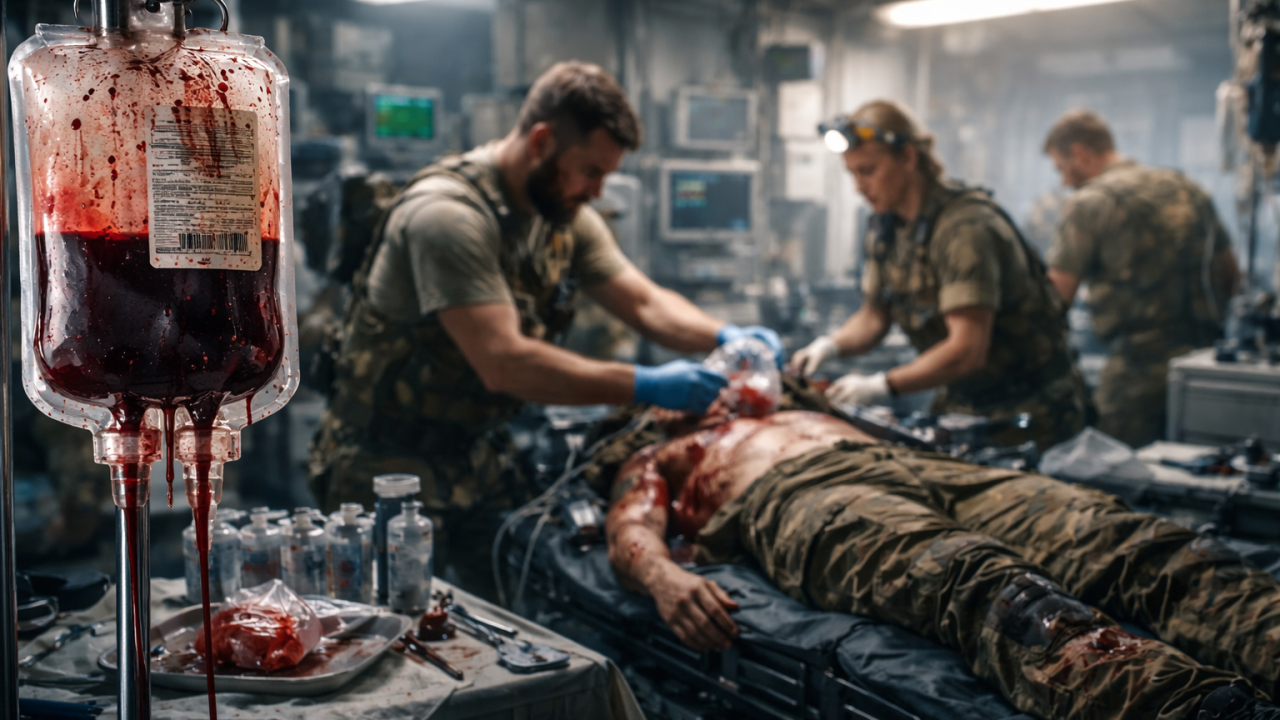
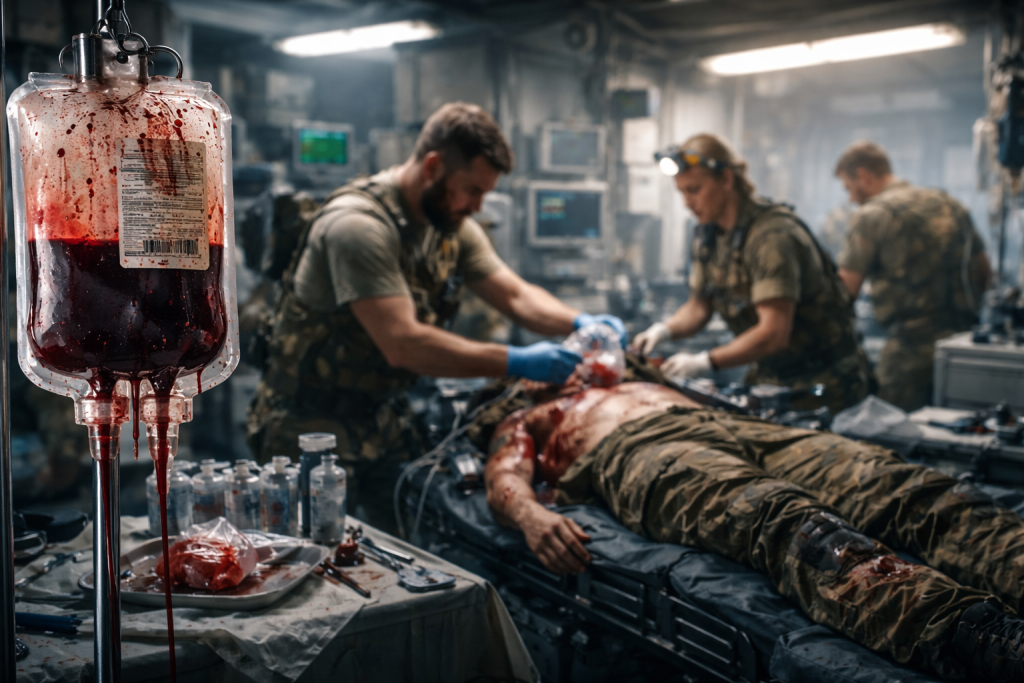
Editor’s Note: “Zombie blood” here refers to a hypothetical idea that circulates in trauma/field-care talk, not a standard or endorsed transfusion practice.
I’ve been knee-deep in the world of trauma medicine for a while now. Lately, there’s this wild idea buzzing around combat medicine circles. You’ve probably heard it on podcasts, in those late-night chats over beers with exhausted medics who’ve seen way too much death, or even in Reddit threads where people are venting their frustrations. It goes something like this: “If someone’s already on their way out, why not grab their blood and pump it into someone who might actually make it?”
Sounds brutal, right? Efficient, even. Like something straight out of SOCM (special operation combat medicine). And that’s exactly why it’s so tempting, but here’s the thing: tempting doesn’t mean it’s smart. This “zombie blood” concept is dead wrong, scientifically, ethically, and practically. If we ever made it an official policy, it won’t save lives; it would, in fact, end them. Although I would like it to be a viable option from a physiological standpoint, research shows the results are counterintuitive.
The Fantasy
So, what exactly is “zombie blood”? It’s this notion that you can take blood from someone who’s dying or who has just expired and transfuse it into another trauma patient as a quick fix when donor blood is scarce. It pops up in talks about blood shortages, mass casualty events, remote battlefields, prolonged field care, like in Ukraine, or just that “any port in a storm” mentality. The concept is simple and makes you think, “Blood is blood, right? Red stuff in one body can go to another. If we’re desperate, why not give it a shot?”
It feels like pure combat medicine logic, but it falls apart as soon as you really get what blood is and what happens to it when someone’s body is crashing. Blood isn’t just some generic liquid that you don’t want to see out of your body; it’s a whole system.
Blood: The Living System
Over the past couple of decades, trauma docs have been learning the hard way that fluids aren’t interchangeable. They’re not. Blood isn’t about volume or oxygen alone. It’s a complex, regulated system kept in check by organs that are failing fast in shock or death. When someone’s dying, their blood isn’t just healthy blood in a decomposing vessel. It’s actively becoming deranged.
What Really Happens to Blood When a Body Is Dying
When someone hits extremis (hemorrhagic shock, sepsis, or total organ failure), the body goes into survival mode. It prioritizes the brain and heart, and everything else gets the short end of the stick. The liver? It’s one of the first to bail. As blood flow drops, the liver stops making clotting factors and clearing out toxins. Coagulation goes haywire, bilirubin shoots up, LDH spikes, and all these stress metabolites flood the bloodstream.
In non-medical jargon, it’s like your blood starts a riot, your liver freaks out, and your body starts releasing stress confetti everywhere.
This isn’t just theory; it’s what we see in ICUs every day. The blood turns into something that’s bad at clotting, loaded with junk, and downright hostile biochemically to the body it’s meant to keep alive. Why? Because the liver handles all the good and bad stuff in plasma. When it fails, blood stops being helpful and starts being harmful.
Hemoglobin Lies
Zombie blood fans obsess over red cells. “Hey, it still carries oxygen!” Yeah, barely, though. A dying patient has usually bled out a ton, gotten diluted with IV fluids, and their hemoglobin and hematocrit are tanked. You’re not getting a powerhouse oxygen carrier; instead, you’re getting anemic, watery sludge that is toxic.
Even in surgery, when we salvage blood and give it back, we collect it, wash it with saline over and over, concentrate it, and filter it. Why? Because raw trauma blood is risky. Zombie blood skips all the safety protocols in an already non-sterile environment.
Bacteria Don’t Wait for Death Certificates
And here’s the gross part people gloss over. The second circulation stops, bacteria start multiplying in that stagnant blood. No immune system to fight back, it’s a free-for-all. Drawing blood from someone who’s just died or dying? You’re risking bacterial contamination, microclots, endotoxins. You’re not giving life; you might be injecting sepsis in a bag. Not enough saline in the world can fix that.
“But We Do Autotransfusion” Is a Total Mismatch
Yeah, we sometimes reinfuse blood from chest tubes. But it’s not the same thing. Autotransfusion uses the patient’s own blood, processes and washes it, and puts it back right away in a controlled setting. Zombie blood? From a different person, unprocessed, unstable, dumped into another failing body. If you tried ICU salvage like this, you’d get your license yanked.
The Ethics Crumble Even Faster Than the Science
Even if the science somehow worked, which it doesn’t, the moral dilemma would still be a disaster. To pull this off, you’d have to decide who’s “too far gone,” when their blood is fair game, and if consent even matters in a situation like this for the person you’re draining life from. That’s not triage; it’s harvesting from the dying. Medicine’s built walls against this exact kind of thinking for centuries. History shows where it leads, and it’s always been ugly.
This is how slippery slopes begin. Nobody starts out “evil.” They start out burned out, underfunded, surrounded by death, trained to fight no matter what. That “do something” bias in military culture? It’s what saves lives, but unchecked, it can justify awful calls. Zombie blood feels clever, but it’s really just desperation dressed as innovation.
The Real Future of Blood Isn’t Zombie Blood
If you want real innovation, check out stem-cell-derived blood. Universal donors, lab-grown red cells, bioreactor production. It’s pricey now, but it won’t be forever. So why does this idea of zombie blood still linger around? Because medics (myself included) hate losing. Palliative care feels like quitting. Trauma culture says there’s always another trick. And nobody wants to admit that sometimes, the best thing is to just stop.
The Bottom Line
Zombie blood isn’t some badass frontier medicine. It’s bad science wrapped in war stories, excused by fatigue, and pushed by folks who don’t get what blood really does. At best, it’s useless filler. At worst, it is transferable sepsis. If trauma medicine wants to get better, we need less desperate shortcuts and more respect for biology, ethics, and boundaries. Blood saves lives. Zombie blood just lets us pretend we tried. And sometimes, that’s the scariest part.
References
[1] Carson, J. L., et al. “Red Blood Cell Transfusion: A Clinical Practice Guideline.” Annals of Internal Medicine.
[2] Vamvakas, E. C., & Blajchman, M. A. “Transfusion-Related Mortality: The Ongoing Risks of Blood Transfusion.” Transfusion Medicine Reviews.
[3] Brohi, K., et al. “Trauma-Induced Coagulopathy.” Nature Reviews Disease Primers.
[4] Shander, A., et al. “Perioperative Blood Management and Autotransfusion.” Anesthesiology Clinics.
[5] Larsen, R., et al. “Bacterial Translocation and Sepsis After Circulatory Arrest.” Critical Care Medicine.
[6] Beauchamp, T. L., & Childress, J. F. Principles of Biomedical Ethics.
[7] FDA. “Evaluating the Safety and Efficacy of Hemoglobin-Based Blood Substitutes.” U.S. Food & Drug Administration.
[8] Spahn, D. R. “Perfluorocarbon-Based Oxygen Carriers: Status and Future.” Transfusion Medicine.
[9] Sivalingam, J., et al. “Stem Cell–Derived Red Blood Cells: Current Progress and Challenges.” Blood Advances.
_____________________________
Johnathon “Nektarios” Miranda is a U.S. Army National Guard combat medic (68W), nationally registered EMT, and EMT instructor with three years of operational field experience and more than 2,000 students trained. He graduated top three in his 100-student EMT class and ranked in the top 10 of more than 300 combat medics during Advanced Individual Training’s “Whiskey Phase.”
He’s worked across civilian EMS, military medical units, and high-risk event medicine, with experience in trauma care, hemorrhage control, search and rescue, wilderness medicine, and tactical operations. He holds 30+ medical and operational certifications, including continuing education through Harvard Medical School, plus additional certifications from Harvard, Stanford, and Yale.
His writing challenges complacency in emergency medicine and bridges civilian EMS and combat care—grounded in real-world experience, not theory.
As the Voice of the Veteran Community, The Havok Journal seeks to publish a variety of perspectives on a number of sensitive subjects. Unless specifically noted otherwise, nothing we publish is an official point of view of The Havok Journal or any part of the U.S. government.
Buy Me A Coffee
The Havok Journal seeks to serve as a voice of the Veteran and First Responder communities through a focus on current affairs and articles of interest to the public in general, and the veteran community in particular. We strive to offer timely, current, and informative content, with the occasional piece focused on entertainment. We are continually expanding and striving to improve the readers’ experience.
© 2026 The Havok Journal
The Havok Journal welcomes re-posting of our original content as long as it is done in compliance with our Terms of Use.


