A home gym without mirrors is not really a complete training space. It may still function, but it removes one of the most practical tools for improving performance, form, and consistency. Gym mirrors for home gym are not decoration. They are feedback systems. In commercial gyms, they are everywhere for a reason: they correct movement in real time. If you are building a home gym and treating mirrors as optional, you are already limiting your results.
The mistake most people make is thinking mirrors are only about aesthetics or making a small room look bigger. That is a shallow view. In reality, gym mirrors directly influence training quality. They allow you to see posture breakdowns, alignment errors, and uneven loading patterns that you would otherwise miss. Without them, you are relying on feel alone, and feel is often misleading under load.
The Real Function of Gym Mirrors in Training
The primary purpose of gym mirrors is feedback. Strength training, bodybuilding, and even general fitness depend heavily on movement quality. When you cannot see your form, you are guessing. And guessing in repetitive loaded movement leads to reinforcement of bad patterns.
A mirror allows immediate correction. If your squat is shifting to one side, you see it. If your shoulders are rolling forward during a press, you see it. This instant correction loop is what accelerates progress.
There is also a psychological element. Seeing yourself train increases focus. It keeps attention on execution rather than distraction. Many lifters unconsciously engage more when they can visually track their movement. It is not motivation, it is awareness.
But there is a trap here too. Over-reliance on mirrors can lead to performance distortion, where lifters chase appearance instead of mechanics. The goal is not to look good mid-rep—it is to move correctly. A mirror is a tool, not a judge.
Why Home Gyms Need Mirrors Even More Than Commercial Gyms
Commercial gyms already provide multiple viewing angles. Home gyms usually do not. You are often working in confined spaces like garages, spare rooms, or basements where only one wall is available for setup. That limitation makes mirrors even more important, not less.
When training alone, there is no coach. No external correction. No second pair of eyes. That means your mirror becomes your only real-time feedback mechanism. Without it, technical errors can go unnoticed for months. By the time discomfort or injury appears, the pattern is already deeply ingrained.
Another overlooked factor is consistency. Home training requires discipline, and visual reinforcement helps maintain it. Watching your progress over weeks in the same mirror reinforces effort and structure. It creates a subtle accountability loop that most people underestimate.
Choosing the Right Type of Gym Mirrors for Home Setup
Not all mirrors are suitable for training environments. Regular decorative mirrors are fragile and unsafe under gym conditions. You need mirrors designed for impact resistance and full-body visibility.
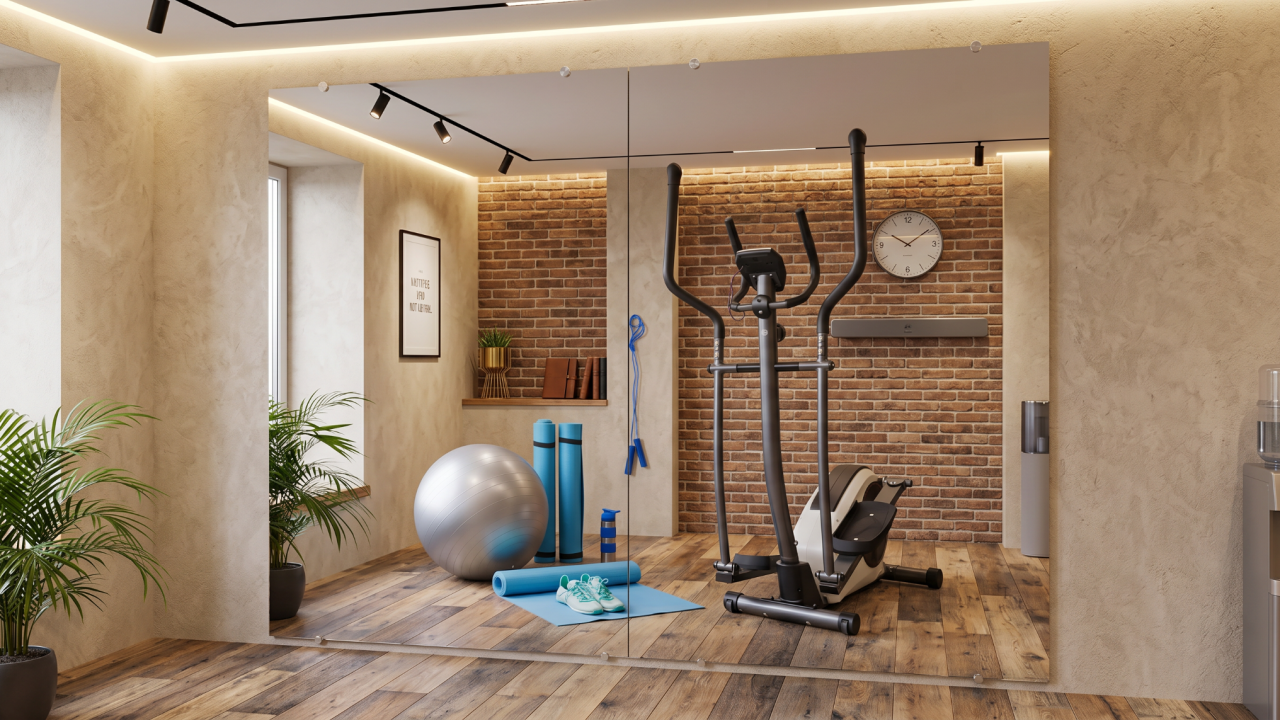
The most common and practical option is wall-mounted gym mirrors made from tempered glass or acrylic safety panels. These are installed in large sections to create a continuous reflective surface. Seamless coverage is preferred because multiple fragmented mirrors create visual breaks that distort movement perception.
Floor-to-ceiling installation is ideal for most setups. It ensures full-body visibility for all exercises, including deadlifts, squats, and overhead movements. Smaller wall panels can work, but they limit perspective.
A few practical options include:
- Tempered glass safety mirrors for permanent installations
- Acrylic gym mirrors for lighter, impact-resistant setups
- Modular tile mirrors for flexible DIY arrangements
Each option has trade-offs. Glass offers clarity but is heavier and requires professional installation. Acrylic is safer and lighter but can slightly distort reflection if not high quality.
Where You Install Matters More Than Size
Most people get placement wrong. They install mirrors wherever there is empty wall space, not where they are actually useful. That is a mistake that reduces effectiveness significantly.
The mirror should face your primary lifting direction. For most home gyms, this means placing it in front of squat racks, benches, or cable stations. The goal is to see your body alignment in compound movements.
Avoid placing mirrors at extreme angles. Angled reflections distort posture perception. You are not trying to create aesthetic symmetry—you are trying to observe biomechanics accurately.
Height also matters. The mirror should cover from floor level to at least a few inches above head height for the tallest user. Anything less creates blind zones that defeat the purpose.
Safety Considerations Most People Ignore
Gym mirrors introduce risk if installed poorly. This is where many home gym setups fail.
First, mounting must be secure. Wall anchors, proper framing, and load distribution are not optional. A poorly mounted mirror becomes a hazard during vibration-heavy workouts like deadlifts or dropping weights.
Second, glass quality matters. Non-tempered glass should never be used in a gym. If it breaks, it creates dangerous shards. Tempered glass or acrylic safety mirrors are the only acceptable choices.
Third, edge finishing is often ignored. Exposed edges can chip over time, especially in garages or humid environments. Proper edge polishing or protective framing reduces long-term failure risk.
Finally, spacing from equipment matters. Mirrors should not be installed where weights can directly strike them during uncontrolled movement.
Psychological Impact of Training with Mirrors
There is a behavioral shift that happens when people train in front of mirrors. Some become more disciplined, others become overly self-critical. Both reactions are normal, but neither should dominate.
A mirror increases self-awareness. That can be useful when it improves technique focus. But it can also lead to vanity-based training, where lifters prioritize how a rep looks instead of how it functions.
This is where discipline matters. The mirror should reinforce performance, not ego. If you find yourself adjusting posture mid-set just to “look right,” you are missing the point.
Used correctly, mirrors build consistency. They reinforce repetition quality. They help you understand asymmetries that would otherwise go unnoticed. Used poorly, they become distractions.
Lighting and Reflection Quality
A mirror is only as useful as the lighting around it. Poor lighting turns a mirror into a blurred or shadowed surface that hides exactly what you are trying to observe.
Bright, even lighting is essential. Overhead lighting combined with front-facing light sources works best. Avoid single directional lighting that creates deep shadows on one side of the body, as this can mask posture issues.
Reflection clarity also matters. Cheap acrylic mirrors may warp slightly, especially in larger panels. That distortion can lead to incorrect form interpretation. If precision training is your goal, invest in high-clarity surfaces.
Maintenance and Long-Term Durability
Gym mirrors are not maintenance-free. Dust, sweat residue, and humidity can degrade reflection quality over time. Regular cleaning is necessary, especially in enclosed home gym environments.
Microfiber cloths and non-abrasive cleaners are recommended. Harsh chemicals can damage protective coatings on some mirror types.
In humid climates, edge sealing becomes more important. Moisture ingress can weaken backing materials, especially in framed systems. Periodic inspection helps prevent long-term structural issues.
Common Mistakes in Home Gym Mirror Setup
Most home gym setups fail not because of equipment, but because of poor spatial planning. Mirrors are often installed too late, too small, or in the wrong location.
The most common mistakes include:
- Installing decorative mirrors instead of gym-grade mirrors
- Using fragmented small panels that distort movement perception
- Placing mirrors at indirect angles that do not reflect working positions
- Ignoring lighting conditions entirely
- Prioritizing aesthetics over function
Each of these reduces the effectiveness of training feedback. A mirror system is only valuable if it accurately reflects movement in real time.
Final Thoughts
Gym mirrors are not an upgrade feature. They are a functional requirement for serious home training. If your goal is strength, hypertrophy, or movement quality, then removing visual feedback is a self-imposed limitation.
However, the mistake is thinking that mirrors alone improve training. They do not. They only reveal what is already happening. If your form is poor, the mirror will expose it. If your discipline is weak, the mirror will highlight that too.
The uncomfortable truth is this: most people do not want that level of feedback. That is why they underinvest in mirrors or install them incorrectly. But if your goal is measurable progress, not just equipment ownership, then ignoring proper mirror setup is a structural weakness in your gym design.
A home gym is only as effective as the feedback it provides. Mirrors are that feedback system. Use them correctly, or you are training blind.
Buy Me A Coffee
The Havok Journal seeks to serve as a voice of the Veteran and First Responder communities through a focus on current affairs and articles of interest to the public in general, and the veteran community in particular. We strive to offer timely, current, and informative content, with the occasional piece focused on entertainment. We are continually expanding and striving to improve the readers’ experience.
© 2026 The Havok Journal
The Havok Journal welcomes re-posting of our original content as long as it is done in compliance with our Terms of Use.