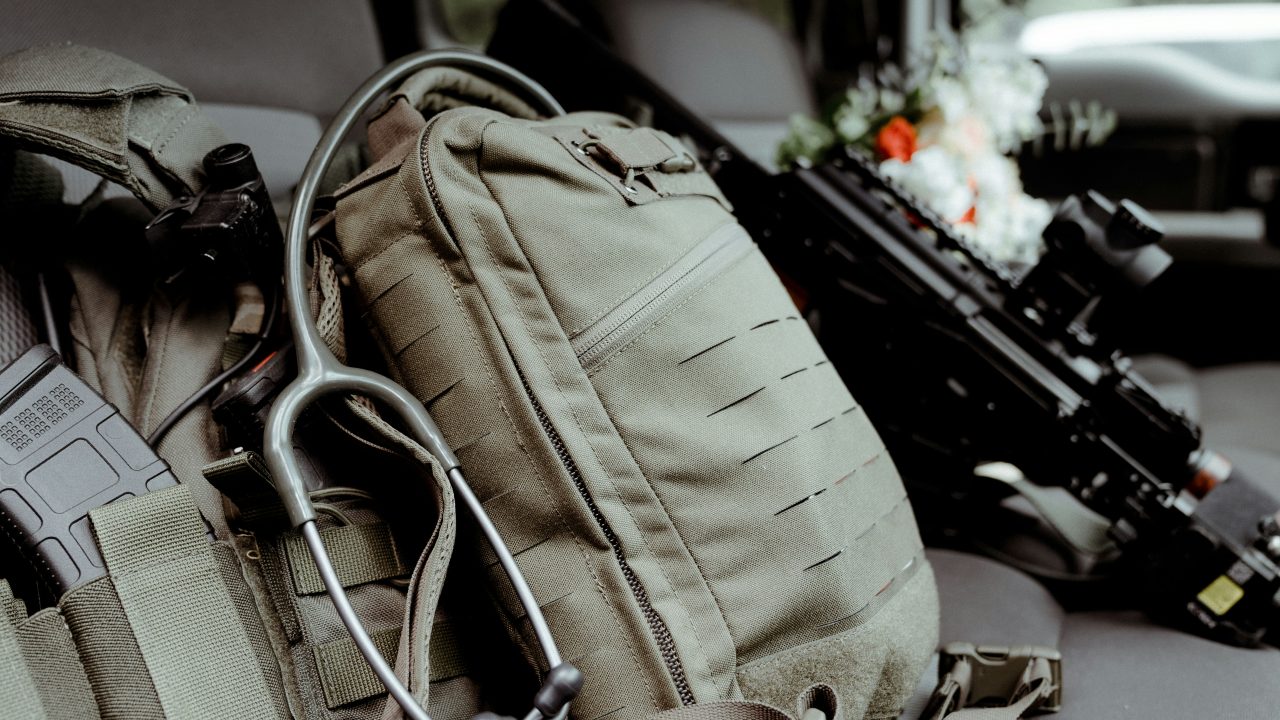
Photo by Frederick Shaw on Unsplash
Most people who have spent time in uniform understand something civilians often learn the hard way: the situation changes faster than the plan. It does not matter how good your brief was or how confident you felt going in. At some point the ground shifts, the timeline compresses, and the only thing standing between a bad outcome and a manageable one is the quality of your preparation and the discipline to execute under pressure.
That same dynamic is playing out in civilian life with increasing frequency. Grid failures, supply chain disruptions, financial system instability, cyberattacks on critical infrastructure, sudden medical emergencies, and localized natural disasters are no longer low-probability events that other people deal with. They are recurring features of modern life. Readiness in 2026 is not a survivalist fringe position. It is a practical response to an environment that has become genuinely less predictable.
Preparation Is Built Before It Is Needed
The most important thing the military gets right about readiness is timing. You do not build capability when the mission is already on. You build it in garrison, in the spaces between operations, when the pressure is manageable and mistakes are recoverable. The people who perform well under genuine stress are almost never the ones who prepared hardest in the final hours before contact. They are the ones whose preparation was already so deep that execution became automatic.
The civilian equivalent is identical in principle if different in form. Emergency savings built incrementally over months do not require a financial crisis to be useful – they restructure how you respond to one. A communication plan developed and rehearsed with your family before a power grid failure is worth more than any amount of gear purchased in the 24 hours before a storm. Backing up critical documents, establishing out-of-area contacts, understanding your neighborhood’s vulnerabilities – none of these feel urgent in ordinary time. All of them matter enormously when ordinary time ends.
Situational Awareness Is Not Paranoia
There is a version of preparedness culture that tips into obsessive threat-scanning, and it is not useful. Genuine situational awareness – the kind that actually improves outcomes – is something different. It is the practiced habit of paying attention to the relevant variables in your environment without letting that attention degrade into anxiety or noise-chasing. Veterans who have spent time in complex operating environments tend to develop this naturally. It is worth developing deliberately if you have not.
In practical terms this means understanding your local infrastructure dependencies: which power substations serve your area, where water pressure comes from, what your municipality’s emergency communication channels are and whether they actually work. It means having a clear-eyed assessment of your household’s actual vulnerabilities rather than a generalized sense that things could go wrong. It means knowing the difference between a credible threat indicator and social media amplification of a non-event. Those are different skills, and in a crisis environment the ability to make that distinction fast is worth considerably more than an extra week of food storage.
Digital Preparedness Is No Longer Optional
The infrastructure that runs modern life is almost entirely digital, and most people have built no resilience into that dependency whatsoever. A single compromised password can lock someone out of their financial accounts during exactly the moment they most need access. A lost phone with no offline backup of critical contacts eliminates communication options at the worst possible time. A device that has not been updated in eight months is running known exploits that adversarial actors are actively scanning for.
OPSEC – operational security – is not just a military concept. It applies directly to how civilians manage their digital footprint, their account security, and the information they make publicly available. Veterans transitioning out of service sometimes underestimate how much of their training in this area transfers directly to civilian life. The habit of asking what information you are exposing and who could use it against you is as relevant to your home network as it ever was to any operation you ran. Basic steps: two-factor authentication on all critical accounts, offline copies of essential documents, a password manager, and a clear answer to the question of what you would do if your primary device and your primary payment method became unavailable simultaneously.
Physical and Mental Readiness Remain the Foundation
No amount of gear or planning compensates for a body and mind that are not functional under stress. This is not a controversial position – it is what every serious readiness framework starts with, and it is consistently the most neglected element among people who approach preparedness as primarily a logistics problem. Physical conditioning, adequate sleep, stress management, and the kind of mental resilience that comes from regularly doing hard things in a controlled environment are not secondary concerns. They are the platform everything else runs on.
The military fitness culture that havokjournal.com’s readership knows well has a direct application here. The standard is not peak athletic performance. The standard is functional capability under degraded conditions – the ability to carry a load, move quickly when necessary, make clear decisions after poor sleep, and maintain emotional regulation when the situation is genuinely bad. People who maintain that standard in ordinary life are qualitatively different responders in extraordinary circumstances.
Information Discipline in a High-Noise Environment
One of the most significant threats to good decision-making in a crisis is not lack of information. It is the wrong information arriving faster than it can be verified. Social media during any significant event becomes a fire hose of rumor, speculation, emotional reaction, and deliberate disinformation within minutes of the first reports. The people who make the worst decisions in those moments are usually the ones who are most plugged in to the noise rather than the least.
Information discipline means establishing trusted sources before you need them – official emergency management channels, verified local news, direct communication with people who have ground truth – and having the self-control to weight those over viral content from accounts you cannot verify. This applies in emergency scenarios, but it also applies to the smaller decisions people make constantly in a digital environment. Whether someone is evaluating a financial product, assessing a political claim, or reviewing
Whether someone is evaluating a financial product, assessing a political claim, or checking free spins bonuses and what conditions actually attach to them before committing time or money – the same principle applies: verify the claim, understand the terms, and make the decision based on what is actually true rather than what the presentation is designed to make you feel. Information discipline is a single skill that scales from small daily decisions to genuine crisis response.
Community Is a Force Multiplier
Individual preparedness has hard limits. No single household, regardless of how well-provisioned, is fully self-sufficient through an extended disruption. The communities that recover fastest from significant events are consistently the ones with the strongest pre-existing social infrastructure – not necessarily the wealthiest or the best-equipped, but the ones where people know each other, trust each other, and have established patterns of mutual support before they were needed.
Building that infrastructure is unglamorous work. It means knowing your neighbors well enough to have a realistic picture of who is vulnerable and who has useful capabilities. It means establishing communication plans that do not depend entirely on cell network availability. It means being the kind of neighbor who shows up before being asked, because that reciprocity is what makes a community actually resilient rather than just geographically adjacent. Veterans who transition into civilian communities often have exactly the skills and the mindset to catalyze this. That is worth recognizing and acting on.
Systems Beat Improvisation Every Time
The through-line of everything above is the same principle that underlies good military planning: systems built in deliberate time outperform improvised responses to sudden pressure. This is not because systems are perfect. They are not. It is because systems reduce decision load when cognitive bandwidth is most constrained, maintain function when emotions are running high, and create options where improvisation creates chaos.
The goal is not to have a plan for every contingency. That is both impossible and counterproductive – over-planned people freeze when reality diverges from the scenario they prepared for. The goal is to have enough structure that the basics are handled automatically, which frees cognitive resources for the genuinely novel problems that every real crisis produces. Build the systems. Train the habits. Trust the foundation. That is how you stay ready in a world that changes overnight.
Buy Me A Coffee
The Havok Journal seeks to serve as a voice of the Veteran and First Responder communities through a focus on current affairs and articles of interest to the public in general, and the veteran community in particular. We strive to offer timely, current, and informative content, with the occasional piece focused on entertainment. We are continually expanding and striving to improve the readers’ experience.
© 2026 The Havok Journal
The Havok Journal welcomes re-posting of our original content as long as it is done in compliance with our Terms of Use.


