Here’s a quick question: What does Duolingo, a Domino’s Pizza Tracker, GitHub, and your Apple Watch all have in common? Well, on the surface, nothing. One teaches you how to say basic Spanish phrases so you can order tapas; one manages your code repository; and the other continuously reminds you to get up every hour.
Underneath though, they are all using the same psychological motor. Think about it. Duolingo has daily streaks, XP points, and push notifications from a green owl to make learning vocabulary drills a daily routine.
GitHub has a grid of little green squares that keep developers writing code each and every day to avoid having their streak broken.
Apple Watch converts each day’s movement into three color coded circles – Move, Exercise, Stand – which essentially ask you to complete them before midnight.
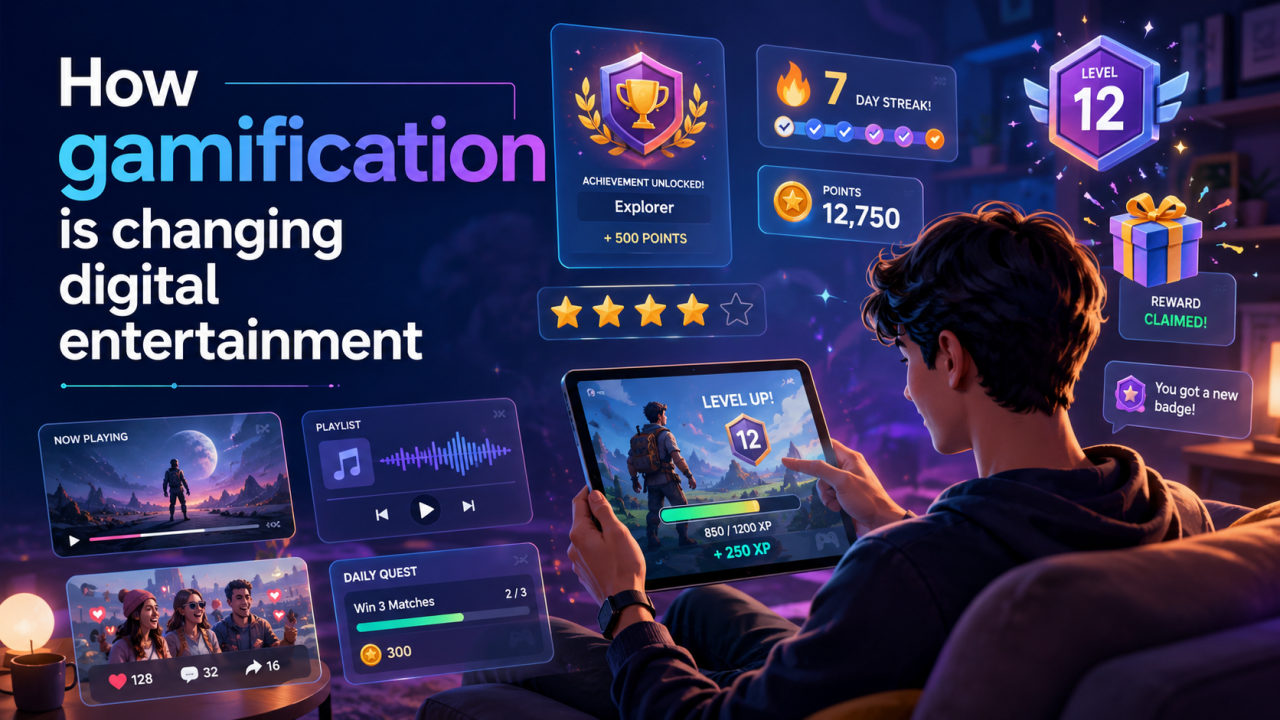
Gamification is where companies will use elements of games – such as getting points, earning badges, completing a daily streak, etc., and put them into ‘non-gaming’ items. So why would they do this? We know our brains are lazy, however our brains LOVE winning. Today we’ll look at some examples of businesses we appreciate for using this method creatively.
Facebook offers users top fan badges for comments.
When was the last time you spent several hours leaving comments on a public page simply to obtain a small, shiny badge next to your name? This may seem silly at first glance, but Facebook’s Top Fan badges unleashed a massive increase in overall page engagement immediately. By giving commenters a badge that visually showed off their level of activity within their own communities, Facebook took advantage of both social proof and status. Each member of Facebook was competing to maintain their ‘level’ within their own digital community. The cost for Facebook? Only a couple of lines of coding. The benefit? Unbelievable increases in user retention along with comment section participation.
If you contribute to a very large Facebook group, you’ll see that Facebook automatically assigns various titles based upon actions taken by group members. Some examples include: Conversation starter, Visual Storyteller. In doing this, Facebook triggers the natural desire to achieve, gain recognition from peers, and establish hierarchy among its users.
Spotify Wrapped creates a nice yearly feedback loop.
Each year during December people proudly post their top artists, total minutes listened to their favorite artists and even odd genres such as “Melancholy Indie Folk Pop.” This wasn’t an accident.
Spotify wrapped takes an otherwise passive listening experience and converts it into a unique story that the user cannot resist viewing, and subsequently sharing. It gamifies the user’s personality. The user is developing a “taste profile” that he/she will be judged against (and validated).
The other part to this is that Spotify wrapped also influences behavior. We begin thinking: “My Spotify wrap needs to look better this year,” which subtly causes us to search for more music, listen longer and remain loyal to the service.
Nike Run Club makes running more enjoyable by turning miles run into leveling up.
Running can be very hard, and it’s not a lot of fun for most people. Repetitive and demanding physically. Nike run club makes running feel like leveling up by adding tracking of your progress through milestones, badges etc. You don’t just go on a run. You get to unlock your fastest 5 k, earn badges for distance marks, and watch your personal bests over time.
Nike Run Club turns effort into progress. Pain is now measurable. Instead of just going out for a run, you are seeing progress that will keep motivating you. This loop of effort→reward→motivation→repeat. And once you start to see how much better you are doing, giving up will be like losing progress. Most people hate losing more than they love winning
Gamification is spreading to other “non-app” places too.
Productivity Tools (e.g., Notion) & Language Apps (beyond Duolingo) are introducing streaks, progress bars, Visual trackers, etc. for non-gaming purposes to add a sense of movement to regular activities.
Apps also are using “celebrations” such as “You’ve reached Inbox Zero!” for accomplishing something that was previously seen as mere organization.
One of the most interesting uses of gamification in non-traditional environments has been observed in casino style sweepstakes. Unlike traditional online gambling sites, sweepstakes casinos like Baba Casino rely heavily upon gamification features and layers. The main differences between sweepstakes casinos and traditional gaming websites lie within the types of mechanisms that encourage continued interaction from players. Sweepstakes casinos offer:
– Daily rewards
– Login streaks
– Bonus currency
– Timed challenges
– Virtual currencies
– Unlocking bigger rewards or entries
This creates an environment where users will be drawn into a cycle of activity in order to continue participating. Users may log-in each day to receive bonuses, complete smaller missions/spins, accumulate virtual currency, unlock larger rewards/entries, etc… It begins to resemble a progression-based model found in many mobile games.
Buy Me A Coffee
The Havok Journal seeks to serve as a voice of the Veteran and First Responder communities through a focus on current affairs and articles of interest to the public in general, and the veteran community in particular. We strive to offer timely, current, and informative content, with the occasional piece focused on entertainment. We are continually expanding and striving to improve the readers’ experience.
© 2026 The Havok Journal
The Havok Journal welcomes re-posting of our original content as long as it is done in compliance with our Terms of Use.


