
By Ryan Mimna
It was January 2022 in the middle of the pandemic. It was a dark period for me. I had graduated college in fall 2019 and was using my limited resources to try to find a job. I only had my pride as a buoy for hope, which naturally kept me from reaching out for help.
“A man stands on his own” is something a proud man tells himself, I suppose. I’ve found that a lot of these veteran nonprofits seem to be more about helping themselves than actual veterans. My lifeline came from getting a temp job as a medical case specialist at QTC.
I found myself in corporate America for the first time. I wouldn’t call it hell, but it was a soulless place, and that felt close enough.
What is a soulless place, you may ask?
Let’s see if we can find out together.
It was my first corporate temp job after a disastrous stint working in a cryogenic lab. But that’s another story for another time. QTC is a subsidiary of Leidos, a large defense contractor. My job was to schedule my fellow veterans for appointments related to their VA disability claims. Oh yes, my dear reader, I was in the belly of the beast, working for one of the corporations the VA outsources its disability compensation exams to. Soulless truly seemed like the right word as I dove into this cold-calling corporate hellscape I found myself entwined in.
It was a cold morning in January, the day I slunk into my suit for my first day on the job. I never wore a suit there again. I was living in South Philly at the time and took the Broad Street Line to City Hall. QTC’s office was in a brutalist building across the street from Love Park in Center City, Philadelphia. I was excited at the prospect of a new career, and one that served my fellow veterans. It felt like something I could really sink my teeth into. With passion and purpose, I stepped into the building.

If you’ve ever visited Philadelphia, you will see that the ideals our country was founded upon are in stark contrast to the reality of the city today. QTC proved no different for my own ideals. When I first met our “mentors” and had my initial interactions with them, you would wonder if they had ever met a veteran, let alone spoken to one, given how aloof and disconnected they were. At the time, I couldn’t help but notice it mirrored the general U.S. population’s aloofness toward the two wars our country had been embroiled in for the past two decades. But I digress. They huddled me and the rest of the temps into what they called QTC University. I was given a death-by-PowerPoint outline of the job with the enthusiasm of a DMV employee. My starry eyes slowly went dead as I realized the nature of the machine.
Let me give you some context for how this sausage gets made. There were several different teams in this cubicle farm, each handling various aspects of the disability claim process. My role in the machine was making the calls to veterans in order to schedule appointments. In fact, my livelihood depended on meeting a quota of scheduled appointments per day. So my job came down to cold-calling veterans, getting critical pieces of information such as their full Social Security number, date of birth, and other pertinent details, then asking if they could drive 300 miles on a Tuesday at 3 a.m. for the only available appointment for their disability claim, or else they were cooked. It essentially became like being a used-car salesman, because to be successful in that job, you had to get appointments by any means necessary. It did not matter whether it was in the veteran’s best interest. It was just whatever dubious doctors and medical centers they had, hopefully in a close geographic location. You get a cold call from some stranger asking for your Social Security number and then trying to work through medical offices to get an appointment scheduled. It all seemed like a rather dubious system.
To be fair, one thing that is important to me is approaching life with a sense of intellectual honesty. So I always try to be charitable and see why things may be the way they are. I imagine that if I were tasked with creating a system that could support veterans across the continental United States with close access to disability compensation exams, that would be no easy task, even with unlimited resources. And the fact that there are entities out there trying to accomplish that mission is noble in itself. It just wasn’t for me.
That being said, let me give you a taste of a day in the life of a medical case specialist at QTC. You had all kinds of veterans, from people who served 25 years to people who served 25 days and were claiming PTSD from basic training. You had Vietnam draftees applying for hearing disability claims, and even I apparently went through QTC for my hearing exam. I had no recollection of QTC itself, but I remembered going to a facility in Moorestown, New Jersey. It was about 10 miles from my house, so it was a speedy process. I suppose the system thrives best in densely populated areas like New Jersey. My point is, you had all kinds. But some of my fellow veterans’ claims seemed more spurious than others.
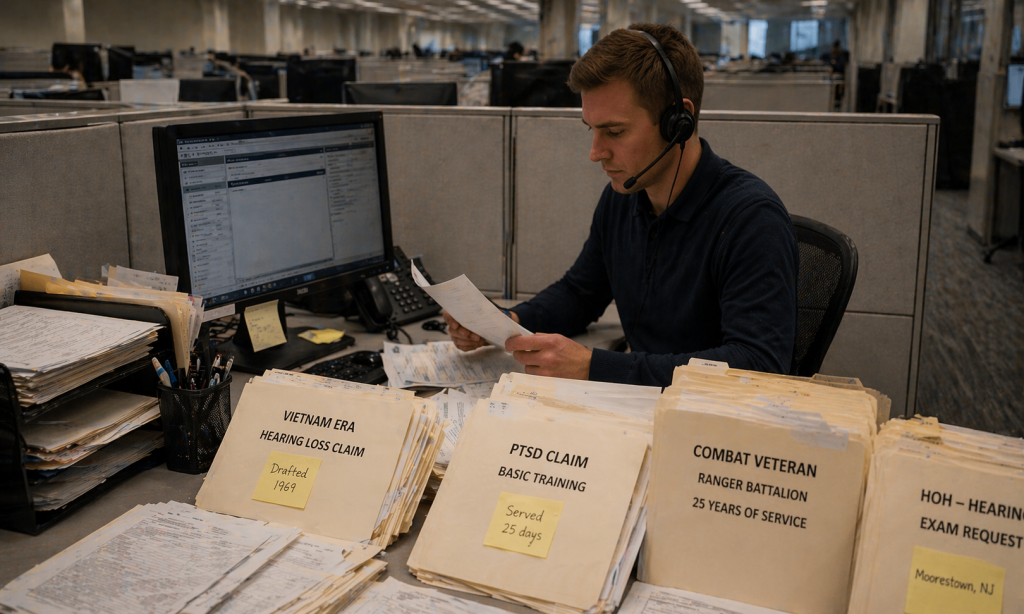
As someone who served in Ranger Batt., it brought me to the brink of my soul and professionalism to engage with a basic training dropout claimant putting in a PTSD claim. I saw such cases often enough that they still come to mind. But it was also a privilege to do my best to assist an old man who had been drafted into the Vietnam War as a young man. It wasn’t easy asking a 70-year-old man for his Social Security number, though. I feel like that is the exact thing I would warn my grandparents not to do over the phone.
The only saving grace was that the veteran would have had to put in a VA claim recently in order to get the call, so by riding with that truth, I could often get them to give it over the phone. Then you tell them the nearest hearing appointment is 200 miles away and have to sell a 72-year-old man on an eight-hour drive to get a hearing exam done. How the hell do you sell that? Quite often, these elderly veterans were putting in disability claims for cancer related to service, so now it becomes: 72 years old, dealing with cancer, and up for a 400-mile round trip for medical exams? That would be an arduous journey for a healthy 32-year-old man.
I remember one scenario where I had the only available appointment for a veteran who lived on an island in New England, and it was about 300 miles away. That gentleman just stayed on my list as I made calls week after week, seeing if he was interested in a 10-hour round trip to move his VA claim forward. He never was. I had a lot of veterans in New England on my list with similar scenarios.
Better yet, you would offer them multiple appointments, each hundreds of miles away from the others. It felt dehumanizing to tell them those terrible options were the only choices available, that they would have to do around 25 to 30 hours of driving for three to five medical appointments. It seemed like an absurd ask.
Another thing I could never adequately answer was this: “I have a VA hospital five miles away from my house. Why do I have to drive 150 miles to the nearest appointment?” I never had an adequate answer except to emphasize that I was a veteran as well and shared the same sentiment, but was beholden to policy. Corporate policy dictated by the VA. Rigid and inflexible. And so it was.
But why couldn’t a veteran elect to have a portion done at a VA hospital, even if the wait was longer? I ask because, living in Philadelphia, I would be damn irate if someone told me I had to drive 200 miles to Nowheresville, Pennsylvania, for part of my exam. I would ask whether there was any way the VA hospital could do it, or whether there was simply anything available.
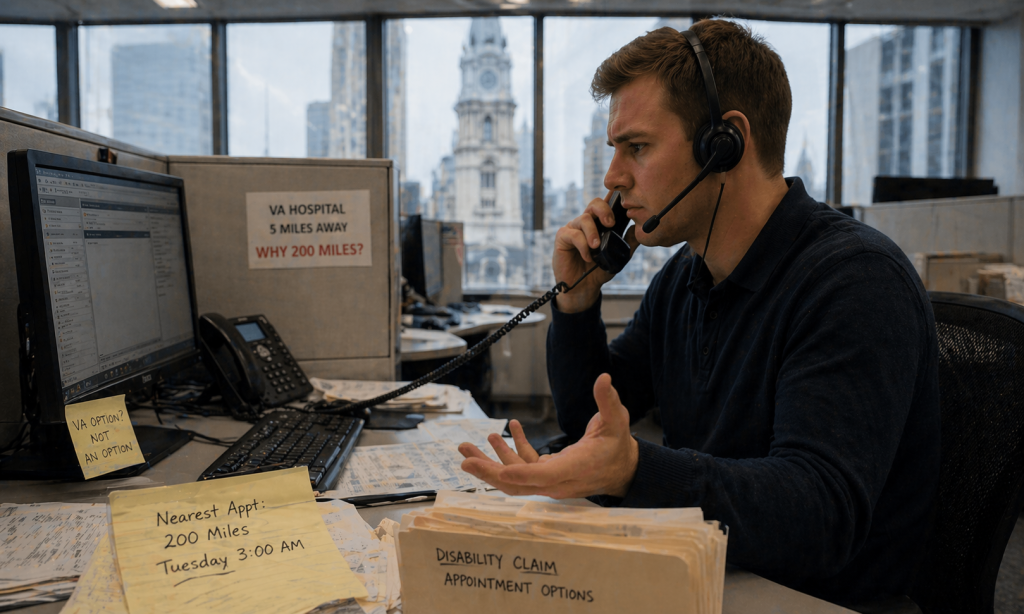
This reminds me of another ugly aspect of the job and possibly explains the middleman nature of it. There was a two-to-three-week window in which you had to schedule the appointments, so if there was a golden appointment a mile from someone’s house, they would never know because we were forbidden from offering it. And why would you? You had your 15-appointment metric to make. It was about getting bodies into exam rooms, no matter how far away. The logic, as I understood it, was that on a macro level, given the quantity of veterans applying for disability exams, the system simply could not accommodate these golden-hour appointments while also dealing with the volume of veterans who had put in claims. But it always sucked seeing an appointment that would have been perfect for a veteran, only for policy and red tape to forbid me from offering it. To that point, I would actually get reprimanded if I made appointments outside the scheduling window. I was powerless in that situation and just the monkey in the middle. The best I could do was try to make my metrics and do right by my fellow veterans, as policy allowed.
Fear makes a man desperate, and desperation makes a man fearful. Regardless, I believe it is important to do the right thing. So I really struggled with this job. As I said before, the quota was 15 appointments a day, and our receiving cases also depended on the other teams doing their jobs, so we got an adequate quantity of new veterans in order to make that quota. And the thing about veterans, and human beings in general, is that we are eclectic by nature. Eventually, I just ended up with a lot of veterans in remote regions who had no realistic positive outcomes, along with a drought of new promising cases. Honestly, looking back, it was really strange to think that hope in my life came from hoping to get a veteran for whom I could schedule the highest number of appointments. It reminds me of Albert Camus’ belief that life is inherently absurd because human beings crave meaning in a silent, indifferent universe.
So it was on a warm day in May, after struggling to constantly make quota, that I learned I had been let go. My supervisor didn’t even give me the dignity of telling me in person. I received a call from my recruiter, who delivered the fatal news. I was never given a reason why. I’ve always surmised it was because I struggled to make the daily appointment quota. The worst part was that, a few weeks earlier, I had been recognized by the Stasi that monitored our calls for my professionalism and exceptional call quality. I was even given a free cheesesteak. I thought I was a shining light in this desolate place, grating as the work was. The reality is, I was just a temp. The beautiful thing about hiring temps is that you can cast them away like a balloon in the wind. It wasn’t beautiful for me.
So what is a soulless place?
I can’t say I’m the one to define it, but I can certainly speak about it.

_____________________________
Ryan Mimna lives in Philadelphia and works in the finance industry. He served in the U.S. Army from 2011 to 2015 and, after completing the Ranger pipeline, served with 1st Battalion, 75th Ranger Regiment, including multiple tours in Afghanistan. After leaving the Army, he finished a bachelor’s degree in political science at the University of Pennsylvania, where he began writing and later turned toward poetry. For The Havok Journal, he writes reflective pieces and poetry, often centered on fear, meaning, and the inner life.
As the Voice of the Veteran Community, The Havok Journal seeks to publish a variety of perspectives on a number of sensitive subjects. Unless specifically noted otherwise, nothing we publish is an official point of view of The Havok Journal or any part of the U.S. government.
Buy Me A Coffee
The Havok Journal seeks to serve as a voice of the Veteran and First Responder communities through a focus on current affairs and articles of interest to the public in general, and the veteran community in particular. We strive to offer timely, current, and informative content, with the occasional piece focused on entertainment. We are continually expanding and striving to improve the readers’ experience.
© 2026 The Havok Journal
The Havok Journal welcomes re-posting of our original content as long as it is done in compliance with our Terms of Use.


