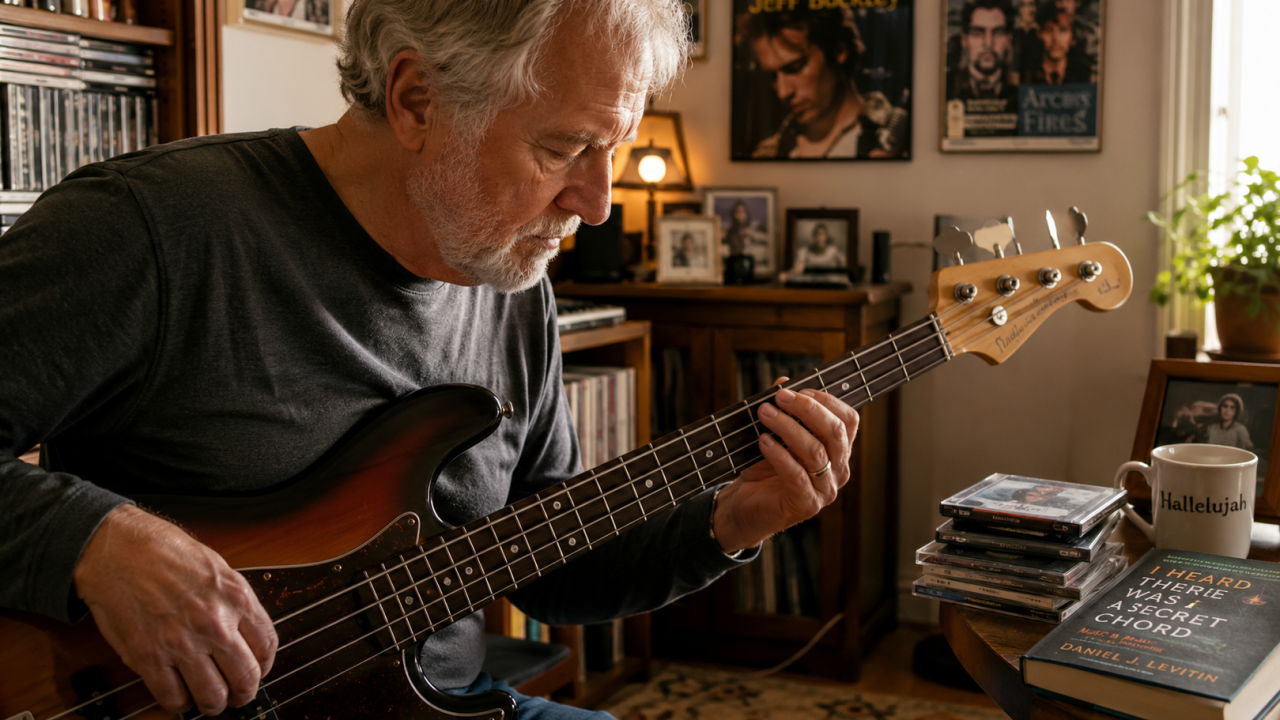
I like music, all sorts of music. I like listening to it, not so much just hearing it in the background, but listening to it attentively. I’m a Luddite when it comes to technology, so I still play CDs and occasionally vinyl records. I have a CD player that flips through up to six different discs randomly. Right now, I have the machine full of CDs. I have been listening to Jeff Buckley, Arcade Fire, The Breeders, some obscure Indian raga, an old mix CD of songs from the 2000s from my youngest son, and Death Cab for Cutie. I listen to classical music, gospel, soul, blues, rock, kirtan, klezmer, folk. The list is endless and the combinations of genres are too.
So, who cares? Well, I do. Maybe you might too.
I have been reading a book by Daniel J. Levitin. The book is called I Heard There Was a Secret Chord: Music as Medicine, by Daniel J. Levitin (W.W. Norton & Company). I bought the book partly because the title is also the first verse from the Leonard Cohen song, “Hallelujah.” The author is a musician/neuroscientist. The book is all about how music affects the brain. Levitin has an annoying habit of namedropping famous musicians that he knows, but overall, the book is fascinating. He’s done his homework, and the research is convincing, at least it is to me. He makes a strong case that music activates different parts of the brain in ways that no other human endeavor can. The upshot is that music helps the brain to function even when it’s been damaged by trauma, such as PTSD, or disease or age. Playing music causes a large number of areas of the brain to work together, and even just listening closely to music gets some of these regions to light up.
As a real-life example of what I mean, I have a friend whose father has Alzheimer’s disease. My mother had that too, and she died from it. My friend and his mother have started playing music for their sick family member. The musical selections are from CDs that my friend’s father enjoyed in the past. The music puts the man in a better mood and makes him more cooperative. Additionally, my friend and his mom often place a music keyboard in front of his dad. The father was an amateur pianist. Once the father notices the keyboard, he starts playing it. He improvises on the keyboard. Music is one of the few doors that are left open to his mind. Despite all of the damage wrought by the disease, music can still connect my friend’s father to the outside world.
As I mentioned, my mom died of Alzheimer’s. This weighs on my mind, especially since I am 68 years old, and my wife and I are raising our five-year-old grandson. I need to keep my mind sharp for at least another thirteen years. This is where music comes into play, literally.
Back when our youngest son was a teenager, he wanted to play guitar. We got him a guitar, and a friend of mine who plays the blues gave our son some guidance. I bought myself a bass guitar. I wanted to play with our son but not compete with him. We played music together. We learned the classics: “Smells Like Teen Spirit” and “Hey Joe.” My son made up his own melodies and gave me some lame bass parts to go with them. We jammed occasionally. I was never good with the bass. I didn’t put enough time and effort into it. My son got older and lost interest in playing his guitar. My bass found a home in the back of a closet.
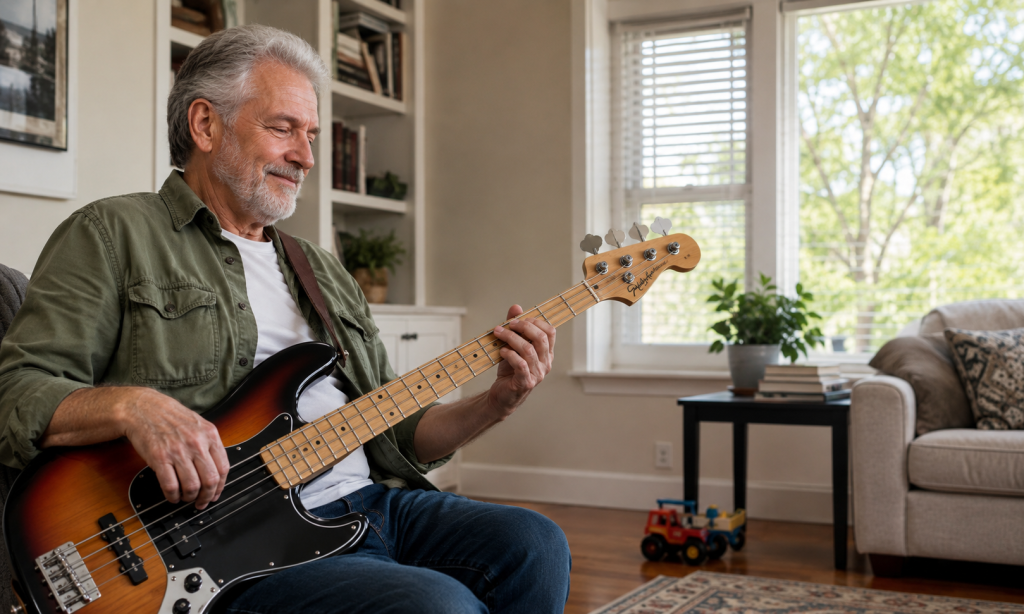
Now, after several years, I have retrieved the bass from the depths of the closet. I tuned it and I am trying to relearn what little I knew. I practice on the instrument sporadically. Our grandson demands my attention frequently and unexpectedly, so it is pointless to set aside any specific time period to play the guitar. I grab ten minutes a couple times a day. I am trying to become familiar again with “Day Tripper,” “Stand by Me,” and “Sunshine of Your Love.” It’s a struggle. My fingers are stiff and uncooperative. My brain is the same way. I am exercising long-dormant muscles, both physical and mental.
It’s still fun. As Levitin notes in his book, we play music. Yeah, it’s hard work at times, but it’s also enjoyable. I love to just pick at the strings and see what kind of patterns I can make. I fool around a lot and let my fingers wander. I am not very disciplined when I play, but then I don’t want to be. My mind can wander at times, and that’s OK.
I like music.
_____________________________
Frank Pauc is a former Army aviator, a longtime trucking-company supervisor, and a contributor to The Havok Journal. A West Point graduate from the Class of 1980, he completed the Military Intelligence Basic Course and flight school, served with the 3rd Armored Division in West Germany and the 7th Infantry Division at Fort Ord, and left the Army in 1986. He later taught citizenship classes through Voces de la Frontera in Milwaukee, took part in peace and protest work, and writes largely about veterans, family, grief, and the long aftermath of military service.
As the Voice of the Veteran Community, The Havok Journal seeks to publish a variety of perspectives on a number of sensitive subjects. Unless specifically noted otherwise, nothing we publish is an official point of view of The Havok Journal or any part of the U.S. government.
Buy Me A Coffee
The Havok Journal seeks to serve as a voice of the Veteran and First Responder communities through a focus on current affairs and articles of interest to the public in general, and the veteran community in particular. We strive to offer timely, current, and informative content, with the occasional piece focused on entertainment. We are continually expanding and striving to improve the readers’ experience.
© 2026 The Havok Journal
The Havok Journal welcomes re-posting of our original content as long as it is done in compliance with our Terms of Use.
