“Probably all of us have found ourselves in circumstances where our convictions demanded that we speak out for or against certain statements or policies, although we know that by doing so we may anger the group we are with. Such things happen in the councils of government, and they happen on high school sports teams. They happen when we confront racist remarks; they happen when we are with people who support positions we regard as immoral; they happen when our bosses tell us to do things that we believe are wrong.
And often, too often, we sigh and go along. Over the course of time, the small concessions we make to please our friends (at the price of our principles) develop into a routine, a pattern, a character. People who ‘habitually violate moral norms often reach the point of not knowing what is right, because they are likely to resort to rationalization and close their eyes to the truth in order to subdue their guilt feelings without reforming their lives,’ point out ethicists Grisez and Shaw.
–James H. Toner, Morals Under the Gun (2000), p.115
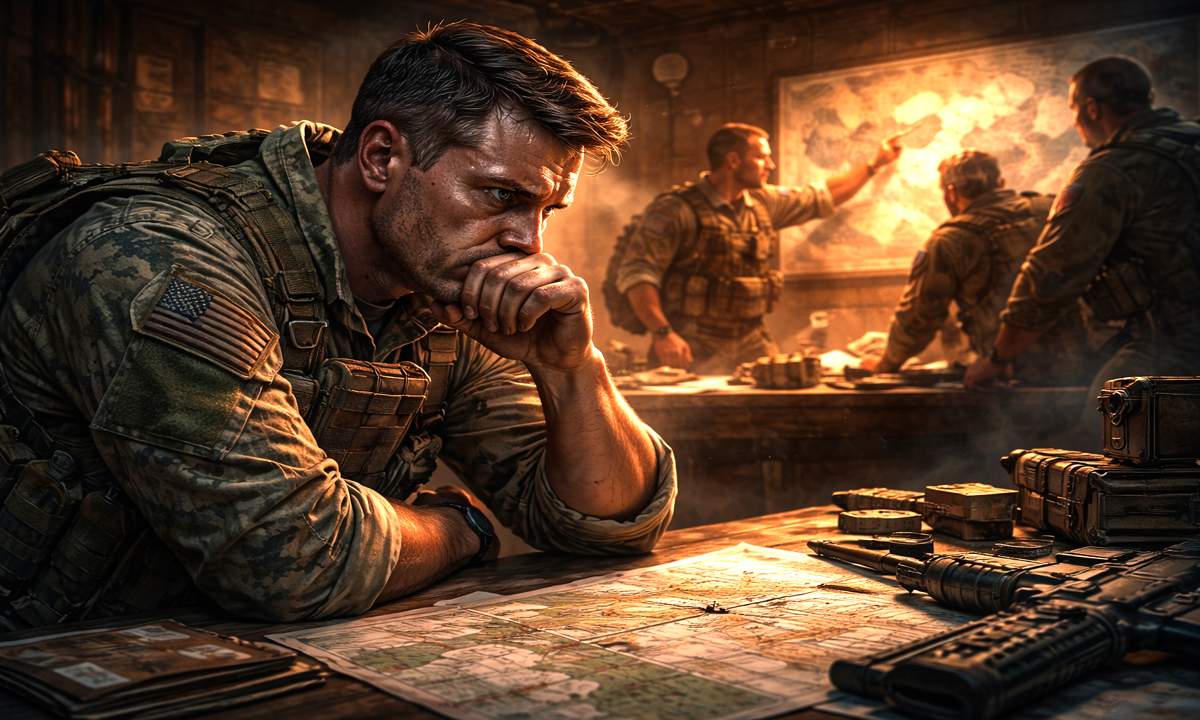
There’s a moment most people in uniform recognize, even if they don’t talk about it.It’s the moment when something feels off—and you know it.
Not tactically. Not procedurally.
Morally.
And in that moment, you’re not fighting the enemy.
You’re fighting yourself.
James H. Toner wrote that most of us will find ourselves in situations where our convictions demand we speak up—even when we know doing so will put us at odds with the group. Anyone who’s spent time in the military understands exactly what that means.
Because in our world, cohesion isn’t just encouraged—it’s survival.
You don’t want to be the guy who slows things down. You don’t want to be the one who questions the plan when everyone else is nodding. You don’t want to be the outsider in a culture that runs on trust, loyalty, and shared hardship.
So you stay quiet.
At first, it’s small.
A comment you let slide.
A shortcut you don’t challenge.
An order you execute, even though something about it doesn’t sit right.
You tell yourself it’s not your place. Or that someone else will speak up. Or that maybe you’re overthinking it.
And most of the time, nothing catastrophic happens.
Which is exactly how the problem starts.
Because the danger isn’t the single compromise—it’s the pattern that follows.
Toner points out that people who habitually violate moral norms don’t usually wake up one day and decide to abandon their principles. They get there gradually. They rationalize. They adjust. They convince themselves that what once felt wrong is now acceptable.
Not because the standard changed.
But because they did.
In the military, we like to believe we’re insulated from that kind of moral drift. We have values drilled into us from day one—honor, integrity, accountability. They’re not just words; they’re supposed to be guardrails.
But values don’t enforce themselves.
People do.
And people are fallible—especially under pressure.
Because “under the gun” doesn’t just mean incoming rounds. It means time constraints. It means chain of command. It means peer pressure. It means the unspoken understanding that rocking the boat has consequences.
Careers stall. Reputations shift. Trust erodes.
So the calculation becomes less about right and wrong, and more about risk and reward.
That’s where things get dangerous.
Because once you start weighing your principles against your comfort—or your career—you’ve already started down the slope.
The truth is, most ethical failures in the military don’t come from ignorance. They come from silence.
From the lieutenant who didn’t push back.
From the NCO who knew better but chose not to say anything.
From the team member who saw the line being crossed and decided it wasn’t his problem.
Not because they were bad people.
But because they were human.
And being human means we’re wired to belong. To conform. To avoid conflict within our tribe.
That’s why moral courage is harder than physical courage.
Running toward gunfire is immediate, instinctive, and visible. Speaking up against your own people—especially when the stakes are ambiguous—is slow, deliberate, and often invisible.
There’s no applause for it. No medal. Sometimes not even acknowledgment.
Just tension in the room.
But that tension is the point.
Because integrity isn’t tested when it’s easy. It’s tested when it costs you something.
The military doesn’t need more people who can recite values.
It needs more people who will live them when it’s inconvenient.
That doesn’t mean turning every disagreement into a moral crusade. Judgment matters. Context matters. Not every bad idea is an ethical violation.
But when you know—when it’s clear, not just uncomfortable—you don’t get to hide behind ambiguity.
You don’t get to outsource your conscience to the group.
At the end of the day, the uniform doesn’t carry your moral responsibility.
You do.
And the cumulative effect of those small decisions—the ones no one writes reports about, the ones that don’t make headlines—those are the ones that define who you become.
Because character isn’t built in the big moments.
It’s revealed there.
It’s built in the quiet ones.
The ones where no one is watching.
The ones where you’re under the gun—not from the enemy, but from the people standing next to you.
And you have to decide which matters more:
Belonging…
or being right.
_____________________________
Charles is the owner of The Havok Journal. He served more than 27 years in the U.S. Army, including seven combat tours in Iraq and Afghanistan with various Special Operations Forces units, two assignments as an instructor at the United States Military Academy at West Point, and operational tours in Egypt, the Philippines, and the Republic of Korea. He holds a doctorate in business administration from Temple University and a master’s degree in international relations from Yale University. For The Havok Journal, he writes largely on leadership, military and veteran issues, and current affairs.
As the Voice of the Veteran Community, The Havok Journal seeks to publish a variety of perspectives on a number of sensitive subjects. Unless specifically noted otherwise, nothing we publish is an official point of view of The Havok Journal or any part of the U.S. government.
Buy Me A Coffee
The Havok Journal seeks to serve as a voice of the Veteran and First Responder communities through a focus on current affairs and articles of interest to the public in general, and the veteran community in particular. We strive to offer timely, current, and informative content, with the occasional piece focused on entertainment. We are continually expanding and striving to improve the readers’ experience.
© 2026 The Havok Journal
The Havok Journal welcomes re-posting of our original content as long as it is done in compliance with our Terms of Use.


