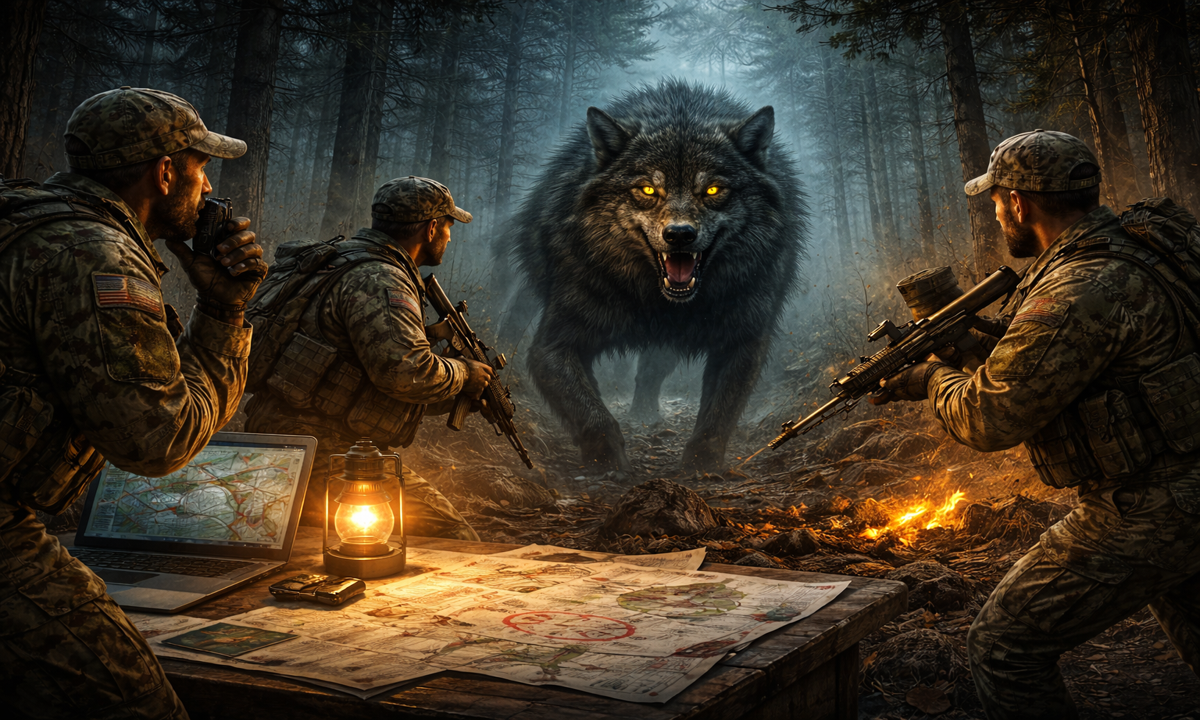
Lupus in fabula—“the wolf in the story.” High school Latin was a long time ago, and Westover Senior High seems like it is a world away. When I heard the phrase earlier this week, I had to look it up.
Roughly translated, it means that you’re talking about someone, and suddenly they appear. We’ve adapted the phrase over time. Today it’s “speak of the devil.” It’s almost a joke now—something you say when coincidence lines up just right.
But the original meaning carried more weight.
Because when the wolf shows up, it’s not a punchline.
It’s a problem.
The Wolf Was Never Really Gone
In the ancient world, wolves weren’t metaphors. They were real. They killed livestock. They threatened villages. When people spoke about them, it wasn’t abstract—it was survival.
So when the wolf appeared, it wasn’t ironic.
It was confirmation.
The danger you were just talking about? It’s here.
We’ve lost that edge. We treat the phrase like superstition or coincidence, but the underlying truth hasn’t changed.
The threats we talk about have a habit of showing up.
Sometimes because we didn’t take them seriously enough.
Talking vs. Preparing
There’s a difference between acknowledging a problem and preparing for it.
Most organizations are very good at the first.
They hold meetings. They write reports. They identify risks in neat bullet points. They brief leadership on what could happen.
But when the wolf actually shows up, you find out what was real and what was theater.
Because preparation doesn’t happen in PowerPoint.
It happens in:
- Training that reflects reality, not convenience
- Plans that survive first contact, not just approval
- Leaders willing to act before consensus forms
Everything else is just conversation.
The Comfort of Distance
It’s easy to talk about problems when they’re hypothetical.
Cyber threats. Strategic competitors. Institutional failure. Cultural decay. Pick your poison.
As long as the wolf stays in the story, you can analyze it. Debate it. Turn it into something manageable.
Distance creates comfort.
But comfort creates delay.
And delay creates vulnerability.
Because the moment the threat becomes real—when it moves from theory to presence—most organizations are already behind.
Lupus In Veritas: When the Wolf Walks In
You can tell a lot about a system by how it reacts when the wolf shows up, when things go from lupus in fabula, “the wolf in the story,” to lupus in veritas, “the wolf in reality.”
Some freeze.
They fall back on outdated procedures, hoping the old answers still apply. They wait for guidance, for permission, for someone else to take responsibility.
Others deny it.
They minimize the threat. Reframe it. Convince themselves it’s not as bad as it looks. Because admitting the wolf is real means admitting they weren’t ready.
And then there are the few who act.
Not perfectly. Not without friction. But decisively.
They recognize the moment for what it is: the point where theory ends and consequences begin.
The Pattern We Keep Repeating
Here’s the uncomfortable part: we’ve seen this before.
Over and over again.
Warnings dismissed until they’re undeniable. Risks acknowledged but not addressed. Signals ignored until they become crises.
Not because the information wasn’t there.
Because acting on it was inconvenient.
It required change. Resources. Accountability.
And those are always harder to commit to than another meeting.
The Military Lesson
In military terms, lupus in fabula is the moment when the briefing becomes reality.
You’ve war-gamed the scenario. You’ve talked through contingencies. You’ve identified the threat.
And then it happens.
That’s when you find out whether your preparation was real—or just rehearsed.
Units that train honestly, that stress their systems, that confront uncomfortable truths—they adapt faster.
Units that train to look good on paper? They struggle.
Because the wolf doesn’t care about your slides.
Final Thought
“Speak of the devil” sounds harmless.
Lupus in fabula doesn’t.
It reminds you that the things you talk about have a way of becoming real. That threats don’t stay theoretical forever. And that when they show up, you don’t rise to the level of your intentions—you fall to the level of your preparation.
The wolf is never just part of the story.
It’s what happens next.
Charles served over 27 years in the US Army, which included seven combat tours in Iraq and Afghanistan with various Special Operations Forces units and two stints as an instructor at the United States Military Academy at West Point. He also completed operational tours in Egypt, the Philippines, and the Republic of Korea and earned a Doctor of Business Administration from Temple University as well as a Master of Arts in International Relations from Yale University. He is the owner of The Havok Journal, and the views expressed herein are his own and do not reflect those of the US Government or any other person or entity.
Buy Me A Coffee
The Havok Journal seeks to serve as a voice of the Veteran and First Responder communities through a focus on current affairs and articles of interest to the public in general, and the veteran community in particular. We strive to offer timely, current, and informative content, with the occasional piece focused on entertainment. We are continually expanding and striving to improve the readers’ experience.
© 2026 The Havok Journal
The Havok Journal welcomes re-posting of our original content as long as it is done in compliance with our Terms of Use.


