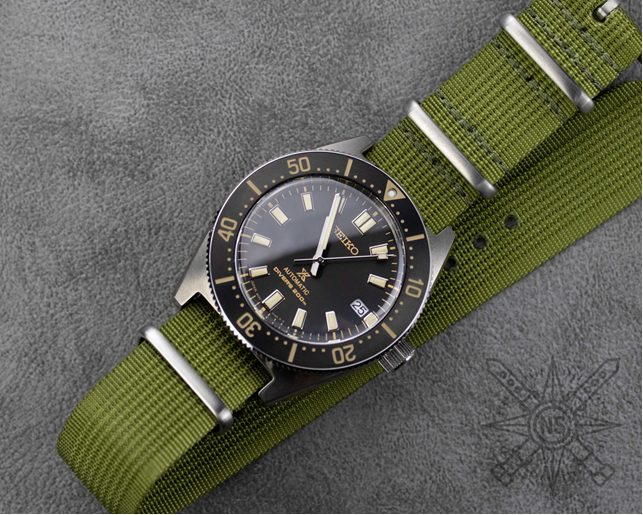
There is a category of gear that earns its place not by being impressive but by being reliable. The kind of equipment that nobody notices when it works and everybody notices when it fails. The military watch strap is exactly this kind of gear — and the specific engineering decision that defines the best of them is one that most civilians have never heard of, even though it has been standard issue for over fifty years.
The Problem the Strap Was Designed to Solve
On 30 November 1973, the British Ministry of Defence published Defence Standard 66-15 — a technical specification for the watch strap to be issued to Her Majesty’s Armed Forces. The document ran to several pages of precise measurements, material specifications, and construction requirements. It was written in response to a specific operational problem: standard two-piece watch straps were failing in the field.
The failure mode was simple. A watch strap has two spring bars — the small pins that attach the strap ends to the watch case. When a spring bar fails, as they do under sustained physical stress, the watch falls from the wrist. In a training environment, that means a broken watch. In an operational environment, that means a lost piece of equipment at the worst possible moment.
The MOD specification solved this with a construction that is elegant in its simplicity. Instead of two separate strap pieces, each attached by a spring bar, the MOD specification calls for a single continuous length of nylon that passes over both spring bars and loops behind the watch case. The result: if one spring bar fails, the strap still holds. The watch stays on the wrist. The design has not changed in fifty years because it does not need to.
The Strap That Went Everywhere First
Before the MOD specification formalised the single-pass design for all British Armed Forces, the Royal Air Force had already been issuing a version of it since 1954. The RAF specification — the 6B/2617 — predated the MOD standard by nineteen years. It was the strap worn by RAF pilots and aircrew through the Cold War era, identifiable by its fabric keeper loop rather than the metal hardware of later military straps.
The RAF strap’s longevity speaks for itself. A design that predates the MOD specification by two decades and is still being manufactured today has earned its place through performance rather than marketing.
What Separates the Real Thing from the Copy
The single-pass construction is widely copied. What is less widely replicated is the hardware quality that makes the difference between a strap that holds and a strap that merely looks like it holds.
The specific failure point that most copied straps miss is the buckle. A standard buckle has a spring bar running through its frame — the same type of spring bar that the single-pass construction was designed to protect against at the lug ends. A genuine operational single-pass strap should address this failure point too, which means using a solid buckle machined from a single piece of steel with no spring bar in the frame.
CNS Watch Bands — a Swedish manufacturer that has built their entire nylon range around the original MOD specification — produces exactly this construction. Their solid buckle eliminates the third failure point that most single-pass strap manufacturers leave in place. For a watch worn in demanding conditions, that is not a detail. It is the point.
Why It Still Matters
The veterans and service members reading this understand the logic immediately. Equipment that fails at the wrong moment is not equipment — it is a liability. The watch strap that stays on the wrist when the spring bar goes is the strap worth carrying.
The MOD specification was written by people who understood this. The single-pass construction, the solid buckle, the correct specification of nylon — these were engineering decisions made by people who needed the gear to work, not to look good in product photography. Fifty years later, that logic still holds.
Buy Me A Coffee
The Havok Journal seeks to serve as a voice of the Veteran and First Responder communities through a focus on current affairs and articles of interest to the public in general, and the veteran community in particular. We strive to offer timely, current, and informative content, with the occasional piece focused on entertainment. We are continually expanding and striving to improve the readers’ experience.
© 2026 The Havok Journal
The Havok Journal welcomes re-posting of our original content as long as it is done in compliance with our Terms of Use.


