
Source: Pexels
“Aging in place” is an idea that more and more people are thinking about, although previously it hardly occurred to anyone when they were young. Basically, it’s about where and how you want to live when you get old—not in some ideal version of life, but realistically, everyday, with all your habits, things and people you know.
It is interesting that more and more people today do not see aging as a moment when “you have to go somewhere,” but as a phase of life that you can organize according to your own rules. This is where the concept of “aging in place” comes in.
Why Are People Choosing This Option?
It used to be almost a given that older people would sooner or later end up in some kind of collective accommodation. Today, that is changing.
One reason is very practical—costs. Nursing homes are not cheap and can be a serious financial burden in the long run.
The second reason is much more personal. People want freedom. They want to eat when they want, get up when they want, watch their TV, sit on their couch. These are small things, but they make a huge difference in your daily sense of satisfaction.
Home As Part of Identity
There’s something special about staying in a space you’ve spent years building. Everything has a story, every room a memory.
When you move to a completely new environment, you’re not just changing your address—you’re changing your lifestyle. For many people, it can be stressful and even depressing.
“Aging in place” allows you to maintain continuity. There are no sudden cuts; there is no feeling that you are “transferred” somewhere.
Technology Has Changed the Rules
20 or 30 years ago, this idea was much more difficult to implement. Today, the situation is completely different.
Smartphones, apps and various devices allow people to stay safe and connected even when they live alone. For example, there are systems that can detect a fall, remind you of your medication, or automatically notify someone if something is wrong.
If you look at how smartphones are used today, it’s clear that they’re no longer just for calls and messages—they’ve become a tool that collects and analyzes data about our behavior, health, and habits. Thanks to this, it is possible to monitor things like movements, activity levels, or even potential health risks, which makes it even easier for people to stay safe and independent in their homes.
How to Adapt a Home Without Major Complications
The good thing is that you don’t have to make huge changes to make your home safer and more functional.
Sometimes, little things are enough:
- Better lighting in key parts of the apartment
- Removing things you can trip over
- Handrails in the bathroom
- More practical arrangement of furniture
All of this can significantly reduce the risk of injury and make everyday life easier.
Financial Angle
People often think that customizing a home is expensive. And it can be—but when compared to the long-term costs of institutional care, it often works out much more favorably.
In addition, you are investing in something that directly affects the quality of your life. It’s not the same when you choose how to spend your days and when you have to fit into someone else’s schedule.
You Are Not Alone
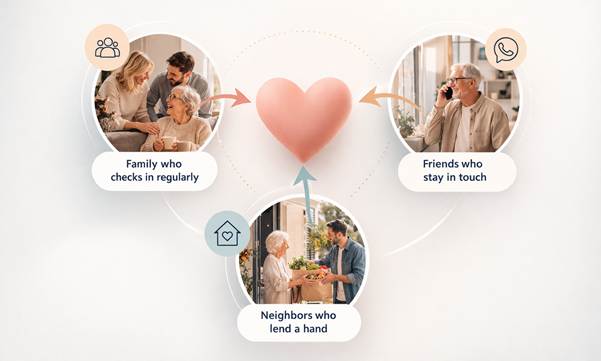
One of the common misconceptions is that “aging in place” means isolation. In fact, the support of the environment is crucial.
It doesn’t have to be anything complicated:
- A family that visits occasionally
- Friends who answer by phone
- A neighbor who can help with small things
Sometimes it’s those little interactions that make the biggest difference.
Real Challenges
It’s important to be honest—this approach is not without flaws.
There are situations when health requires constant supervision or assistance that is difficult to organize at home.
For example, chronic diseases or sudden changes in health conditions may require the presence of professional staff, which is not always easy to provide at home. Also, loneliness can be a problem, especially if the person lives alone and does not have regular contact with family or friends.
What used to be routine—cleaning, cooking, going shopping—can become a challenge, especially if there is no help from the side. This is where the question of safety comes in, because even small things like a slippery floor or poor lighting can pose a risk.
That’s why “aging in place” requires planning and a realistic assessment of the situation, as well as the willingness to seek help or make additional adjustments at certain times.
Planning Today Means a Lot Later
The biggest mistake is waiting for problems to start and only then thinking about solutions.
It’s much smarter:
- Think about the needs in advance
- Introduce changes gradually
- Talk to the family
- Make a financial plan
That way, everything seems more natural and less stressful.
Conclusion
“Aging in place” is a way to maintain dignity and control over your own life as time goes on.
It does not mean that you ignore the reality of aging, but that you approach it smartly. Yes you have an environment where you can function and not depend on the system more than you have to.
At the end of the day, we all want the same thing: to live our lives as long as possible in a way that pleases us. And sometimes the best decision is the simplest one—to stay where you already feel at home.
Buy Me A Coffee
The Havok Journal seeks to serve as a voice of the Veteran and First Responder communities through a focus on current affairs and articles of interest to the public in general, and the veteran community in particular. We strive to offer timely, current, and informative content, with the occasional piece focused on entertainment. We are continually expanding and striving to improve the readers’ experience.
© 2026 The Havok Journal
The Havok Journal welcomes re-posting of our original content as long as it is done in compliance with our Terms of Use.


