
The Backlash
The backlash against AI-generated art has become one of the most emotional labor fights of the digital age. Illustrators rage online. Designers denounce “prompt jockeys.” Art communities ban AI images on sight. Open letters fly. Lawsuits multiply. Social media fills with declarations that AI art is theft, fraud, cultural vandalism, or the creative equivalent of serving gas-station sushi at a Michelin restaurant. And to be fair, some of those complaints are legitimate. But outrage is not analysis, and anger is not a recovery plan.
And then we see the social media comment: “100% AI Slop!”
What we are watching is not just a moral argument about art. It is a collision between identity, economics, technology, and status. Many artists are not merely reacting to a new tool. They are reacting to the sudden realization that a category of work they assumed required years of cultivated skill can now, at least in part, be approximated by software in seconds. That is not a small thing. If your profession has long depended on being one of the few people who could turn an idea into a polished visual, AI feels less like innovation and more like a battering ram aimed at your rent.
Why the Reaction Is So Strong
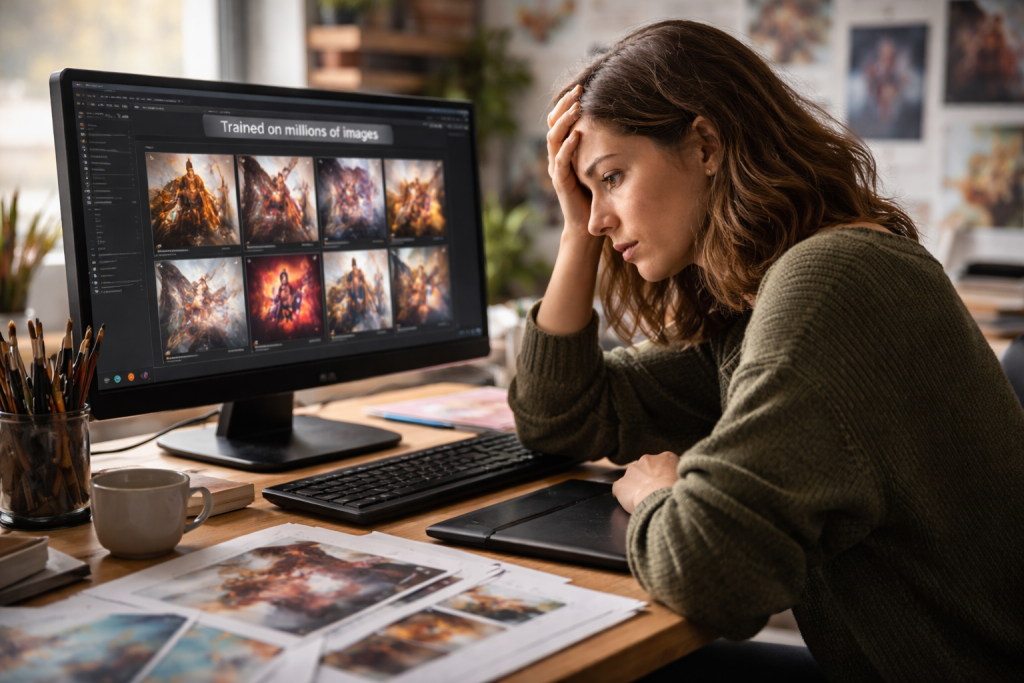
There are several reasons artists react so viscerally to AI, and the first is the most obvious: training data. A large share of the hostility comes from the belief that generative models were built by ingesting enormous quantities of human-created work without consent, licensing, or compensation. The U.S. Copyright Office has spent the last two years examining precisely these issues, and its ongoing AI reports make clear that copyright and training practices are central legal and policy disputes, not fringe complaints cooked up by bitter illustrators on Reddit. The public backlash over Christie’s 2025 AI art auction, which drew thousands of protesting artists, reflected exactly that concern. Artists do not just believe AI competes with them; many believe it was built from them.
Second, artists object to what they see as devaluation of craft. Professional visual artists surveyed in a 2026 CHI paper reported overwhelming opposition to generative AI, with the study finding that most respondents were strongly opposed, reported added stress, and saw reduced job opportunities. The paper also found that 85% said they never use generative AI in their work, while 99% disliked it and 92% strongly disliked it. That is not mild skepticism. That is a profession looking at a machine and seeing a pink slip wearing a gallery pass.
Third, many artists see AI not as a neutral tool but as a market weapon. In commercial art, clients rarely pay for “the soul of the creator.” They pay for usable deliverables, on deadline, at a price they can stomach. That is where the panic becomes rational. A 2025 marketing study found that AI-generated visual marketing images could surpass human-made images on several judged dimensions and could be produced faster and at dramatically lower cost. In other words, the machine does not have to be spiritually profound. It just has to be good enough for the ad campaign, the Etsy listing, the website banner, the social media post, or the PowerPoint deck that some vice president needs by 3 p.m.

The Reality of Commercial Art
That commercial reality matters, because most graphic design is not the Sistine Chapel. It is packaging, promos, thumbnails, hero images, brochures, signage, sales sheets, pitch decks, and digital assets whose mission is to convert attention into money. Businesses do not buy graphic design because they enjoy subsidizing the personal growth of artists. They buy it because they need visuals that help sell something, explain something, or legitimize something. If software now does enough of that work for a fraction of the price, many firms will use it. Not because they hate artists. Because they enjoy remaining solvent.
Economics No One Wants to Admit
That is the part many artists do not want to hear. A great deal of the anti-AI outrage is morally framed but economically rooted. It is easier to say “this tool is unethical” than “this tool exposes how little margin existed in my market value once speed and cost entered the equation.” Those two claims are not mutually exclusive, but they are very different claims. One is about justice. The other is about competition. Much of the current debate deliberately blurs them.
History Says Otherwise
And here is where history becomes uncomfortably relevant.
Entire professions have been gutted by technology before, and moral protest did not save them. Telephone switchboard operators were once a massive occupation. Automation wiped out most of those jobs. An NBER study on mechanized telephone switching found a large, swift, and permanent decline in operator employment. It also found that incumbent workers were more likely later to be in lower-paying jobs or no longer working. The market did not pause because the displacement felt unfair. It simply moved on.
The printing world offers another example. Employment in printing and related support activities has been in long decline as digital technologies changed both demand and productivity. An Oregon labor market analysis published in 2024 reported that employment in that industry had dropped about 57% since 2001 and explained the fall through both reduced demand for printed materials and technology-driven productivity gains that required fewer workers. Nationally, the same analysis cited an 18% drop in employment in printing and related support activities between 2013 and 2023, with further decline projected. Again, workers did not lack opinions. What they lacked was veto power over economics.
Newspaper publishing tells the same story in even harsher numbers. BLS reported that from January 2001 to September 2016, newspaper publishers lost over half their employment, falling from 412,000 to 174,000 jobs, while internet publishing and web search portals grew sharply over the same period. Newsrooms complained. Printers complained. Readers complained. The internet did not care. Technology often behaves like that obnoxious lieutenant who smiles while telling you the old way is “no longer mission essential.”

This Didn’t Start With AI
Graphic design has not been exempt from this pattern. Long before Midjourney and DALL-E showed up to ruin somebody’s portfolio review, the field was already being democratized and compressed by desktop publishing, off-the-shelf software, templates, stock libraries, and office tools. Britannica notes that desktop publishing software combined word processing and graphics capabilities that once required more specialized workflows, and ScienceDirect notes that DTP reduced typesetting time and costs by eliminating manual steps. Microsoft Office, PowerPoint, Canva, and countless drag-and-drop tools did not replace all designers, but they absolutely eroded the lower and middle tiers of routine layout work. They handed non-designers enough power to produce “good enough” visuals without hiring a professional every time.
That is why any claim that graphic design suddenly became precarious only when AI art appeared is historically weak. The erosion started decades ago. The release of Photoshop in 1990 did not destroy design; it changed who could do parts of it and how fast. PowerPoint did not kill presentation designers, but it sure did create a world where legions of office workers could make ugly slides all by themselves, which for many employers was apparently close enough to excellence. AI is not the opening act. It is the latest accelerant poured on a fire that has been burning since desktop publishing escaped the print shop and landed on every office computer in America.
Where the Market Is Headed
Labor-market data points in the same direction. The Bureau of Labor Statistics says employment of graphic designers is projected to grow just 2% from 2024 to 2034, slower than the average for all occupations, and explicitly notes that automated design tools such as AI may reduce the need for companies to contract with freelance graphic designers. The World Economic Forum’s 2025 Future of Jobs reporting goes further, saying graphic designers are now among the declining roles as generative AI reshapes the labor market, a notable shift from its 2023 edition, when graphic designers had been seen as a moderately growing occupation. That does not mean every designer is doomed. It means the profession is moving from protected specialization toward brutal competition.
The Small Business Reality
The economics for small business owners make the issue even less abstract. Many critics of AI talk as if choosing AI over a human artist is simply greed. Sometimes it is. Often it is arithmetic. If you run a small online business with low-margin products, custom illustrations and commercial graphics can easily cost more than the profit generated by the products themselves. That is not a theoretical talking point. It is the financial reality of thousands of tiny businesses trying to survive in a market dominated by cheap overseas production, platform fees, ad costs, shipping, and razor-thin margins. Telling those owners they have a moral obligation to pay rates that would wipe out their profits is not a serious economic plan. It is just outsourcing your conscience to someone else’s checking account.

Not Every Customer Was Yours
That does not mean artists are wrong to ask for fair compensation, licensing, or transparency. It means they are often arguing against the purchasing power of customers who do not have the money. If a business can get an acceptable product image, banner, mockup, or concept piece from AI in ten minutes instead of paying hundreds of dollars it does not have, the lecture about “supporting human creators” tends to land with all the force of a scented candle in a hurricane. Some buyers simply never were viable customers for custom art in the first place. AI did not steal those commissions from elite illustrators. In many cases, it created visuals for people who otherwise would have used clip art, made do without, or produced something ugly in PowerPoint and called it branding.
The Middle Gets Crushed
There is also a class divide inside the art world that rarely gets acknowledged. Established artists with a strong reputation, loyal clientele, distinct style, or fine-art positioning are not facing the same threat as the commodity end of the market. AI hits hardest where buyers care more about speed, volume, and cost than about authorship. Routine commercial work, stock-like visuals, background assets, pitch-deck art, concept ideation, and endless social-media graphics are all vulnerable. Unique fine art, high-trust branding work, live event art, luxury illustration, and artists whose value is tied to personal identity, story, or collector status have more insulation. The machine is best at flattening the middle, not replacing every summit.
Adapt or Exit
That distinction matters because it points toward the future. Many current graphic artists will adapt. Some will move upmarket into fine art or premium custom work. Some will shift sideways into creative direction, brand strategy, UI/UX, art supervision, editing, or hybrid AI-assisted production. Some will use AI themselves and become vastly more productive. Others will leave the field. That is not cruelty; it is what technological disruption looks like when it arrives in a profession that confused software fluency with permanent scarcity. The World Economic Forum’s parallel finding that UI and UX roles are growing while traditional graphic design faces pressure suggests the design economy is not vanishing so much as changing shape.
And yes, some artists will become obsolete.

The Hard Truth
That sentence sounds brutal only because modern professional culture has trained people to believe obsolescence is a moral crime instead of a recurring feature of economic history. We say “adapt” to machinists, printers, travel agents, typists, and switchboard operators without a second thought. But say it to graphic artists and suddenly we are expected to pretend this disruption is uniquely illegitimate because it affects creative people rather than people who worked in factories, phone exchanges, or newsprint. Apparently automation is only dystopian once it starts bothering people with Adobe subscriptions.
What Actually Works
The smarter response would be less melodrama and more triage. Fight for licensing rules where possible. Push for provenance and disclosure. Demand legal clarity on training data. Build premium human-centered brands. Sell originality, trust, collaboration, taste, judgment, and accountability rather than just the ability to make pixels appear. Stop pretending routine production work will be protected by moral indignation. It will not. History is littered with professions that discovered too late that public sympathy does not stop a cheaper workflow.
Final Thought
The real lesson is not that artists are wrong to be angry. They have real grievances. The lesson is that anger alone is strategically useless. If AI-generated art is here to stay, then the choice facing many commercial artists is the same choice that has faced disrupted workers across every era: move up, move sideways, or move out. Those are unpleasant options. They are also historically normal.
The machine does not care whether the old craft took years to learn. The customer often does not either. It sometimes seems that the artist response to small business is, “If you can’t afford us, then tough. You shouldn’t be in business.”
That may be ugly. It may be unfair. It may even be culturally corrosive.
But it is still the market.
And hollering “100% AI Slop!” will be just as effective as 19th-century sailmakers railing against steamships were.

_____________________________
Dave Chamberlin served 38 years in the USAF and Air National Guard as an aircraft crew chief, where he retired as a CMSgt. He has held a wide variety of technical, instructor, consultant, and leadership positions in his more than 40 years of civilian and military aviation experience. Dave holds an FAA Airframe and Powerplant license from the FAA, as well as a Master’s degree in Aeronautical Science. He currently runs his own consulting and training company and has written for numerous trade publications.
His true passion is exploring and writing about issues facing the military, and in particular, aircraft maintenance personnel.
As the Voice of the Veteran Community, The Havok Journal seeks to publish a variety of perspectives on a number of sensitive subjects. Unless specifically noted otherwise, nothing we publish is an official point of view of The Havok Journal or any part of the U.S. government.
Buy Me A Coffee
The Havok Journal seeks to serve as a voice of the Veteran and First Responder communities through a focus on current affairs and articles of interest to the public in general, and the veteran community in particular. We strive to offer timely, current, and informative content, with the occasional piece focused on entertainment. We are continually expanding and striving to improve the readers’ experience.
© 2026 The Havok Journal
The Havok Journal welcomes re-posting of our original content as long as it is done in compliance with our Terms of Use.