Because of my professional background, I get asked a lot about what it’s like to work within the special operations forces (SOF) community. I served in a number of different SOF units over the years, and between deployments and CONUS training missions, I worked with most of the major ones. These days, I work with a lot of current and former members of the SOF community here at The Havok Journal as well as in my “day job.”
When it comes to the military, I’m on the support side of the house. It wasn’t always that way, but when it comes to my time in SOF, all of my jobs were in an enabler capacity.
I’m not ashamed of that. On the contrary, I’m proud of the work I did in various SOF units both at home and overseas and never aspired to do anything else. I was fortunate to realize early in my career that my comparative advantage lies behind a desk, not behind a rifle. And as it turns out, I was pretty good at what I did.
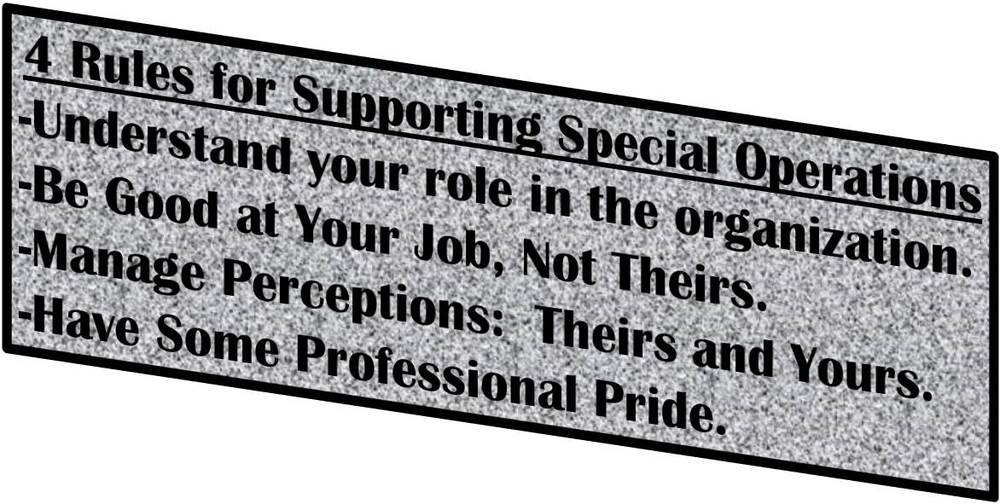
So when it comes to SOF I don’t know what it takes to get selected as a “shooter,” or an “operator,” or any of the other terms tossed around by people who really don’t know what they mean to describe the types of men I supported. Fortunately, there are plenty of great articles out there that do that. But I do know what it takes to be successful in a supporting role in a SOF unit—it only takes these four things:
_______________
-Understand your role in the organization.
You’re an enabler. If you want to be an “operator” (whatever you think that word means), go get an “operator” MOS. You’re a support guy, and that’s OK. Embrace that role, but know what it entails.
You have to be the professional equivalent of the men you support. Is your organization full of world-class door-kickers? Then you need to be a world-class intel analyst. Does your unit do special operations aviation like no one’s business? Then you better do admin like nobody’s business. Your unit’s ops are blacker than everyone else’s? Then you do logistics blacker than everyone else. Everyone in a SOF organization has a part to play in the overall success of the mission; if the ops guys can do your job AND theirs, what value are you bringing to the organization?
You should never allow any of the people you support to be as good at your job as you are—and trust me, most of them will think they are, and some of them might actually be right. Regardless, it should be your mission in life to prove them wrong. No one in the unit should be better than you at your job. If they are, you need to step up your game or step out of the unit.
-Be Good at Your Job, Not Theirs.
The unit hired you to do a specific job, so do it. You’re never going to be as good at things like kicking down doors, sneaking around in the enemy’s back yard, training indigenous forces, or shooting bad guys in the face as the operations guys are. Those kinds of things are THEIR jobs. Practice being good at YOUR job. The better you are at your job, the better the whole organization will be, because if the operations folks don’t have to do your job, they can spend more time training to do theirs.
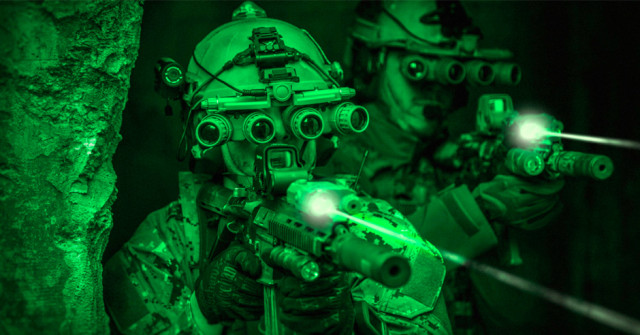
Too many enablers come to SOF units thinking that they’re going to be breaking things, blowing stuff up, and killing people. While support troops may indeed be called upon to do those kinds of things from time to time, it is far more likely that your job is going to be to support the men who have those functions as a primary duty and to enable the success of their mission set. If you’re not OK with that, do yourself and everyone else a favor and just don’t come to SOF. This is particularly true of “former action guy” types who re-classed into a “supporting” role and can’t get their mind around the fact that they are no longer the “supported.”
If a particular skill set is outside your specific job in the unit, don’t spend inordinate amounts of time training for it. Don’t go around seeking out the “cool guy” schools at the expense of professional development within your own specialty. It’s important to have a firm foundation of military skills, including direct combat, but there are opportunity costs for everything; the more time you spend doing “sexy” things, the less time you have to become world-class in the job you’re actually supposed to be doing.
-Manage Perceptions: Theirs and Yours.
Remember that appearances matter, and every unit is different. Be physically fit. Dress appropriately. Groom yourself in conformance with the norms of your unit. Don’t be on Facebook or playing Call of Duty every time someone comes to the office on business. And for God’s sake, don’t be fat. In short, manage the perceptions the people you support have of you and don’t reinforce negative stereotypes of your profession. Additionally, Each SOF unit has a distinctive culture, or “flavor.” Figure them out quickly. Perhaps the worst thing you can say is “But this is the way we did it in XXX unit,” especially if that unit was not part of the SOF community.
Manage your own perceptions as well. You may be “in” the unit, but it’s not correct to say that you “are” that which you support. You’re SF support, not a Green Beret. You’re a Naval Special Warfare enabler, you’re not a SEAL. You do support ops for MARSOC, you’re not a Critical Skills Operator.
Don’t represent yourself as something you’re not to people outside the unit. Be proud of who and what you are; you’re still SOF, and you don’t need to inflate what you’ve done. Understand that people with special qualifications and skills are going to be treated differently. Do your job the best you can, and don’t worry about what other people are doing, wearing, or saying, or where they’re getting to go.
You should act like you’re competing for your job every day because in the most elite SOF units, you are. There is always someone out there who has the same skill set and the same hunger for the job that you have. Don’t make the people you support start thinking that they’d rather have that guy than you. Be present, be professional, and whenever possible, be proactive.
-Have Some Professional Pride.
Take pride in your profession. If the men you support don’t understand what you bring to the table, educate them. If they do know what you bring, but don’t let you bring it, take it somewhere else.
Don’t go to a SOF organization that doesn’t have a screening process for its enablers. Most SOF units have an  established process to make sure that their enablers are able to perform at a level adequate to support the unit’s operations. You know what it means when a SOF unit doesn’t have a process for its enablers when it’s a “needs of the service” assignment? It means they don’t give a damn about the support side of the house. And when that is the case, you get pot luck with enablers. How can you tell whether a SOF unit has a screening process? Well, if getting assigned is as simple as picking up a phone and calling your detailer or branch manager, think twice before you sign up for that gig.
The first SOF unit I was in didn’t have a screening process for its support side of the house and consequently viewed its enablers with utter contempt. It didn’t take me long to realize that I wasn’t a second-class citizen to them; I and everyone like me were more like indentured servants, who couldn’t be trusted outside the wire to do the jobs they were trained, equipped, and prepared to perform, and who were supposed to be grateful for the scraps of missions that fell from the operational dinner table. It was not a culture of one team working to accomplish the mission; it was a caste system. And the support types were the untouchables.
But I was good at my job, and I knew there were units out there who would make the most of my potential. So I tried out for a job “behind the fence” so to speak, and didn’t look back. So did pretty much every other enabler in that unit worthy of the name. All units are better when everyone is specially selected, trained, equipped, empowered, and held accountable for the role they play. Organizations which deliberately or inadvertently neglect important parts of their formation suffer from it over time, and will never reach their full potential as an organization.
_______________
Remember the Fifth SOF Truth, the one nobody in SOF really wants to talk about? “Most SOF missions require non-SOF assistance.” The same holds true within the SOF community itself.
The dirty little secret of SOF is that no matter how much support troops are mistreated, looked down upon, disparaged, or made to feel like second-class citizens, most SOF units would not be able to accomplish their missions without their enablers.
If you’re one of those people or aspire to be one, I salute you. Keep the above rules in mind while you’re supporting Special Operations Forces, and you’ll go far.
_____
This first appeared in The Havok Journal on September 21, 2014.
Charles Faint served over 27 years in the US Army, which included seven combat tours in Iraq and Afghanistan with various Special Operations Forces units and two stints as an instructor at the United States Military Academy at West Point. He also completed operational tours in Egypt, the Philippines, and the Republic of Korea and earned a Doctor of Business Administration from Temple University as well as a Master of Arts in International Relations from Yale University. He is the owner of The Havok Journal, and the views expressed herein are his own and do not reflect those of the US Government or any other person or entity.
Buy Me A Coffee
The Havok Journal seeks to serve as a voice of the Veteran and First Responder communities through a focus on current affairs and articles of interest to the public in general, and the veteran community in particular. We strive to offer timely, current, and informative content, with the occasional piece focused on entertainment. We are continually expanding and striving to improve the readers’ experience.
© 2026 The Havok Journal
The Havok Journal welcomes re-posting of our original content as long as it is done in compliance with our Terms of Use.

