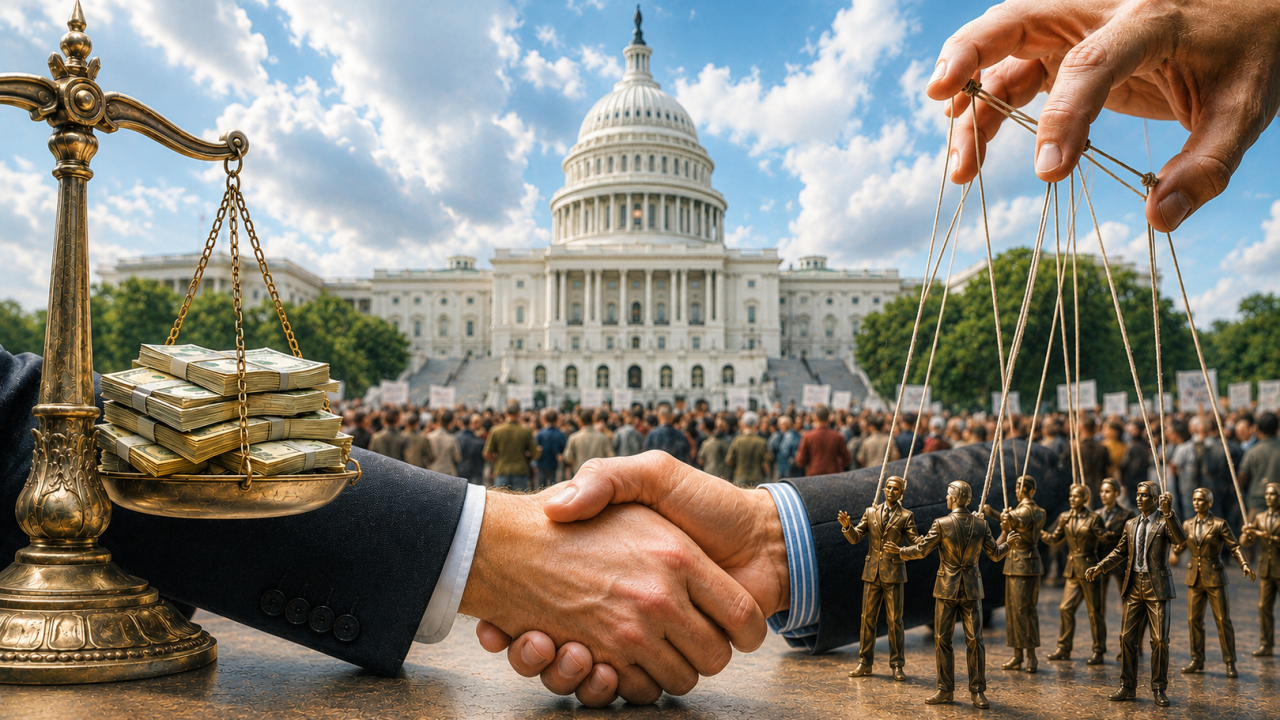
There is an old saying that circulates with remarkable frequency whenever public confidence in government declines: “Politics is the only racket that’s legal.” The quotation is widely repeated, although its precise origin is difficult to establish. Unlike many famous political aphorisms, it cannot be reliably traced to a single individual or publication. It appears to have entered popular political discourse as an anonymous observation rather than an attributable quotation. Whether or not the phrase has an identifiable author, its enduring popularity raises an interesting question.
But what does it actually mean?
At first glance, the statement sounds like little more than cynical hyperbole. It implies that politics resembles organized crime, except that its activities occur within the boundaries of law. Yet beneath the provocative language lies a serious philosophical observation about power, incentives, and human institutions.
The word “racket” deserves careful consideration. In ordinary usage, a racket is an enterprise that benefits those who control it while imposing costs on everyone else, often through coercion, manipulation, or unequal access to authority. The classic protection racket, for example, creates a problem and then sells the solution. The victims participate not because they freely choose to, but because refusing carries unacceptable consequences.
Politics, of course, is not organized crime. Democratic governments derive their legitimacy through constitutional processes, elections, and the rule of law. Equating elected government with criminal enterprise is both historically inaccurate and analytically unhelpful. The quotation points somewhere else. It suggests that politics possesses characteristics unlike almost every other profession.
In competitive markets, businesses survive only if customers voluntarily purchase their products. Universities compete for students. Newspapers compete for readers. Authors compete for audiences. Every organization must persuade someone to participate voluntarily.
Government occupies a unique position because many of its decisions are compulsory rather than voluntary. Taxes must be paid regardless of whether one agrees with every expenditure. Regulations apply equally to supporters and critics alike. Laws remain binding even for those who opposed the legislators who enacted them. Politics therefore operates according to incentives fundamentally different from those governing ordinary markets.
This distinction has occupied political philosophers for centuries. James Madison argued that institutions should be designed with the expectation that individuals pursue their own interests. Max Weber described politics as the pursuit of power within the state. Public choice economists such as James Buchanan and Gordon Tullock later suggested that politicians and bureaucrats respond to incentives much like everyone else, seeking reelection, larger budgets, prestige, and influence rather than acting as perfectly altruistic guardians of the public good.
None of these thinkers argued that politics is inherently corrupt.
Rather, they argued that politics is conducted by human beings. Human beings respond to incentives. That insight helps explain why the quotation continues to resonate.
Citizens often expect political actors to behave differently from everyone else. We imagine public officials acting solely in pursuit of the common good while simultaneously acknowledging that every other profession contains ambition, self-interest, competition, and institutional preservation.
History suggests otherwise.
Political systems frequently reward coalition-building, fundraising, media attention, and electoral success. These incentives do not necessarily produce poor governance, but they do shape behavior. A legislator seeking reelection may pursue different priorities than one serving a single term. Bureaucracies often seek larger budgets because organizational growth increases influence. Political parties naturally emphasize issues that mobilize supporters, even when compromise might produce better long-term policy.
These dynamics are neither uniquely modern nor uniquely American.
They are features of politics itself.
This is where the quotation becomes more sophisticated than it first appears.
Calling politics a “legal racket” is not necessarily accusing every politician of dishonesty. Instead, it highlights an uncomfortable reality: politics is one of the few arenas where the acquisition and exercise of power over others is not merely permitted but institutionalized.
Every society requires governance. The question has never been whether power should exist. The question has always been how power should be constrained. The framers of constitutional governments understood this well. Separation of powers, federalism, judicial review, regular elections, and written constitutions were never intended to eliminate ambition. They were designed to channel competing ambitions against one another so that no single individual or institution accumulated unchecked authority.
In other words, constitutional systems assume the quotation may contain at least a grain of truth. They are built on the premise that power must be monitored because human beings are imperfect.
There is another reason the saying persists.Unlike criminal rackets, political activity often carries an aura of moral purpose. Nearly every policy is presented as serving the public interest. That may indeed be true. Yet noble intentions do not eliminate incentives. Organizations still protect themselves. Coalitions still compete for influence. Resources remain finite. Winners and losers continue to emerge from every significant political decision.
Recognizing these realities is not cynicism.
It is institutional literacy.
Healthy democracies require citizens who can distinguish between disagreement and corruption, between ordinary political bargaining and genuine abuse of power. If every political compromise is viewed as criminality, democratic government becomes impossible. If every exercise of authority is accepted without scrutiny, liberty gradually erodes.
The challenge is finding the balance.
Perhaps that explains why the anonymous quotation has survived for so long. It exaggerates in order to illuminate. It is memorable not because it is literally true, but because it reminds us that politics should never be viewed through the lens of romanticism.
Government remains essential. Politics remains necessary. But neither should ever be mistaken for a realm where ordinary human incentives suddenly disappear. Power has always attracted ambition. The wisest political systems are not those that pretend otherwise. They are the ones designed with that fact firmly in mind.
_____________________________
Charles served over 27 years in the US Army, which included seven combat tours in Iraq and Afghanistan with various Special Operations Forces units and two stints as an instructor at the United States Military Academy at West Point. He also completed operational tours in Egypt, the Philippines, and the Republic of Korea and earned a Doctor of Business Administration from Temple University as well as a Master of Arts in International Relations from Yale University. He is the owner of The Havok Journal, and the views expressed herein are his own and do not reflect those of the US Government or any other person or entity.
As the Voice of the Veteran Community, The Havok Journal seeks to publish a variety of perspectives on a number of sensitive subjects. Unless specifically noted otherwise, nothing we publish is an official point of view of The Havok Journal or any part of the U.S. government.
Buy Me A Coffee
The Havok Journal seeks to serve as a voice of the Veteran and First Responder communities through a focus on current affairs and articles of interest to the public in general, and the veteran community in particular. We strive to offer timely, current, and informative content, with the occasional piece focused on entertainment. We are continually expanding and striving to improve the readers’ experience.
© 2026 The Havok Journal
The Havok Journal welcomes re-posting of our original content as long as it is done in compliance with our Terms of Use.


