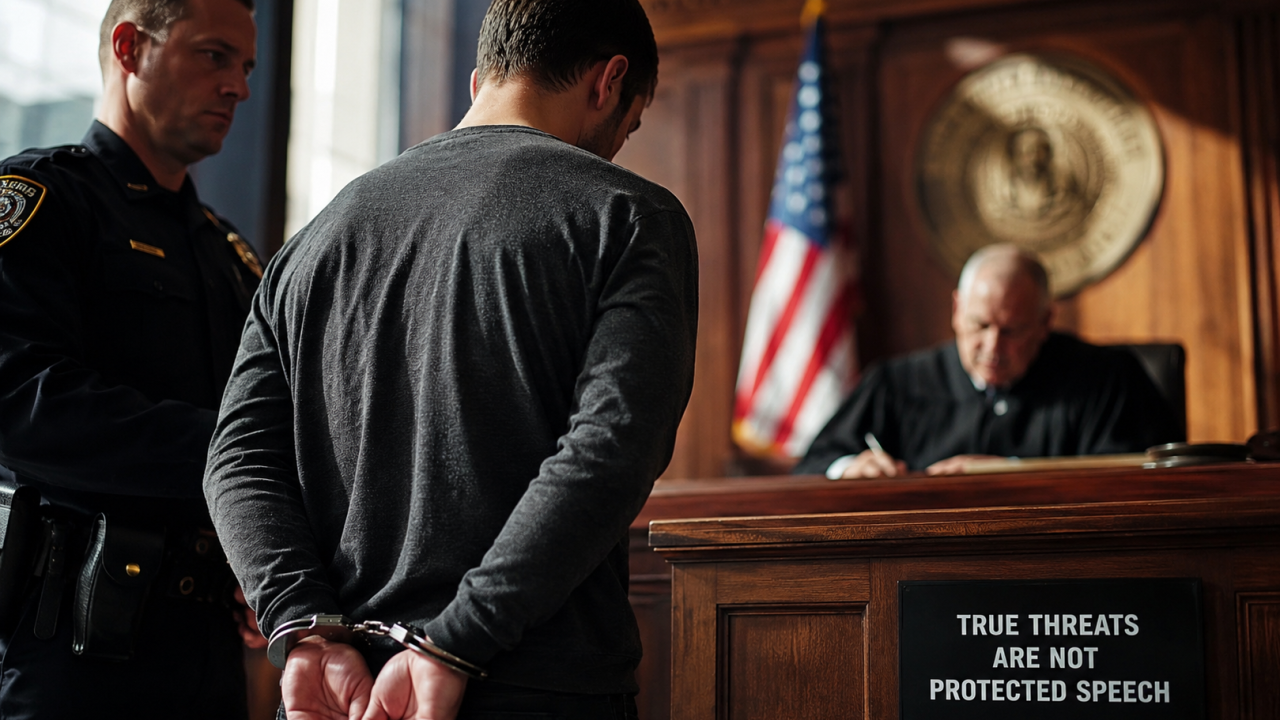
Every election cycle, every social media controversy, and every politically charged news story seems to generate the same debate:
“Isn’t threatening someone protected by the First Amendment?”
The answer is surprisingly straightforward.
No.
The First Amendment provides broad protection for speech in the United States, including speech that many people find offensive, insulting, hateful, or disturbing. What it does not protect are certain narrow categories of expression, including what courts call “true threats.”
The distinction matters because Americans often confuse speech they dislike with speech that is actually criminal.
The First Amendment Protects a Lot More Than Most People Realize
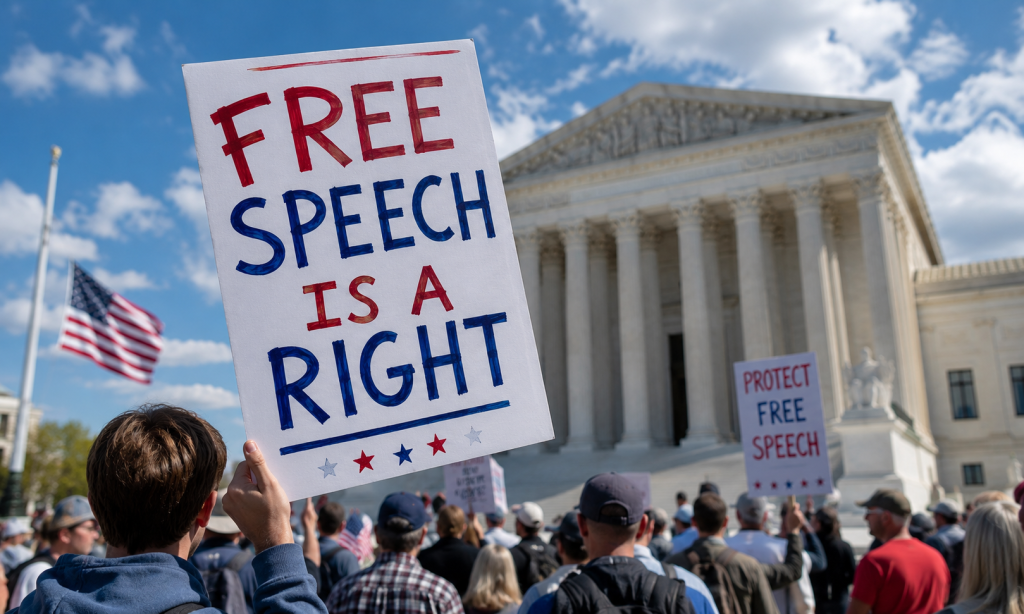
The United States has some of the strongest free speech protections in the world.
Americans are generally free to criticize politicians, religions, corporations, government agencies, social movements, and public figures. They can express unpopular opinions, offensive viewpoints, and controversial ideas without fear of criminal prosecution.
Many statements that people commonly label as “hate speech” remain constitutionally protected. The Supreme Court has repeatedly held that there is no general “hate speech” exception to the First Amendment.
That protection, however, is not unlimited.
Among the categories of speech that may be criminally punished are fraud, obscenity, incitement, and true threats. A true threat is not protected speech because the law recognizes that the threat itself causes harm, even if no physical attack ever occurs.
What Is a “True Threat”?
The Supreme Court has defined a true threat as a serious expression of an intent to commit unlawful violence against a person or group. The law is concerned less with political opinions or rhetoric and more with whether the communication conveys a genuine threat of harm.
For example:
• “I disagree with that politician.”
• “That judge should be voted out.”
• “That organization is destroying the country.”
Those statements are protected.
By contrast:
• “I’m going to kill that judge.”
• “Someone should shoot those people, and I will do it.”
• “Tomorrow I’m bringing a rifle to settle this.”
Now prosecutors may have a criminal case.
The key question is whether a reasonable recipient would understand the statement as a serious threat of unlawful violence rather than mere hyperbole, joking, political rhetoric, or emotional venting.
Online Threats Are Real Threats

One of the biggest misconceptions of the internet age is the belief that online threats somehow don’t count.
Federal law specifically criminalizes transmitting threats through interstate communication systems, including the internet. A person sitting behind a keyboard in one state can face federal charges for threatening someone in another state.
Courts have repeatedly rejected the argument that social media posts are automatically protected because they were posted online rather than delivered face-to-face.
Facebook posts.
X posts.
Emails.
Direct messages.
Text messages.
All can become evidence in a criminal prosecution if they contain genuine threats of violence.
The Supreme Court’s Evolving Standard

The law surrounding threats has become more nuanced in recent years.
In Elonis v. United States (2015), the Supreme Court rejected the idea that a person could be convicted merely because others interpreted a statement as threatening. The Court held that some level of subjective intent must be proven.
The issue became even clearer in Counterman v. Colorado (2023). There, the Supreme Court ruled that the First Amendment requires proof that the speaker acted with at least recklessness regarding whether the communication would be perceived as threatening. In other words, prosecutors generally must show more than simple negligence.
This is important because the Court recognized a reality of modern communication:
People sometimes make jokes.
People use sarcasm.
People post song lyrics.
People engage in political hyperbole.
The government cannot simply criminalize speech because someone, somewhere, interpreted it in the worst possible way.
At the same time, the Court made clear that genuine threats of violence remain outside First Amendment protection.
What About Threats Against Groups?
Threats directed at groups can also be criminal.
A threat does not have to identify a single individual by name.
For example, threatening members of a racial, religious, ethnic, or political group may still qualify as a true threat if the statement communicates a serious intent to commit unlawful violence.
The law examines context, language, audience, and surrounding circumstances. A vague political opinion is generally protected. A specific threat to murder members of a particular group may not be.
What About “Jokes”?

One of the most common defenses offered after an arrest is:
“It was just a joke.”
Sometimes that defense succeeds, and sometimes it fails spectacularly.
Courts look beyond the speaker’s after-the-fact explanation and examine the entire context. They consider whether the statement would reasonably be understood as a serious threat and whether the speaker was aware of the risk that it would be interpreted that way.
A poorly timed joke about bombing an airport, shooting a public official, or killing a coworker may result in a visit from law enforcement long before a jury ever hears the speaker’s explanation.
The Difference Between Offensive Speech and Criminal Speech

The most important lesson from modern First Amendment law is that offensive speech and criminal speech are not the same thing.
A statement can be hateful, racist, sexist, vulgar, or politically extreme and still be protected.
A statement can also cross the line into a criminal threat when it communicates a serious intent to commit unlawful violence.
That distinction frustrates people on both sides of the political spectrum.
Some want offensive speech punished as criminal conduct.
Others believe any restriction on threatening speech violates free expression.
American law rejects both extremes.
The First Amendment protects an enormous amount of speech, including speech many people despise. But when words become serious threats of violence, constitutional protection begins to disappear.
Context Matters: Courts Rarely Examine a Threat in Isolation

One of the biggest misconceptions about threat prosecutions is the belief that courts evaluate a single statement by itself.
Courts often examine the broader context surrounding an alleged threat. The same words can carry very different legal meanings depending on who said them, to whom they were directed, and what other evidence exists.
For example, a statement such as, “One day I’m going to kill that guy,” might be dismissed as obvious hyperbole in one context but treated as a serious threat in another. The difference may lie in the surrounding facts.
Investigators and prosecutors frequently examine:
• Prior communications between the parties
• Previous threatening statements
• Social media posts and comments
• Text messages and emails
• Evidence of harassment or stalking behavior
• The relationship between the speaker and the target
• Statements made to friends, coworkers, or family members
• Evidence suggesting preparation for violence
This means that a person’s digital footprint can become highly relevant in a criminal investigation. A threatening post on social media may not be viewed as an isolated incident. Instead, investigators may review months or even years of online activity to determine whether the statement was a joke, political hyperbole, emotional venting, or evidence of a genuine intent to intimidate or commit violence.
The Supreme Court’s recent decisions regarding true threats have emphasized that a speaker’s mental state matters. Because intent is rarely proven through direct evidence, prosecutors often rely on surrounding circumstances to show that a defendant knew, or consciously disregarded the risk, that their statements would be perceived as threatening.
This principle also explains why seemingly harmless statements can take on a different meaning when viewed as part of a larger pattern. A single unwanted message may not be threatening. Fifty messages sent over several months, especially after requests to stop, can create a much different picture.
The practical reality is that modern threat investigations increasingly involve a review of a person’s entire online presence. Posts, comments, videos, private messages, and other digital communications may all be used to help establish context.
For that reason, individuals should never assume that a threatening statement will be evaluated in a vacuum. Courts often look beyond the specific words used and consider the totality of the circumstances surrounding the communication.
Final Thoughts

The internet has created a culture where people often type things they would never say face-to-face. The law, however, generally does not care whether a threat was spoken across a table or posted from a smartphone.
The modern legal question is not whether the statement appeared online.
The question is whether the communication amounted to a true threat: a serious expression of unlawful violence directed toward a person or group.
If it does, the First Amendment may not save the speaker, and the phrase “I was only joking” may arrive far too late to matter.
And, of course, the person being threatened may just have a firearm and react by defending themselves when they feel they are in danger. The legality of their actions doesn’t really change the outcome for the dead person.
_____________________________
Dave Chamberlin runs a consulting and training company and brings more than 40 years of civilian and military aviation experience to his work. He retired as a Chief Master Sergeant after 38 years as an aircraft crew chief in the U.S. Air Force and Air National Guard, and has also worked in technical, instructor, consultant, and leadership roles. He holds an FAA Airframe and Powerplant license and a master’s degree in aeronautical science, and his writing often focuses on military issues, especially those affecting aircraft maintenance personnel.
As the Voice of the Veteran Community, The Havok Journal seeks to publish a variety of perspectives on a number of sensitive subjects. Unless specifically noted otherwise, nothing we publish is an official point of view of The Havok Journal or any part of the U.S. government.
Buy Me A Coffee
The Havok Journal seeks to serve as a voice of the Veteran and First Responder communities through a focus on current affairs and articles of interest to the public in general, and the veteran community in particular. We strive to offer timely, current, and informative content, with the occasional piece focused on entertainment. We are continually expanding and striving to improve the readers’ experience.
© 2026 The Havok Journal
The Havok Journal welcomes re-posting of our original content as long as it is done in compliance with our Terms of Use.


