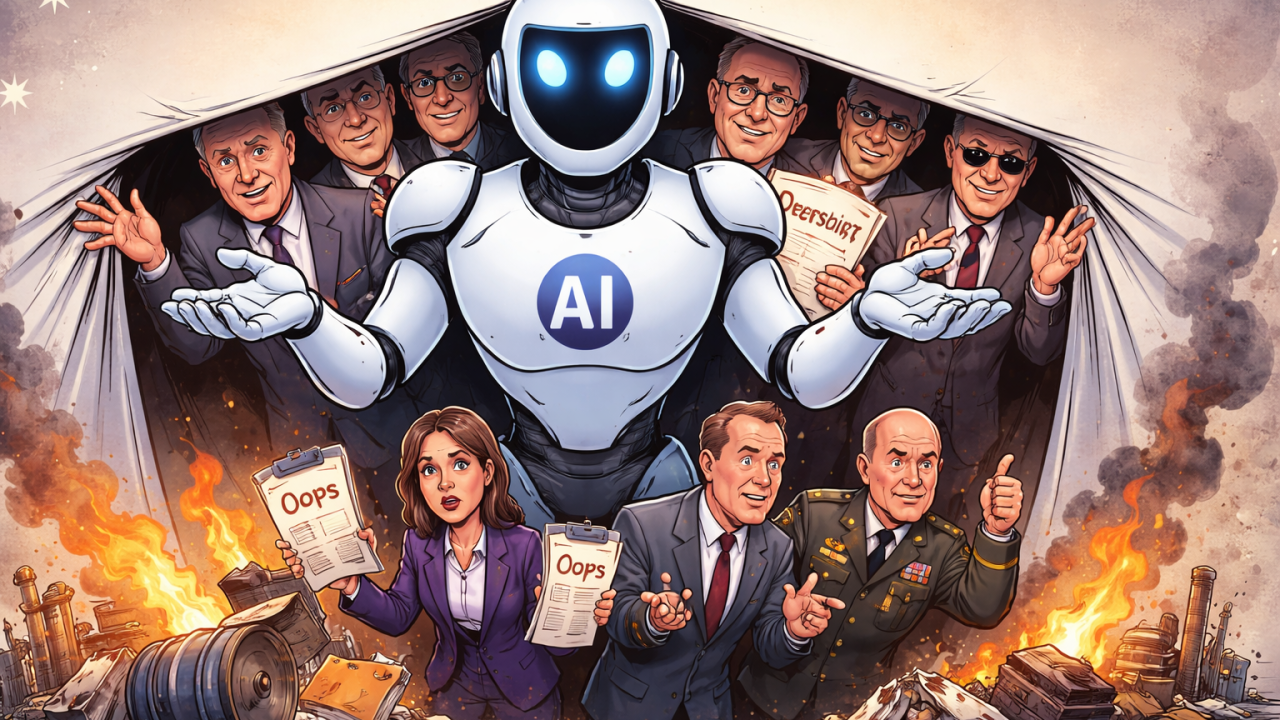
There is no technology more perfectly suited to our age than artificial intelligence, because there is no age more desperate to avoid responsibility.
That’s the whole romance. Not innovation. Not discovery. Not even profit, though God knows the usual ghouls will always show up with a trough and a pitch deck. The real seduction is moral. AI promises a civilization-wide escape hatch from judgment. No one has to know, decide, remember, or answer for anything anymore. The machine can do it. Or rather, the machine can be blamed for it, which is much better.
That’s what makes the whole spectacle so funny. We’re being sold a miracle of human advancement by some of the least serious people ever to wear a conference badge. Every public presentation has the same stale liturgy. We hear about empowerment, augmentation, responsible deployment, frictionless productivity, human flourishing, and whatever other phrase was focus-grouped into a state of total bloodlessness by people who think ethics is when you put rounded corners on a slide deck. Meanwhile the actual product still behaves like an intern with a head injury and a dangerous need to please. It invents facts, misreads basic instructions, fabricates confidence on command, and generally carries itself like a mediocre man explaining something he learned ten minutes ago from a podcast.
And they love it.
Of course they do. It doesn’t matter that the thing is unreliable. Unreliability is manageable. What matters is that it is useful. Not useful in the sense of true or wise or even competent. Useful in the bureaucratic sense. Useful as an alibi.
That’s the breakthrough.
A bad call made by a human being is still a bad call. It has a face attached to it. There’s a name in the email chain. Somebody can be cornered in a hallway and asked what in God’s name they were thinking. But once the decision passes through a system, especially a system with math attached to it, the whole moral atmosphere changes. Suddenly we’re not dealing with blame. We’re dealing with process. There will be a review. A framework. A cross-functional conversation. Perhaps an external consultant in a soft shoe and an expensive watch will be brought in to explain that there were lessons learned. Nobody is fired. Nobody is humiliated. Nobody is held in the old barbaric way known as responsible.
Corporate America looked at that and saw heaven.
Why bother maintaining expertise when you can rent plausibility? Why pay seasoned people to exercise judgment when you can hand managers a machine that produces fluent nonsense in under three seconds? Call it augmentation and watch the severance paperwork glide out like swans. Call it efficiency and suddenly the deskilling of entire professions becomes a leadership strategy. The company gets cheaper, the work gets worse, and everyone involved speaks in that weird antiseptic dialect meant to suggest maturity while concealing the fact that they’ve just replaced thought with autocomplete.
And the part that really deserves applause, if by applause you mean the hollow banging sound of civilization hitting a guardrail, is the moral costume. The same institutions that have spent decades treating workers as disposable, customers as data exhaust, and the public as a mildly hostile weather pattern now want credit for talking about responsible AI. Responsible AI. It has the sound of a man ordering a third martini and congratulating himself for using a coaster. Responsible deployment of what exactly? A technology marketed to consumers as convenience, to executives as labor arbitrage, and to states as a chance to surveil, classify, predict, and manipulate at scale with less tedious human friction.
That’s not an accident. It’s the business case.
And once national security enters the room, whatever was left of the conscience exits through a side door and doesn’t bother with a coat. Every empire hears the same song. This tool is too powerful not to build. Too dangerous not to deploy. Too important to leave to rivals. Notice how danger never leads to restraint. It leads to acceleration. The possibility of catastrophe is treated not as a warning but as a funding opportunity. Entire grown adults in government develop the glazed spiritual look of slot machine addicts the minute they hear phrases like scalable intelligence and automated analysis. Tell the permanent state that a machine can turn uncertainty into action faster than a human can ask whether the action is stupid, and you’re not describing a problem. You’re ringing a bell.
The deeper obscenity, though, is cultural. AI flatters a public that is exhausted, distracted, lonely, overmanaged, and half convinced that thinking itself is an administrative burden. And on this point the evangelists are not wrong. Plenty of people will crawl willingly into a system that makes decisions feel easier. Convenience is not trivial. It is chemically persuasive. Give people something warmer than an institution, less demanding than a friend, and more instantly gratifying than their own judgment, and many of them will hand over huge pieces of themselves with genuine relief. Not because they’re fools. Because they’re tired.
That’s why the future being built is so bleakly ordinary. Not robot overlords. Not chrome skeletons marching down Main Street. Something far more pathetic and therefore far more likely. A society in which judgment atrophies because outsourcing it becomes normal. A society where institutions hide behind systems, managers hide behind outputs, and citizens are slowly trained to treat opacity as expertise. You will still be free, in the formal ceremonial sense. You will simply be surrounded by recommendation engines, procedural black boxes, synthetic authorities, and machine-generated inevitabilities until independent thought starts to feel like a hobby for difficult people.
Which, to be fair, is exactly how failing elites like it.
That’s the joke. The machine does not have to be all-powerful. It just has to be official. It doesn’t need to be wiser than you. It only needs to sit between you and every decision that matters, smiling politely while the people behind it insist that nobody is in charge.

_____________________________
Tammy Pondsmith covers the managerial class with the patient disgust of a woman who has watched too many cowards call themselves systems thinkers.
As the Voice of the Veteran Community, The Havok Journal seeks to publish a variety of perspectives on a number of sensitive subjects. Unless specifically noted otherwise, nothing we publish is an official point of view of The Havok Journal or any part of the U.S. government.
Buy Me A Coffee
The Havok Journal seeks to serve as a voice of the Veteran and First Responder communities through a focus on current affairs and articles of interest to the public in general, and the veteran community in particular. We strive to offer timely, current, and informative content, with the occasional piece focused on entertainment. We are continually expanding and striving to improve the readers’ experience.
© 2026 The Havok Journal
The Havok Journal welcomes re-posting of our original content as long as it is done in compliance with our Terms of Use.