By D.D. Finder
“We’re going to check your rectum.”
We?
How many people do you need?
Isn’t one enough?
I turned around, compartmentalizing the next twenty seconds of my life. At the time, I knew jack shit about medicine. I did, however, note that my crushing abdominal pain was nowhere near my butthole. Still, I wasn’t the doctor.
My jeans dropped to the floor, and I thought about a friend who’d had his first prostate exam a few months earlier, resulting in an unwanted erection. Was I about to apologize for pitching wood?
Lube. Finger. Spread. Pressure. Lots of pressure. Then he stopped.
Thank God. I was done. I’d never been happier to be flaccid.
“Nurse, more lubricant, please.”
Wait a fucking minute. That was the warm-up?
Another squirt of cold jelly and I felt like a turkey getting stuffed. His finger exited like it was clocking out. I yelled for a towel and the nurse John Stockton’d some linen right into my hand. What I thought was shit was just lube.
I turned my head and saw the doctor walk past the sink, leaving the room with the nurse trailing behind in silence. No discussion of results. No sorry about that. And certainly, no hug.
“I would wash your hands before eating,” I wanted to shout.
I had my reasons.
Giardia. Pinworms. Malabsorption syndrome. Viral gastroenteritis. Peace Corps gave me plenty of reasons to feel filthy. And now add this to the list: disimpacting a perfectly clean colon on a Friday night.
Twelve hours earlier, I woke up with mild stomach pain. It felt like a fart too proud to leave, comfortably sequestered in my gut. The pain evolved into a rubber chainsaw of agony, letting me know this fart was demonic.
Decades ago, we were issued basic cell phones for emergencies. Some nights, they barely worked. That night, mine did.
Around 7 p.m., I dialed up the on-call Peace Corps nurse, Kathy. She was a no-bullshit type of woman who had probably smoked since birth and looked like she’d won a knife fight before attending nursing school.
“Kathy, it’s DD. My stomach hurts. A lot.”
“Press down on the lower right area and let go.” Her voice was like a diesel engine, lulling you to sleep.
I followed her instructions and yelped.
“You might have appendicitis. You need to get to the hospital.”
Yeah, that was a tall order. The hospital was a curvy, three-hour bus ride away, assuming the bus didn’t break down. And at that time of night, there was no public transportation from my town to Guatemala City.
“Sorry, Kathy. No can do. I’ll try to sleep this off and catch the first bus in the morning.”
Kathy jumped on my suggestion like a pit bull on a toy.
“No. You’re coming in now. You might die. Ask the firefighters to bring you in.”
I’ve got firefighters in my town?
I called a fellow volunteer farther out, and within thirty minutes, the town’s ambulance was at my door. A Toyota pickup with a soft shell covering the bed. I walked out, and they pointed to the blood-soaked, WWII-era cot. I said, “No, thanks.”
I sat in the front.
The firefighters rode in the back, staring at their empty cot.
The near two-hour, code three ambulance ride involved blind mountain curves, cars refusing to pull over, and blaring ranchera music. Driver’s choice, of course. Grown men screaming about betrayal and lost love while I tried not to die in the front seat. I hate ranchera.
They dropped me off in front of a private hospital that looked more like a spa, reserved for high-end officials, wealthy business owners, and, to my surprise, a grungy volunteer like myself. I was told healthcare in the Peace Corps was top-notch. Small detail, though: you had to make it to the hospital. My first victory of the night, I was there.
Clutching my abdomen, I shuffled through the sliding doors, immediately greeted by a team of nurses who escorted me to a private room.
I was scared shitless and alone. Pain’s death grip seized my stomach, trying to drag me farther from friends and family, thousands of miles away.
In walked the doctor and a nurse. A few minutes later, lube still drooled out of my butthole in protest.
Next, the surgeon hurried in with a smile, speaking perfect English that he’d learned studying medicine in Illinois. My ass quivered. This guy was a lot taller.
“I think you have appendicitis. Let me see.”
I motioned to turn around, but he told me to lie down.
No butt exam? Well, that’s another win.
He pushed on my abdomen like Kathy had instructed hours earlier, then let go. I yelped again.
“You need surgery right away. I’ll see you in the operating room.”
My mouth dropped. What the hell was the doctor with the finger up to? Was he trying to win a bet with the nurse? Was he really a doctor?
Before I could ask, the surgeon stepped out. Loneliness crept back in. I was about to have my first surgery. In another country.
Oh. Fuck.
My fingers raced to make an international call on a cheap cell phone. My sister was a nurse. My mom as well. Maybe it was nerves or a poor international plan offered by the Peace Corps, but a busy signal blared in my ear.
In walked Kathy with a swagger of certainty.
“You’re going to be okay. You need this surgery.”
Amazing how the roughest voices can be so sweet and comforting. She squeezed my hand before the OR staff wheeled me away.
The lights in the OR erased any notion of how late it was. Even at twenty-two years old, when the sun dropped, I was in bed. There wasn’t much to do in the cinderblock house I rented. No TV. No radio. Three light bulbs illuminating dirt floors of my tiny home. And those damn fighting roosters next door started screaming at 5 a.m. They’re called cocks for a reason.
“Vamos a cuidarle bien,” the anesthesiologist told me.
“Está bueno,” was all I could manage.
I started shaking from the cold, sterile room, or maybe it was nerves, as an anesthesia mask suffocated my face. A nurse took pity on me and turned on the music. A gentle guitar swept through the OR’s speakers. Eric Clapton’s voice cut through the acoustics.
“…Tears in Heaven.”
Are you fucking kidding me?
The song he wrote about his son’s tragic death was going to be the last thing I heard. Couldn’t they have played Nirvana? Or maybe Metalli…
My peripheral vision closed in. A sweet darkness hugged me to sleep. Any protest I had left was muted by a paralytic, while haunting lyrics licked my ears.
“¡No mueva!”
A snake in my throat choked me awake, slithering deep, gagging me as I tried to fight. A hand swatted me down, and the breathing tube was pulled before I fell back to sleep for a few more hours.
900.
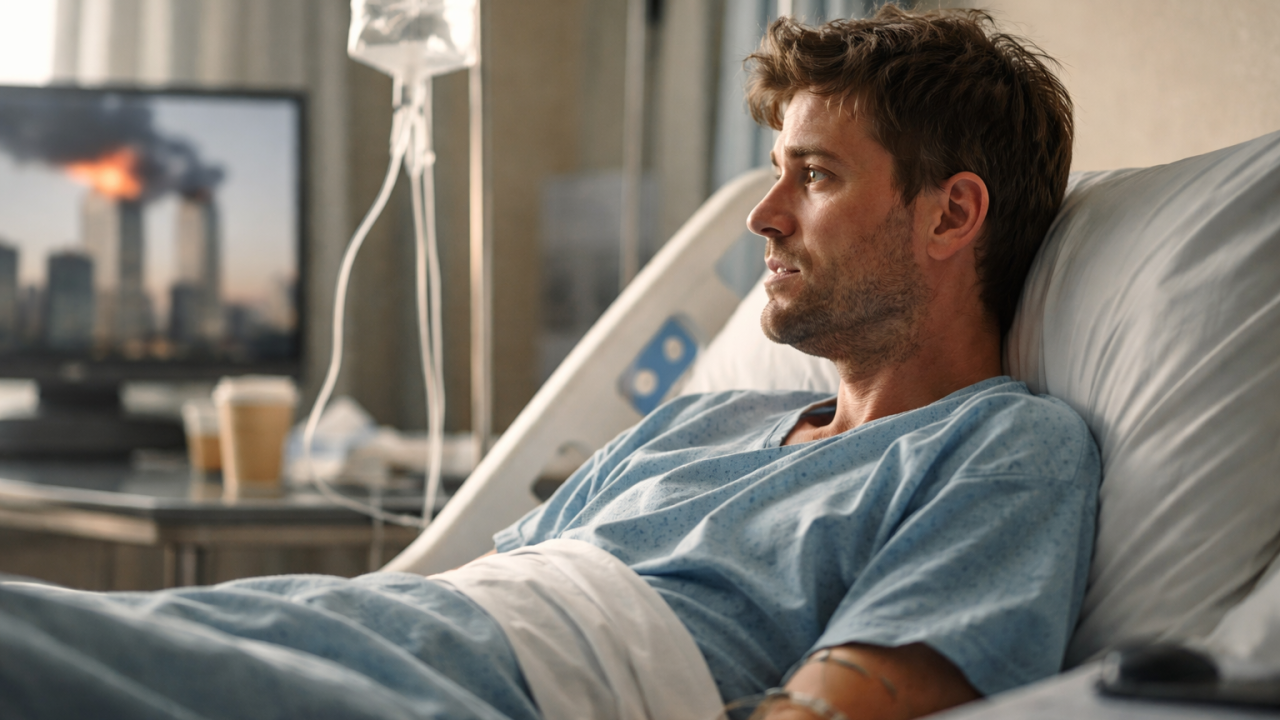
I woke up feeling like a night of heavy drinking had racked me against a hospital bed. My muscles came back online, and memories trickled in. Kathy. Abdominal pain. Ranchera music. A sweeping finger. Coldness. Tears in Heaven.
My eyes scanned new surroundings. A TV in front of me played a dubbed Crocodile Dundee. A light showcased a bathroom nearby. Some tube poked out from beneath the bed covers and dipped out of sight. My stomach was bloated from the air they’d pumped into it. I looked pregnant. But last night’s prostate exam contradicted such a possibility. Yesterday’s pain was replaced with a different one. Just as bad.
The nurse walked in, happy to see I was more awake, and pulled off the bed covers, encouraging me to get my ass up and moving, when all I wanted to do was sink back under the warmth and sleep off Eric Clapton.
A tube coming out of my penis caught my attention. Before I could ask the nurse what it was, she deflated the pilot balloon with a syringe and yanked the Foley catheter out like she was starting up an old lawn mower.
The pain shot me out of bed.
“I’ve got to pee!” I said in Spanish, holding my freshly applied bandages, hobbling to the bathroom. Walking felt as if I had two left feet. I ping-ponged off the nurse’s arm all the way to the toilet.
I didn’t know it at the time, but I had just passed two more tests for discharge that day. I peed. I ambulated. Both feats of strength within ten minutes of waking.
The nurse helped me back to bed, and breakfast arrived. Scrambled eggs. A little bit of cotija cheese. Warm corn tortillas. Some OJ. Not bad for my first meal in over twenty-four hours. The food gave me enough energy to enjoy the knife scene in Crocodile Dundee. I laughed at how bad the translation was and cried at how bad the pain was from laughing.
I hit the off button on the remote. Laughing isn’t the best medicine post-appendectomy.
“Something’s happening in your country.” A nurse ran into my room, turning the TV back on.

945.
September 11, 2001.
The second tower smoked.
My brother worked in a building adjacent to the World Trade Center. My family still did not know I was in a hospital. More important, did we know where my brother was?
Discharge instructions passed through my hands, but my eyes stayed glued to the television. A generic text message from the Peace Corps alerted our phones: the U.S. Embassy was on lockdown; volunteers were to stand fast. No traveling to the city, exactly where I was, bandages taped to my abdomen and still in a shit ton of pain.
I held my stomach as I walked through one of the most dangerous cities in Central America, searching for a hostel to wobble into and crash on a hopefully clean bed. A few months earlier, a friend of mine had traveled to Mexico City and stayed at a hostel. Late one night, he went into the shared bathroom and found a clown lying in a pool of blood next to a toilet. Oversized clown shoes jutted out from beneath the bathroom stall, motionless. At first light, my friend was gone.
I looked for clowns and was glad I found none. The mattress looked bedbug-free. Another win. Better yet, I had a phone to call home.
Hours later, my brother was accounted for. He’d woken up late and been stuck in the subway for hours. My family was safe. So was I. Our country was not. Even thousands of miles away, the threat felt palpable.
I finished out my Peace Corps service two years later. Whether I was the right guy for the job or not, we were America’s billboard in Latin America. We didn’t walk down village streets unnoticed. Stereotypes arrived before I did. If someone was wary of what they thought Americans were, I could puff my chest and throw a “fuck you” back, or I could sit down and have a conversation. I tried both. Only one worked.
Seven years later, my overly excited EMT partner and my preceptor blared the theme to Rocky en route to a 911 call. I was sitting shotgun, this time as a provider and not a patient.
“Doesn’t this get you fired up?”
I could barely hear the sirens clearing out the streets of Revere, Massachusetts. Was Rocky his ranchera? I wondered on the way to a young woman in distress.
Our patient curled up on her couch, frozen in pain. Her self-prescribed edible marijuana hadn’t alleviated it, and now she was tripping balls.
“I don’t want to go.”
“I’m sorry. But this could be something you can’t ride out.”
Kathy’s guttural voice echoed in my head.
My knowledge of emergency medicine was growing. Knife wounds. Chest pain. Overdoses. Strokes. Hypertensive emergencies. And the multitude of reasons for abdominal pain.
A rectal exam for appendicitis still puzzled me. Ultrasound. CT scan. Rebound tenderness (Blumberg’s sign). All far more reliable than a long index finger. My patient probably didn’t want to hear about my experience as the pothole-ridden streets of Revere jolted her pain with every bump. Her ambulance ride was only seven minutes. Another fact she wouldn’t care for.
Life and a career in the first responder world give you a lot. Some good. Some bad. Sometimes, it’s a finger up the butt. When it happens, I hope two things: the lube was sufficient, and you make it home. With a story.
_____________________________
D.D. Finder is a former ICU and flight nurse, EMT, and Returned Peace Corps Volunteer with over two decades in high-stakes medicine. He has worked in ambulances and helicopters, in intensive care units, and in rural clinics across Latin America. His debut medical thriller, Ready Left. Ready Right., became an Amazon bestseller for its realism and grit. The follow-up, Two Minutes Out, debuts in May. He still works as a registered nurse and lives in Colorado with his wife, a loyal pit bull, and an orange cat firmly in charge.
As the Voice of the Veteran Community, The Havok Journal seeks to publish a variety of perspectives on a number of sensitive subjects. Unless specifically noted otherwise, nothing we publish is an official point of view of The Havok Journal or any part of the U.S. government.
Buy Me A Coffee
The Havok Journal seeks to serve as a voice of the Veteran and First Responder communities through a focus on current affairs and articles of interest to the public in general, and the veteran community in particular. We strive to offer timely, current, and informative content, with the occasional piece focused on entertainment. We are continually expanding and striving to improve the readers’ experience.
© 2026 The Havok Journal
The Havok Journal welcomes re-posting of our original content as long as it is done in compliance with our Terms of Use.